



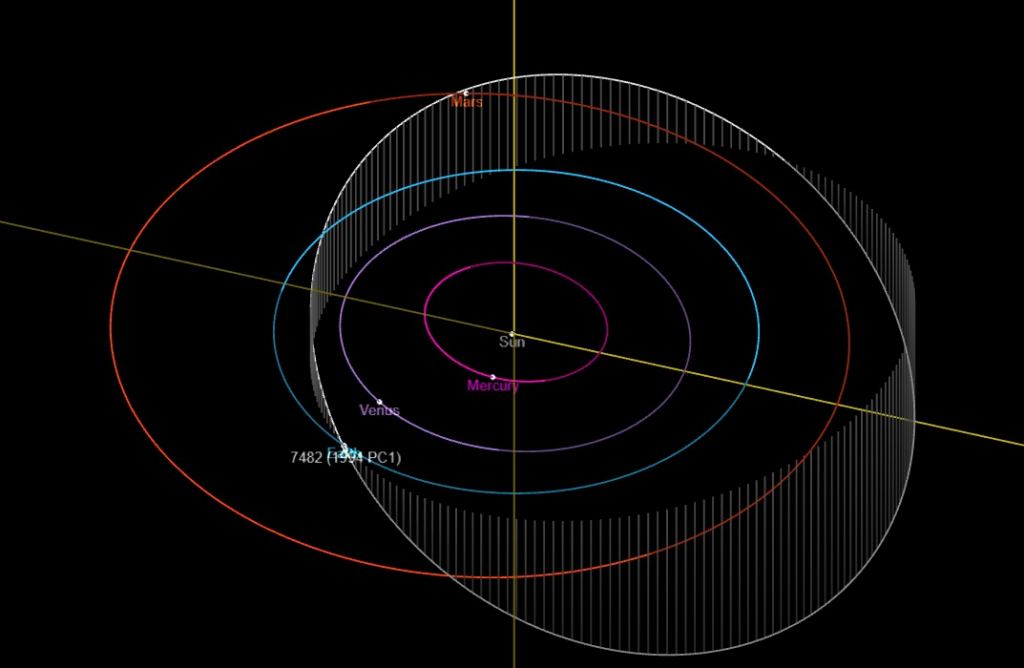
In a slow moving universe, asteroids give us a rare chance to see things moving in real time. On the evening of Tuesday, January 18, 1.1-kilometer asteroid (7482) 1994 PC1 passed 1.23 million miles (1.98 million kilometers) from the Earth. This is about five times the distance from the Earth to the moon, and just a shade over the distance to the anti-sunward Earth-sun Lagrange 2 point, soon to be the home of the James Webb Space Telescope.
Fortunately, both the Earth and said space telescope are safe from the asteroid on this pass, and will remain so for centuries in to the foreseeable future. The asteroid was discovered on the night of August 9, 1994 by astronomer Robert McNaught observing from the Siding Spring Observatory. The Apollo asteroid is an Earth-crosser, with a perihelion interior to our own at 0.9 AU from the sun, and an aphelion out in the asteroid belt at 1.8 AU, with an orbital period of 572 days. It’s orbital inclination of 33.5 degrees relative to the ecliptic makes it pass far from the Earth on most years.
Fun fact: looking back through sky plates, 1994 PC1 actually turns up in images all the way back to 1974.
1994 PC1 is a S-class stony-type asteroid, and is only slightly larger than another well-known NEO asteroid 101955 Bennu the target of NASA’s Osiris-Rex sample return mission, which returns to Earth with its precious cargo late next year.
This week’s pass is the closest for the asteroid since January 17, 1933 (pre-discovery) at 0.00752 AU, and the closest for the next two centuries, although the pass on January 18, 2105 is nearly as close, at 0.01556 AU.
Hunting the asteroid
This week’s close approach gives observers a chance to see the asteroid for themselves. At its closest on the night of January 18th at 21:51 Universal Time (UT), 1994 PC1 will be straddling on the Cetus/ Pisces border and moving at a blistering 2 degrees an hour (spanning a section of sky four times the size of tonight’s Full moon, per hour) or 2 arc minutes per minute. That’s fast enough to see the motion of the speedy asteroid versus the starry background after watching it at the eyepiece for just a minute or two. At it’s brightest, 1994 PC1 should flirt with magnitude +9 or so, making it easily visible with a small telescope or perhaps, binoculars.
I remember the thrill of seeing asteroid 4179 Toutatis on its close pass in 2004. That passage was very similar to this week’s, watching as the space rock silently crept across the starry background.
The good news is, you can start hunting for 1994 PC1 tonight; the asteroid is still a respectable +12th magnitude plus on either evening before or after closest approach, January 17 or January 19. Also, unlike closer passes, parallax-versus-observer location won’t play too much of a factor in the asteroid’s true position in the sky.
The night of Monday, January 17 found asteroid 1994 PC1 low to the south at dusk on the border of the southern hemisphere constellations of Fornax and Eridanus. Tough, though not an impossible target for North American observers.
The key night of Tuesday, January 18 saw the asteroid making its closest pass by Earth for this century. Standing on the surface of the asteroid Tuesday night, you saw the Earth as a 22′ half-full disk, slightly smaller than a full moon. Though the precise time of closest approach favors Africa and European longitudes, North America also gets a good look at dusk. Another good approach to tracking the asteroid is to know when it’s going to pass near a bright star, stake out the position, and watch at the appropriate time.
Wednesday, January 19, sees the asteroid much farther north in the constellation Andromeda. Though the object is almost 1.7 million miles distant, Wednesday also offers a slim window for viewing after twilight ends, and before the waning gibbous moon rises.
Luckily, asteroid 1994 PC1 won’t offer us the same doomday scenario as the recent comedy “Don’t Look Up” … simply a good show. https://www.universetoday.com/154005/look-up-and-watch-asteroid-1994-pc1-fly-past-earth-this-week/


Recent Comments