



In humans and other mammals, spinal cord injuries can be devastating, leading to permanent loss of movement, sensation and bladder control. When severed axons (the long fibers that carry messages between nerve cells) cannot regrow, a dense scar forms, preventing nerve signals from passing the injury site.
But the situation is different for some primitive invertebrates, which can rapidly reconnect severed nerves by fusing them. Inspired by this natural phenomenon, scientists led by Michael Lebenstein-Gumovski at the Sklifosovsky Institute for Emergency Medicine in Russia report that they have successfully reconnected severed spinal cords in pigs, enabling them to walk again.
When a spinal cord is completely cut, the two severed ends naturally pull away from each other. In microscopic roundworms, for example, the nerve ends automatically find each other and fuse together. The researchers realized that to recreate a natural fusion process like this, they needed a material to fill the empty space and hold the two ends together.
Fusing broken nerves
As they detail in a paper published in the journal PLOS One, they engineered a fusogen-based gel designed to weld damaged nerve membranes back together. It contains a chemical used in medicine, polyethylene glycol, and a biological polymer, chitosan.
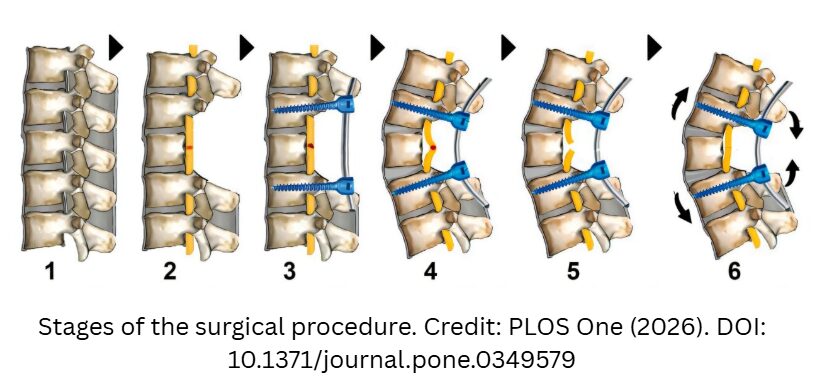
The study used five female Hungarian Mangalica pigs that had their spinal cords cut while under deep anesthesia. Three pigs were treated with the experimental gel applied to the injured area, and their spines were stabilized with screws and rods. A control group of two pigs received the same spinal stabilization but no gel.
Following surgery, all pigs underwent an identical recovery program that included daily leg massages and electrical muscle stimulation. The treated pigs also received polyethylene glycol infusions during the first week after surgery.
The results between the two groups were stark. Rapid improvements were seen in the three treated pigs, with all starting to regain sensation and reacting to skin pricks within two days. By day five, all had regained natural bladder control, and by day 60, all three could stand on their own and walk with all four limbs.
However, the untreated pigs showed no recovery and were unable to walk. When the scientists examined their tissues under the microscope, they discovered massive scars, fluid-filled cysts and withered nerve ends. By contrast, in the treated animals, the researchers observed nerve fibers crossing the injury site.
“Given the rapid clinical improvement observed, the therapeutic effects … cannot be attributed solely to axonal regeneration … This points to immediate neurorepair mechanisms, namely axonal fusion, being the primary driver of the initial recovery,” the team explain in their paper.
Potential treatment?
While this pig study is a significant advance, human clinical trials are likely still a long way off, as larger animal studies will be needed first. However, the research has demonstrated that damaged nerve fibers may reconnect after spinal injury, giving hope for future spinal treatments, as the researchers note.
“This study demonstrates that a fusogen sealant based on a polyethylene glycol-chitosan conjugate promotes significant morpho-functional recovery after complete spinal cord transection, supporting its therapeutic potential,” the researchers conclude.
https://medicalxpress.com/news/2026-06-spinal-injuries-pigs-experimental-gel.html



Recent Comments