



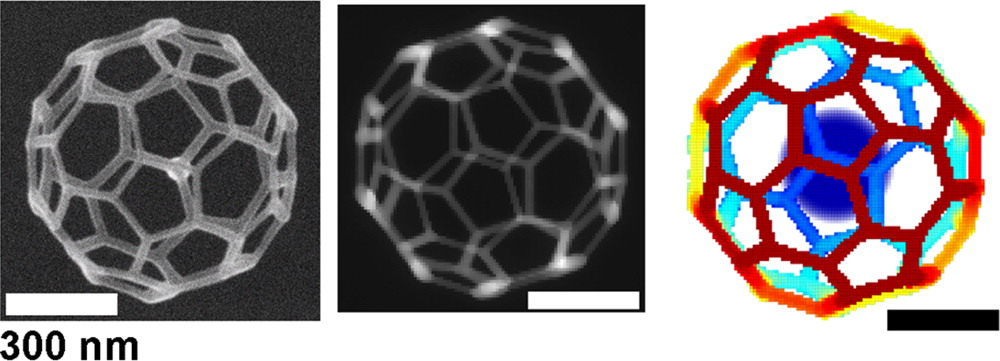
A 32-face 3-D truncated icosahedron mesh was created to test the simulation’s ability to precisely construct complex geometries. The SEM image of the final experimental product (left) was highly consistent with the structure predicted by the virtual SEM image (center) and the simulated design model (right). (hi-res image)
Focused electron beam induced deposition, or FEBID can essentially 3D print at the nanoscale. FEBID uses an electron beam from a scanning electron microscope to condense gaseous precursor molecules into a solid deposit on a surface. Previously, this method was laborious, prone to errors and impractical for creating complex structures larger than a few nanometers. Now, a team at the Department of Energy’s Oak Ridge National Laboratory, in collaboration with the University of Tennessee and the Graz University of Technology, has developed a powerful simulation-guided drafting process to improve FEBID and introduce new possibilities in nanomanufacturing.
The new system integrates design and construction into one streamlined process that creates complex 3D nanostructures.
The ability to accurately design custom nanostructures “opens up a host of novel applications in 3D plasmonics, free-standing nano-sensors and nano-mechanical elements on the lower nanoscale which are almost impossible to fabricate by other techniques.”
It uses a 3D simulation to guide the electron beam and replicate complex lattices and meshes 10 nanometers to 1 micron in size. The model tracks electron scattering paths and the release of secondary electrons to predict the pattern of deposition on the surface of the material and visualize the final structure of an experiment.
The simulation guides the experimental construction, while the completed experiments, in turn, provide feedback on the accuracy and strength of the simulation. Designs are fed into the simulation and drafting program, and any inconsistencies between the two caused by secondary electron activity can be caught before the experiment. “In its simplest form, once we know the emission profile of those secondary electrons we don’t want, we can design around them,” Fowlkes said.
While slower than other nanofabrication methods available in the clean room at CNMS, the FEBID process is the only one that can produce high-fidelity 3D nanostructures. With no way to “see” the nanostructures during construction, researchers previously relied on trial and error, manually adjusting the build parameters to produce the desired shapes.
They will now focus on fully purifying the structures of carbon contamination. Called in situ purification, it removes impurities during construction, using water or oxygen and a laser to liberate residual carbon from the precursor and flush it out of the structure. The simulation can even incorporate the stresses of the carbon removal process and can anticipate the transformation in the final product.
“We can design structures in a way where the actual writing pattern might look distorted, but that’s taking into account the fact that it’s going to retract and contract during purification and then it will look like the proper structure,” Fowlkes said. https://www.ornl.gov/news/researchers-combine-simulation-experiment-nanoscale-3-d-printing


Recent Comments