



Brown dwarfs are smaller than stars, but more massive than giant planets. As such, they provide a natural link between astronomy and planetary science. However, they also show incredible variation when it comes to size, temperature, chemistry, and more, which makes them difficult to understand, too. New work surveyed various properties of 152 suspected young brown dwarfs in order to categorize their diversity and found that atmospheric properties may be behind much of their differences. Credit: Jacqueline Faherty and David Rodriguez
Brown dwarfs are smaller than stars, but more massive than giant planets. As such, they provide a natural link between astronomy and planetary science. However, they also show incredible variation when it comes to size, temperature, chemistry, and more, which makes them difficult to understand, too. New work led by Carnegie’s Jacqueline Faherty surveyed various properties of 152 suspected young brown dwarfs in order to categorize their diversity and found that atmospheric properties may be behind much of their differences, a discovery that may apply to planets outside the solar system as well.
Brown dwarfs hold promise for explaining not just planetary evolution, but also stellar formation. These objects are tougher to spot than more-massive and brighter stars, but they vastly outnumber stars like our Sun. They represent the smallest and lightest objects that can form like stars do in the Galaxy so they are an important “book end” in Astronomy. For the moment, data on brown dwarfs can be used as a stand-in for contemplating extrasolar worlds we hope to study with future instruments like the James Webb Space Telescope.

Brown Dwarf
“Brown dwarfs are far easier to study than planets, because they aren’t overwhelmed by the brightness of a host star,” Faherty explained. But the tremendous diversity we see in the properties of the brown dwarf population means that there is still so much about them that remains unknown or poorly understood.
Brown dwarfs are too small to sustain the hydrogen fusion process that fuels stars, so after formation they slowly cool and contract over time and their surface gravity increases. Thus temperatures can range from nearly as hot as a star to as cool as a planet, which is thought to influence their atmospheric conditions, too. What’s more, their masses also range between star-like and giant planet-like, and diverse age and chemical composition.
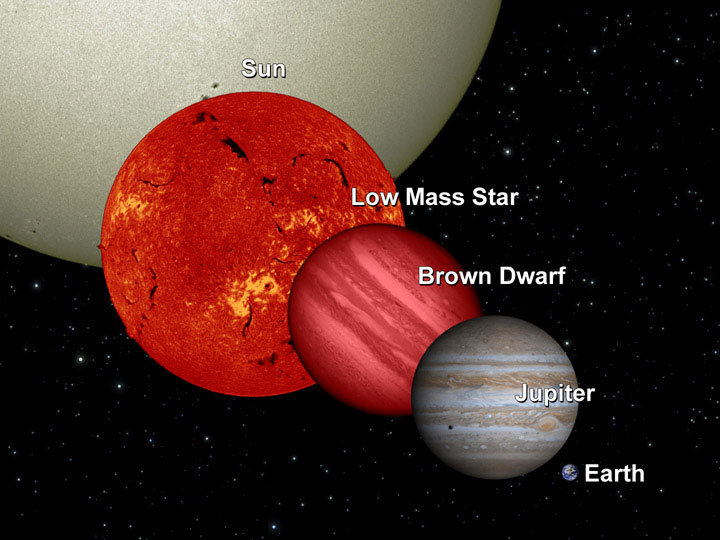
Comparison: most brown dwarfs are only slightly larger than Jupiter (10–15%) but up to 80 times heavier due to greater density.
By quantifying the observable properties of so many young brown dwarf candidates, Faherty and her team showed these objects have vast diversity of color, spectral features, and more. By locating the birth homes of many of the brown dwarfs, they eliminated age and chemical composition differences as the underlying reason for this great variation. This left atmospheric conditions ie weather phenomena or differences in cloud composition and structure – as the primary suspect for what drives extreme differences.
All of the brown dwarf birthplaces identified are regions also hosting exoplanets, so these same findings hold for giant planets orbiting nearby stars. “I consider these young brown dwarfs to be siblings of giant exoplanets. As close family members, we can use them to investigate how the planetary aging process works,” Faherty said. https://carnegiescience.edu/node/2080


Recent Comments