



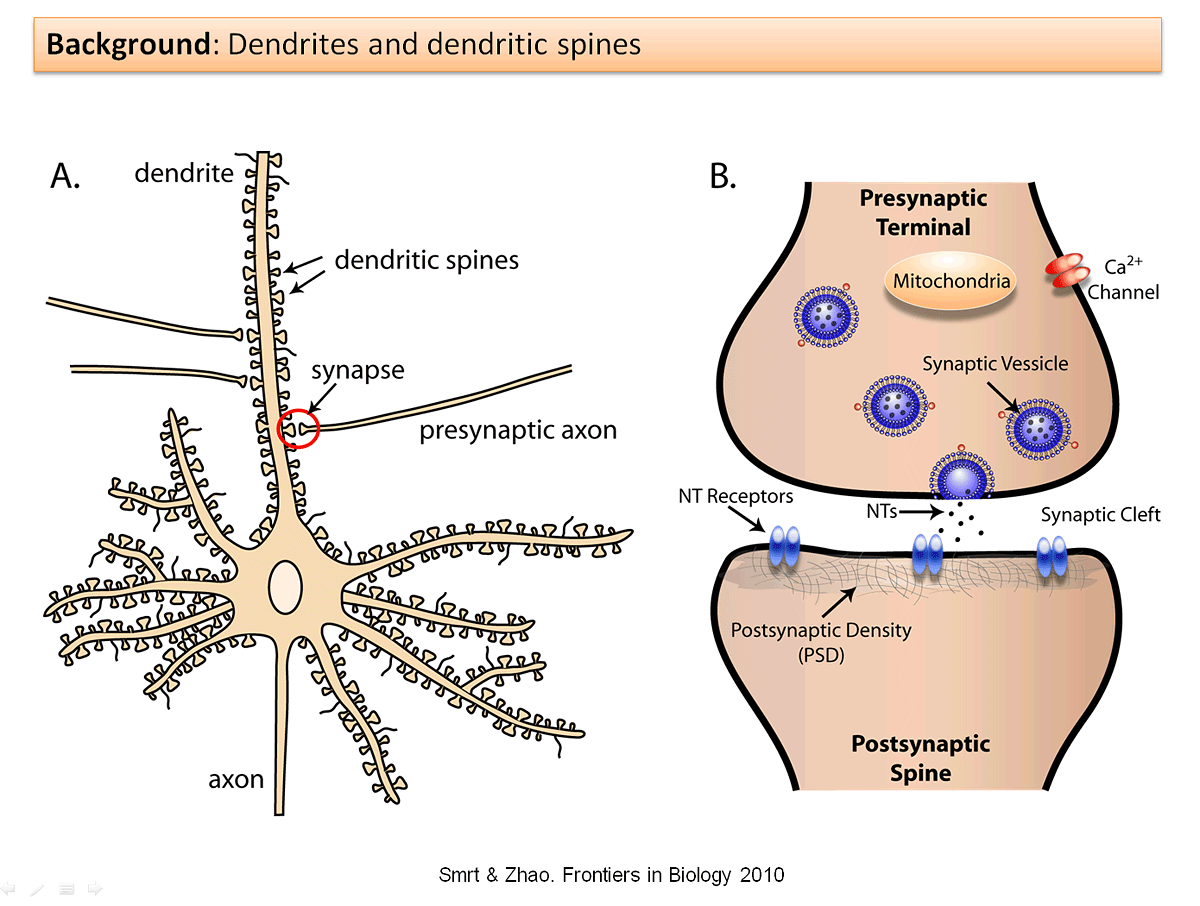
Illustration of the neuron, dendrites, and dendritic spines.
A team has built a mathematical model that describes the molecular events associated with the beginning stage of learning and memory formation in the human brain. The research paves the way for understanding cognitive function and neurodegenerative diseases – at the molecular and cellular levels. The study focuses on the dynamics of dendritic spines, thorny structures that allow neurons to communicate with each other. When a spine receives a signal from another neuron, it responds by rapidly expanding in volume ie transient spine expansion.
Transient spine expansion is one of the early events leading up to learning and memory formation. It consists of a cascade of molecular processes over 4-5 minutes, beginning when a neuron sends a signal to another neuron. Many of the molecular processes leading up to transient spine expansion have already been identified experimentally and reported in the literature. Here, the authors built a map of many of these known processes into a computational framework.
“Spines are dynamic structures, changing in size, shape and number during development and aging. Spine dynamics have been implicated in memory, learning and various neurodegenerative and neurodevelopmental disorders, including Alzheimer’s, Parkinson’s and autism. Understanding how the different molecules can affect spine dynamics can eventually help us demystify some of these processes in the brain,” said Padmini Rangamani.
“This work shows that dendritic spines, which are sub-micrometer compartments within individual neurons, are the prime candidates for the initial tag of transient, millisecond synaptic activity that eventually orchestrates memory traces in the brain lasting tens of years,” said Shahid Khan, senior scientist at the Molecular Biology Consortium at Lawrence Berkeley National Laboratory.
In this study, they constructed a mathematical model, based on ordinary differential equations, linking the different molecular processes associated with spine expansion together. They identified the key components (molecules and enzymes) and chemical reactions that regulate spine expansion. They saw a pattern: the same components could both turn on and off some of the steps in the sequence, ie paradoxical signaling. Further, they linked the chemical reactions of the different molecules to the reorganization of the actin cytoskeleton, which gives the cell its shape.
“By putting all these complicated pieces together in a simple mathematical framework, we can start to understand the underlying mechanisms of spine expansion. This is one of the benefits of combining mechanics of the cytoskeleton and biochemistry. We can bring together pieces of experimental work that are often not seen. However, we should note that we are only at the beginning stages of understanding what spines, neurons and the brain can do.”
http://jacobsschool.ucsd.edu/news/news_releases/release.sfe?id=2016


Recent Comments