Category Astronomy/Space

Sun-like Stars found Orbiting Hidden Companions

This illustration depicts a binary star system consisting of a dense neutron star and a normal Sun-like star (upper left).

New observations reveal neutron stars paired with stars like our Sun. Astronomers have uncovered what appear to be 21 neutron stars in orbit around stars like our Sun. The discovery is surprising because it is not clear how a star that exploded winds up next to a star like our Sun.

Most stars in our universe come in pairs. While our own Sun is a loner, many stars like our Sun orbit similar stars, while a host of other exotic pairings between stars and cosmic orbs pepper the universe. Black holes, for example, are often found orbiting each other...

Read More
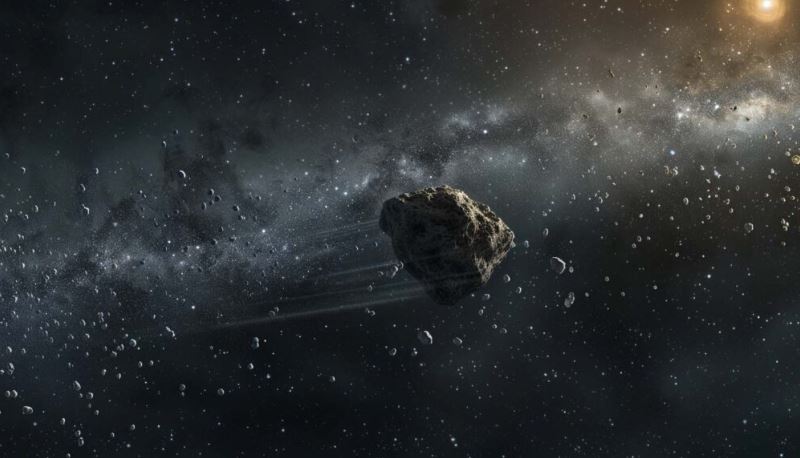

The Origins of Dark Comets

Up to 60% of near-Earth objects could be dark comets, mysterious asteroids that orbit the sun in our solar system that likely contain or previously contained ice and could have been one route for delivering water to Earth, according to a University of Michigan study.

The findings suggest that asteroids in the asteroid belt, a region of the solar system roughly between Jupiter and Mars that contains much of the system’s rocky asteroids, have subsurface ice, something that has been suspected since the 1980s, according to Aster Taylor, a U-M graduate student in astronomy and lead author of the study.

The study also shows a potential pathway for delivering ice into the near-Earth solar system, according to Taylor. How Earth got its water is a longstanding question.

“We don’t know...

Read More

Mars likely had cold and icy past, new study finds

The study site in the Tablelands of Newfoundland. Photo credit: Anthony Feldman/DRI

A new study finds clues lurking in the Red Planet’s soil. The question of whether Mars ever supported life has captivated the imagination of scientists and the public for decades. Central to the discovery is gaining insight into the past climate of Earth’s neighbor: was the planet warm and wet, with seas and rivers much like those found on our own planet? Or was it frigid and icy, and therefore potentially less prone to supporting life as we know it? A new study finds evidence to support the latter by identifying similarities between soils found on Mars and those of Canada’s Newfoundland, a cold subarctic climate.

The study, published July 7th in Communications Earth and Environment, looked for soils...

Read More

Astronomers find Surprising Ice World in the Habitable Zone with JWST data

Temperate exoplanet LHS 1140 b may be a world completely covered in ice (left) similar to Jupiter’s moon Europa or be an ice world with a liquid substellar ocean and a cloudy atmosphere (centre). LHS 1140 b is 1.7 times the size of our planet Earth (right) and is the most promising habitable zone exoplanet yet in our search for liquid water beyond the Solar System. Image credit: B. Gougeon/Université de Montréal

A team of astronomers has identified a temperate exoplanet as a promising super-Earth ice or water world.

The findings, led by Université de Montréal, show that the habitable zone exoplanet, LHS 1140 b, is not likely a mini-Neptune, a small so-called gas giant—large planets composed mostly of gas—with a thick hydrogen-rich atmosphere...

Read More