



- A missing piece in the cell death and inflammation signaling pathway puzzle has been revealed
- Quantum computer boldly goes where no quantum computer has gone before: Space
- Black hole jets reach far beyond galaxies’ visible edges, potentially deciding their fate
- Kidney disease, heart failure or death risk climbs to 55% 10 years after type 2 diabetes diagnosis
Category Astronomy/Space
Did astronomers just witness the formation of a ‘strange star?’
February 22, 2025,
 Astronomy/Space
Einstein Probe catches X-ray odd couple
February 20, 2025,
Astronomy/Space
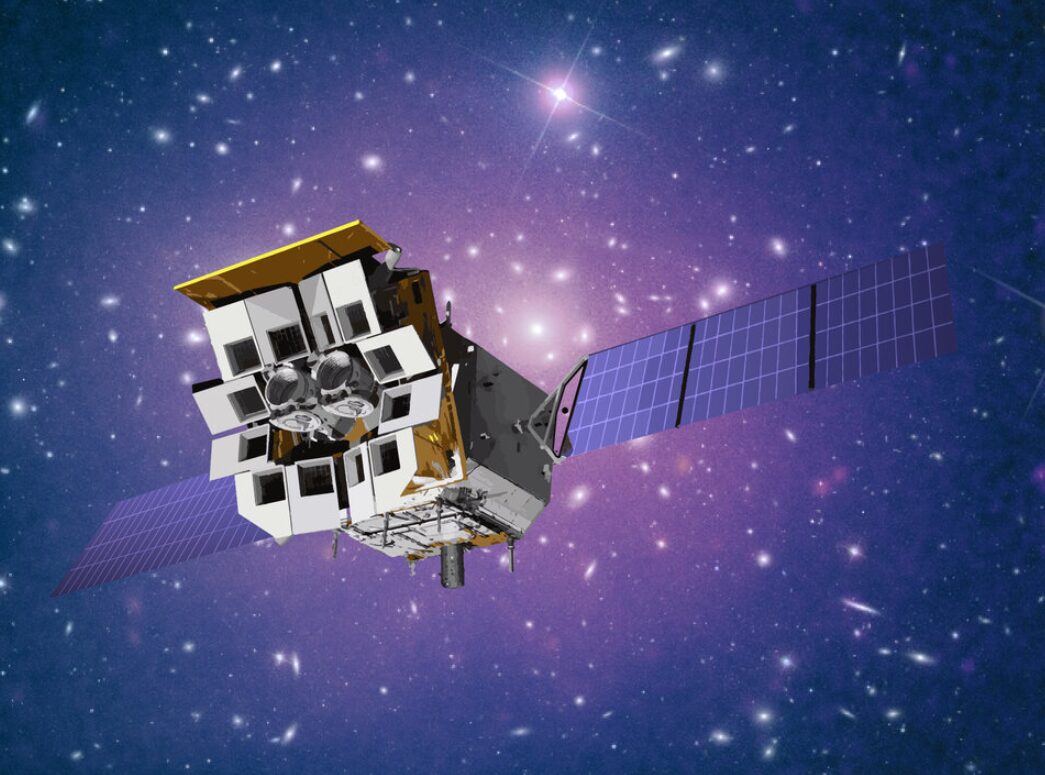
Lobster-eye satellite Einstein Probe captured the X-ray flash from a very elusive celestial pair. The discovery opens a new way to explore how massive stars interact and evolve, confirming the unique power of the mission to uncover fleeting X-ray sources in the sky.
The odd celestial couple consists of a big, hot star, more than 10 times larger than our Sun, and a small compact white dwarf, with a mass similar to our star. Only a handful of these systems have been found so far. And this the first time scientists could track the X-ray light coming from such a curious pair from its initial sudden flare-up to its fading away.
On 27 May 2024, the Wide-field X-ray Telescope (WXT) on Einstein Probe spotted X-rays coming from within our neighbour galaxy, the Small Magellanic Cloud (SMC...
Read MoreSupermassive Black Hole Heading Towards The Milky Way Galaxy
February 19, 2025,
Astronomy/Space
The strange behavior of hypervelocity stars suggests a nearby dwarf galaxy must contain a supermassive black hole. If so, a collision with the Milky Way is inevitable.

Back in 1971, a couple of British astronomers predicted the existence of a black hole at the center of our galaxy. And in 1974, other astronomers found it, naming it Sagittarius A*.
Since then, astronomers have discovered that a similar “supermassive black hole” sits at the center of almost every other large galaxy. In 2019, they took the first image of a supermassive black hole. Today, these exotic objects are a fundamental part of our understanding of how galaxies form and evolve.
But what of smaller astronomical bodies, like the Large Magellanic Cloud, a dwarf sa...
Read MoreAsteroid Ryugu samples suggest presence of salty water in outer solar system
February 17, 2025,
Astronomy/Space

Asteroids that orbit close to the Earth inevitably cause us some anxiety due to the even remote possibility of a collision. But their proximity also offers ample opportunities to learn more about the universe. Ryugu, a 900-meter diameter asteroid in the Apollo belt, has recently proven useful in our search for signs of life’s precursors elsewhere in our solar system.
A team of researchers at Kyoto University have found evidence of salt minerals in samples recovered from Ryugu during the initial phase of Japan’s Hayabusa2 mission...
Read More
Recent Comments