Category Astronomy/Space

Repurposed Technology used to Probe New Regions of Mars’ Atmosphere

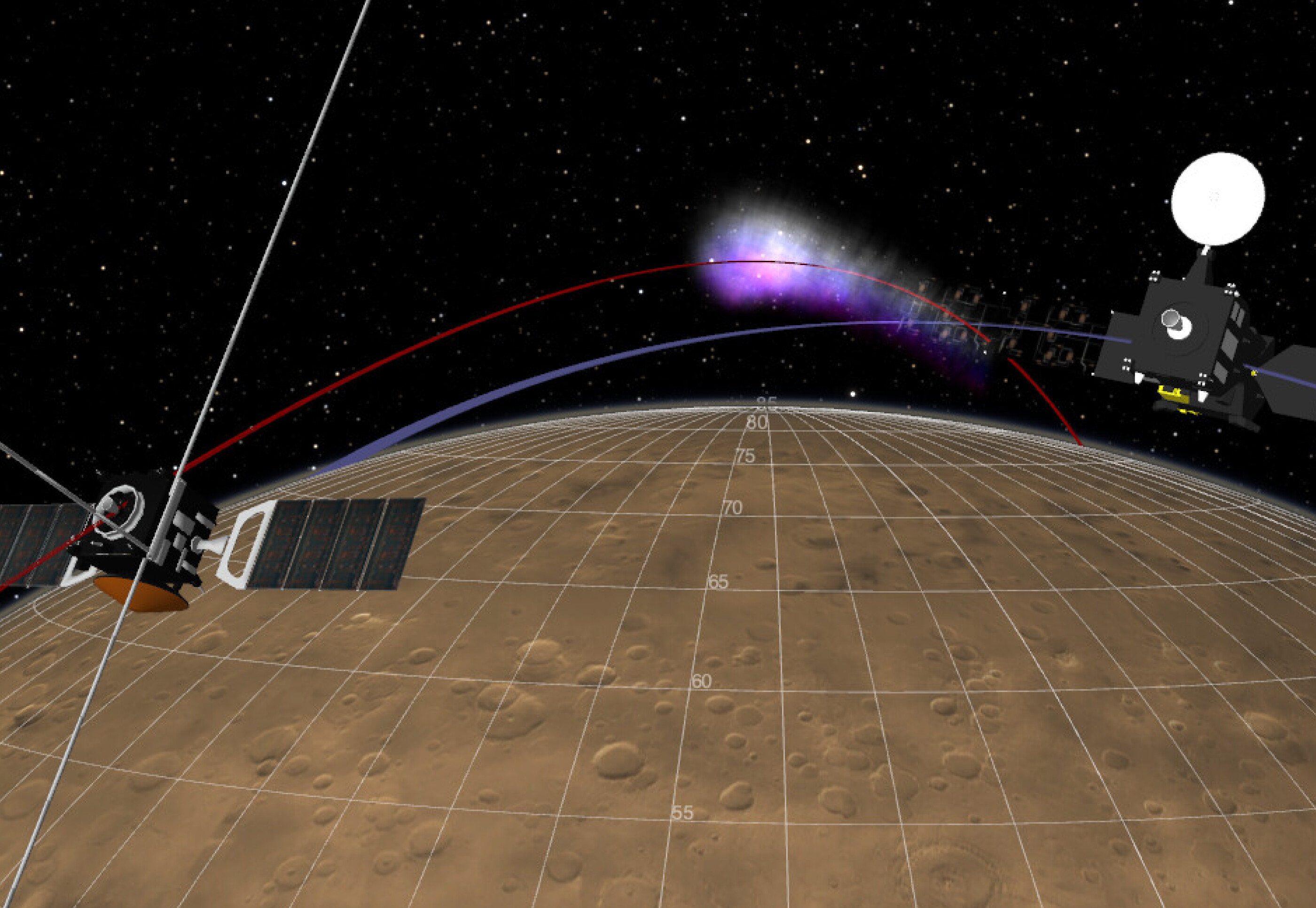
Using the repurposed equipment, a team including Imperial College London researchers have measured parts of the Martian atmosphere that were previously impossible to probe. This includes areas that can block radio signals if not properly accounted for—crucial for future Mars habitation missions.

The results of the first 83 measurements, analyzed by Imperial researchers and European Space Agency (ESA) colleagues across Europe, are published today in the journal Radio Science.

To achieve this, ExoMars’ Trace Gas Orbiter (TGO) teamed up with another ESA spacecraft orbiting the red planet: Mars Express (MEX). The two craft maintain a radio link, so that as one passes behind the planet, radio waves cut through the deeper layers of the Martian atmosphere.

Changes in the atmospher...

Read More
Webb admires Bejeweled Ring of the Lensed Quasar RX J1131-1231

Webb admires bejewelled ring
CREDIT: ESA/Webb, NASA & CSA, A. Nierenberg
LICENCE: CC BY 4.0 INT or ESA Standard Licence

This new picture of the month from the NASA/ESA/CSA James Webb Space Telescope features the gravitational lensing of the quasar known as RX J1131-1231, located roughly six billion light-years from Earth in the constellation Crater.

It is considered one of the best lensed quasars discovered to date, as the foreground galaxy smears the image of the background quasar into a bright arc and creates four images of the object.

Gravitational lensing, first predicted by Einstein, offers a rare opportunity to study regions close to the black hole in distant quasars, by acting as a natural telescope and magnifying the light from these sources...

Read More

Engineers send 3D Printer into Space

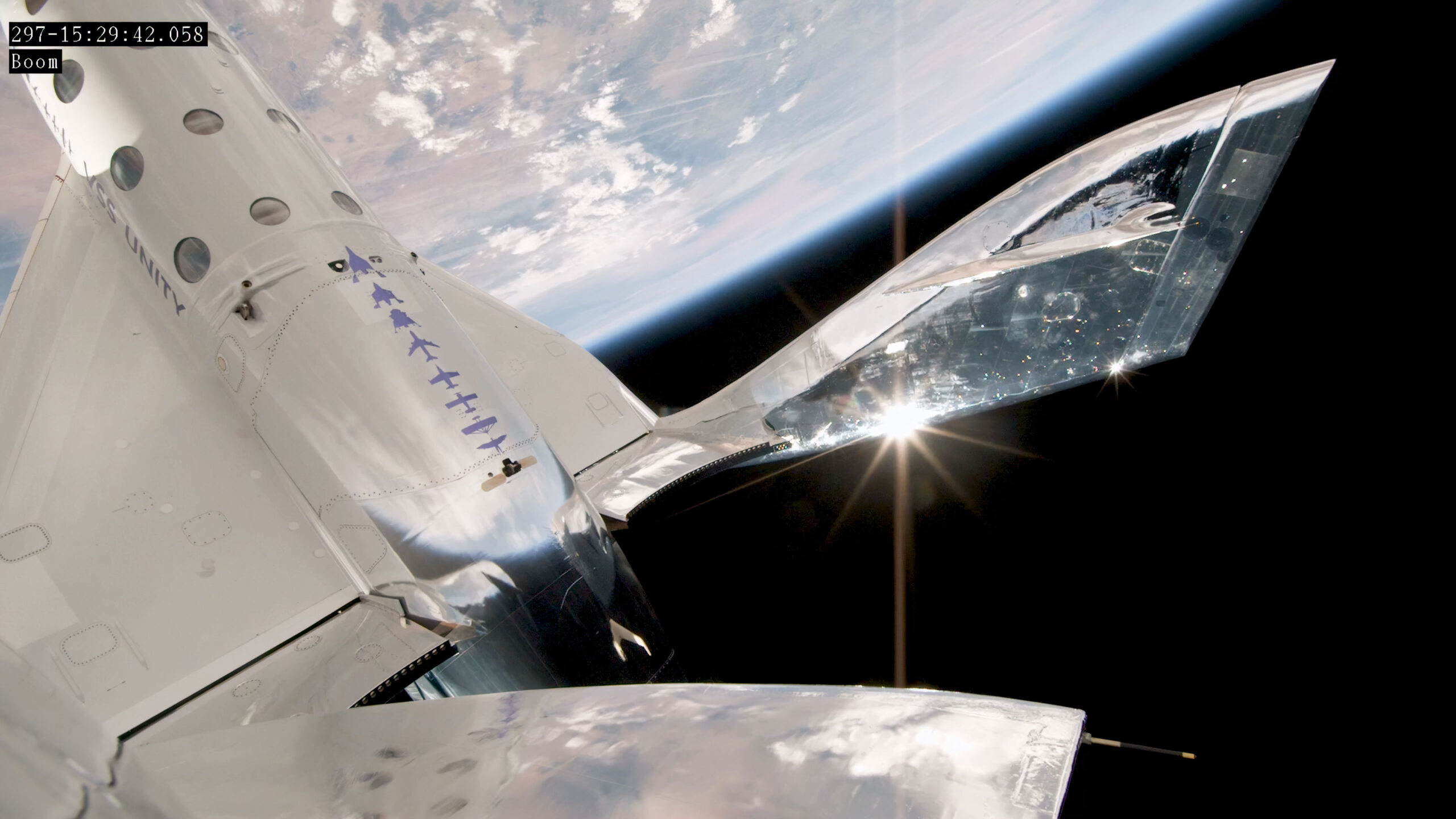
Spaceflight feather, as viewed aboard VSS Unity on June 8, 2024. The Virgin Galactic 07 flight carried Berkeley’s SpaceCal 3D printer and four other research payloads.

Imagine a crew of astronauts headed to Mars. About 140 million miles away from Earth, they discover their spacecraft has a cracked O-ring. But instead of relying on a dwindling cache of spare parts, what if they could simply fabricate any part they needed on demand?

A team of Berkeley researchers, led by Ph.D. student Taylor Waddell, may have taken a giant leap toward making this option a reality. On June 8, they sent their 3D printing technology to space for the first time as part of the Virgin Galactic 07 mission.

Their next-generation microgravity printer—dubbed SpaceCAL—spent 140 seconds in suborbital space while aboard the VSS Unity space plane...

Read More

Scientists discover way to ‘Grow’ Sub-Nanometer Sized Transistors

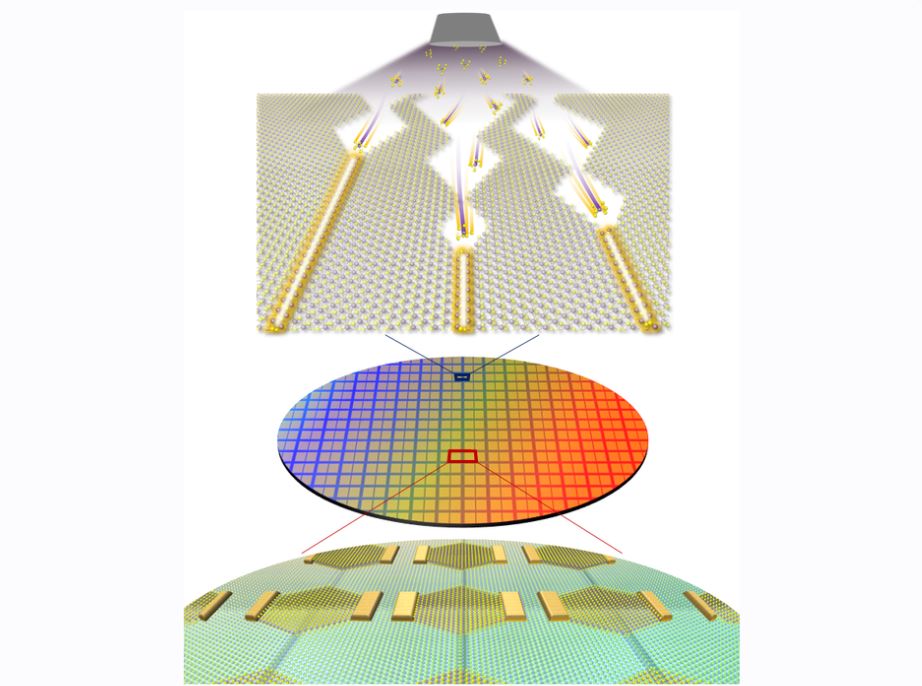
Opening the path to next-generation semiconductors through epitaxial growth of new Van der Waals materials. A research team led by Director JO Moon-Ho of the Center for Van der Waals Quantum Solids within the Institute for Basic Science (IBS) has implemented a novel method to achieve epitaxial growth of 1D metallic materials with a width of less than 1 nm. The group applied this process to develop a new structure for 2D semiconductor logic circuits. Notably, they used the 1D metals as a gate electrode of the ultra-miniaturized transistor.

Integrated devices based on two-dimensional (2D) semiconductors, which exhibit excellent properties even at the ultimate limit of material thickness down to the atomic scale, are a major focus of basic and applied research worldwide.

However, r...

Read More