The core of the Phoenix cluster is shown across the whole electromagnetic spectrum. The bright purples represent X-rays produced by the hot gas, and the dashed purple outlines show regions where this hot gas has been pushed away by the radio jets from the supermassive black hole. The radio jets themselves are shown in red colors. The blues and yellows represent visible light emitted by cool gas and stars. The green contours show the “warm” gas that is in the process of cooling, newly measured in the MIT study with JWST. Credit: NASA
The core of a massive cluster of galaxies appears to be pumping out far more stars than it should. Now researchers at MIT and elsewhere have discovered a key ingredient within the cluster that explains the core’s prolific starburst.
Aomawa Shields, UC Irvine associate professor of physics and astronomy, headed a study comparing the climates of two exoplanets. Computer simulations led her team to conclude that white dwarf stars – previously considered inhospitable to life-supporting exoplanets – could, in fact, host planets in their habitable zones with comparatively temperate climates. Steve Zylius / UC Irvine
Among the roughly 10 billion white dwarf stars in the Milky Way galaxy, a greater number than previously expected could provide a stellar environment hospitable to life-supporting exoplanets, according to astronomers at the University of California, Irvine.
In a paper published recently in The Astrophysical Journal, a research team led by Aomawa Shields, UC Irvine associate professor of physics and as...
A star-forming region in the Tarantula Nebula as captured by the James Webb Space Telescope. MSU researchers have recently uncovered alternative sources of the molecule H₃⁺, which plays a crucial role in the birth of stars and other cosmic chemistry. Credit: NASA, ESA, CSA, STScI, Webb ERO Production Team
From helping catalyze interstellar reactions and fueling the birth of stars to its presence in neighborhood gas giants like Saturn and Jupiter, trihydrogen, or H3+, is best known as the “the molecule that made the universe.”
While we have a clear picture of how the majority of H3+ is formed—a hydrogen molecule, or H2, colliding with its ionized counterpart, H2+—scientists are keen to understand alternative sources of H3+ and to better measure its abundance throughout the cosmos...
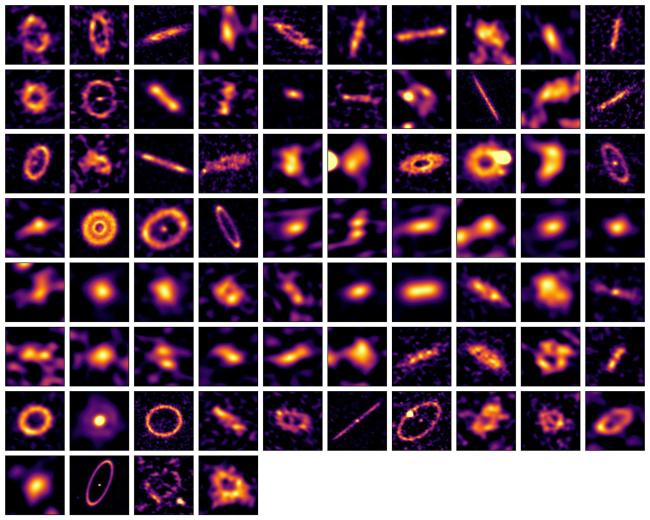
Caption: This gallery contains 74 images of different star systems with cometary belts (known as “exocomets”) taken with the Submillimeter Array (SMA) and the Atacama Large Millimeter/submillimeter (ALMA) radio telescope facilities. The stars in this study range in ages from very young to middle-aged like our Sun. This new study shows how comets play a role in the formation of stars and planetary systems.
Credit: Luca Matra
For the first time, astronomers have imaged dozens of belts around nearby stars where comets and tiny pebbles within them are orbiting.
This result reveals regions around 74 stars spanning a wide range of ages—from those recently formed to others billions of years old—showing how comets play a role in the formation of stars and planetary systems...





Recent Comments