Category Astronomy/Space

Simple Shift could make Low Earth Orbit Satellites High Capacity

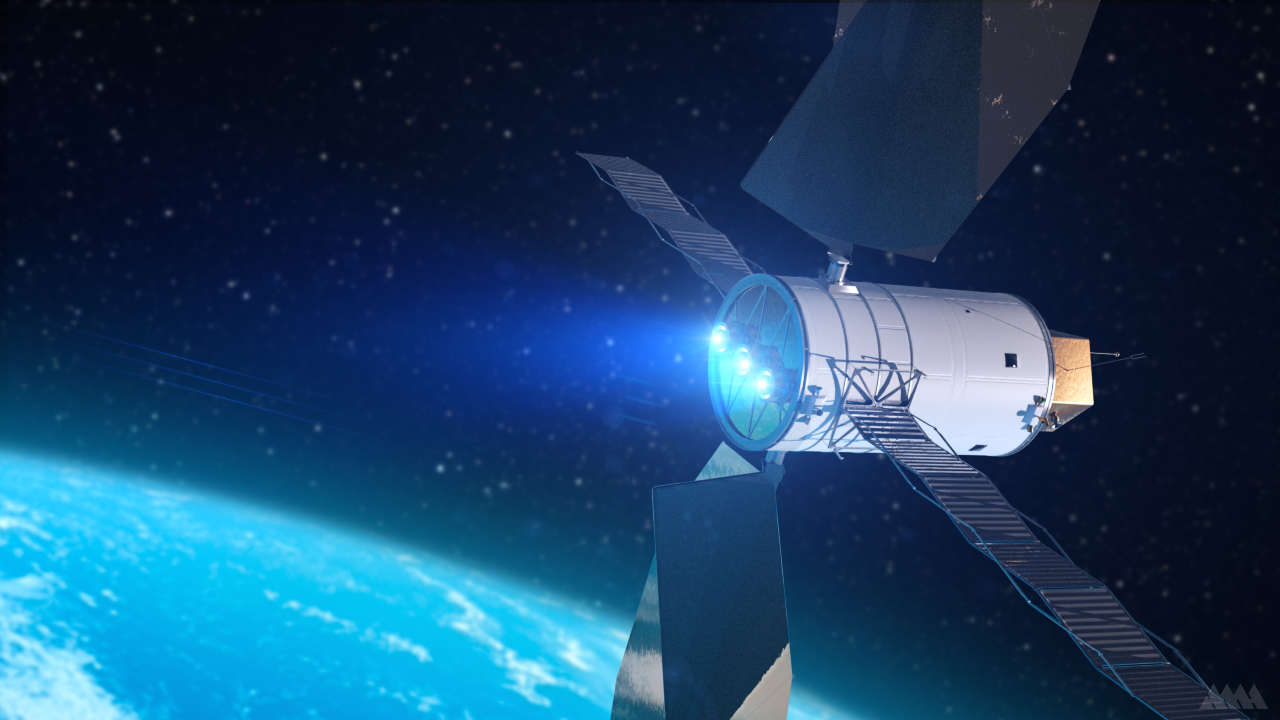
Researchers have invented a technique that enables low Earth orbit satellite antennas to manage signals for multiple users at once, slashing costs and simplifying designs for communication satellites.

Low-orbit satellites could soon offer millions of people worldwide access to high-speed communications, but the satellites’ potential has been stymied by a technological limitation – their antenna arrays can only manage one user at a time.

The one-to-one ratio means that companies must launch either constellations of many satellites, or large individual satellites with many arrays, to provide wide coverage. Both options are expensive, technically complex, and could lead to overcrowded orbits.

For example, SpaceX went the “constellation” route...

Read More

Magnetic Field Maps of the Sun’s Corona

A purple and yellow image shows flares coming off the side of the sun and looping back. An inset shows the actual data of the coronal map  in black and white
The NSF Daniel K. Inouye Solar Telescope presents its first map of the solar coronal magnetic field signals as measured using the Zeeman Effect. The Zeeman Effect polarizes the coronal emission, which requires the advancements of the Inouye Solar Telescope to measure as its signals are only a few parts per billion of the Sun’s surface brightness. The background image identifies the region observed in detail by Inouye as imaged by NASA’s Solar Dynamics Observatory in ultraviolet light. Credit: NSF/NSO/AURA

The U.S. National Science Foundation (NSF) Daniel K...

Read More

AI helps Distinguish Dark Matter from Cosmic Noise

An AI-powered tool can distinguish dark matter’s elusive effects from other cosmic phenomena, which could bring us closer to unlocking the secrets of dark matter.

Dark matter is the invisible force holding the universe together – or so we think. It makes up around 85% of all matter and around 27% of the universe’s contents, but since we can’t see it directly, we have to study its gravitational effects on galaxies and other cosmic structures. Despite decades of research, the true nature of dark matter remains one of science’s most elusive questions.

According to a leading theory, dark matter might be a type of particle that barely interacts with anything else, except through gravity...

Read More

Formation of Super-Earths is Limited Near Metal-Poor Stars – New study may help the search for life beyond Earth

In a new study, astronomers report novel evidence regarding the limits of planet formation, finding that after a certain point, planets larger than Earth have difficulty forming near low-metallicity stars.

Using the sun as a baseline, astronomers can measure when a star formed by determining its metallicity, or the level of heavy elements present within it. Metal-rich stars or nebulas formed relatively recently, while metal-poor objects were likely present during the early universe.

Previous studies found a weak connection between metallicity rates and planet formation, noting that as a star’s metallicity goes down, so, too, does planet formation for certain planet populations, like sub-Saturns or sub-Neptunes.

Yet this work is the first to observe that under current theories...

Read More