Category Astronomy/Space

Astrophysicists Uncover Supermassive Black Hole/Dark Matter Connection in Solving the ‘Final Parsec Problem’

Astrophysicists uncover supermassive blackhole/dark matter connection in solving the 'final parsec problem'
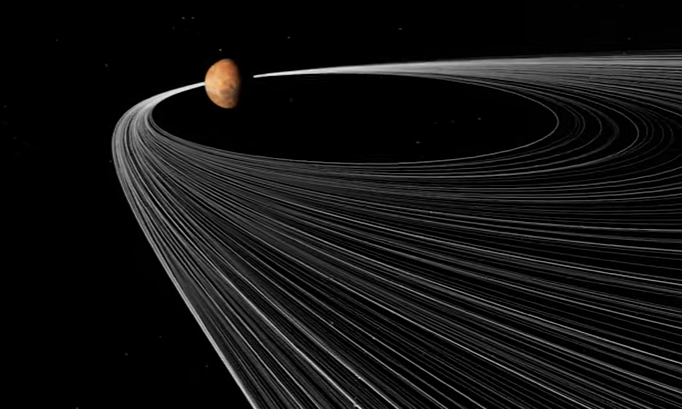
Simulation of the light emitted by a supermassive black hole binary system where the surrounding gas is optically thin (transparent). Viewed from 0 degrees inclination, or directly above the plane of the disk. The emitted light represents all wavelengths. Credit: NASA’s Goddard Space Flight Center/Scott Noble; simulation data, d’Ascoli et al. 2018

Researchers have found a link between some of the largest and smallest objects in the cosmos: supermassive black holes and dark matter particles.

Their new calculations reveal that pairs of supermassive black holes (SMBHs) can merge into a single larger black hole because of previously overlooked behavior of dark matter particles, proposing a solution to the longstanding “final parsec problem” in astronomy.

The research is described in ...

Read More

New Dawn for Space Storm Alerts could help Shield Earth’s Tech

Scientists say it is now possible to predict the precise speed a coronal mass ejection (shown left in an artist's impression) is travelling at and when it will smash into Earth (bottom right moving in our direction) – even before it has fully erupted from the Sun (top right).
Scientists say it is now possible to predict the precise speed a coronal mass ejection (shown left in an artist’s impression) is travelling at and when it will smash into Earth (bottom right moving in our direction) – even before it has fully erupted from the Sun (top right).
Credit: NASA Goddard Space Flight Center/Jhelioviewer
Licence type Attribution (CC BY 4.0

Space storms could soon be forecast with greater accuracy than ever before thanks to a big leap forward in our understanding of exactly when a violent solar eruption may hit Earth.

Scientists say it is now possible to predict the precise speed a coronal mass ejection (CME) is traveling at and when it will smash into our planet—even before it has fully erupted from the sun.

CMEs are bursts of gas and magnetic fields sp...

Read More

Exoplanet-Hunting Telescope to begin Search for Another Earth in 2026

An artist's impression of the European Space Agency's PLATO spacecraft.
An artist’s impression of the European Space Agency’s PLATO spacecraft.
Credit
ESA/ATG medialab
Licence type Attribution (CC BY 4.0)

Europe’s next big space mission – a telescope that will hunt for Earth-like rocky planets outside of our solar system — is on course to launch at the end of 2026.

PLATO, or PLAnetary Transits and Oscillations of stars, is being built to find nearby potentially habitable worlds around Sun-like stars that we can examine in detail.

The space telescope will blast into orbit on Europe’s new rocket, Ariane-6, which made its maiden flight last week after being developed at a cost of €4billion (£3.4billion).

Dr David Brown, of the University of Warwick, is giving an update on the mission at the Royal Astronomical Society’s National Astronomy Meeting at t...

Read More

Sun-like Stars found Orbiting Hidden Companions

This illustration depicts a binary star system consisting of a dense neutron star and a normal Sun-like star (upper left).

New observations reveal neutron stars paired with stars like our Sun. Astronomers have uncovered what appear to be 21 neutron stars in orbit around stars like our Sun. The discovery is surprising because it is not clear how a star that exploded winds up next to a star like our Sun.

Most stars in our universe come in pairs. While our own Sun is a loner, many stars like our Sun orbit similar stars, while a host of other exotic pairings between stars and cosmic orbs pepper the universe. Black holes, for example, are often found orbiting each other...

Read More