Category Astronomy/Space

Groundbreaking Survey reveals Secrets of Planet Birth around Dozens of Stars

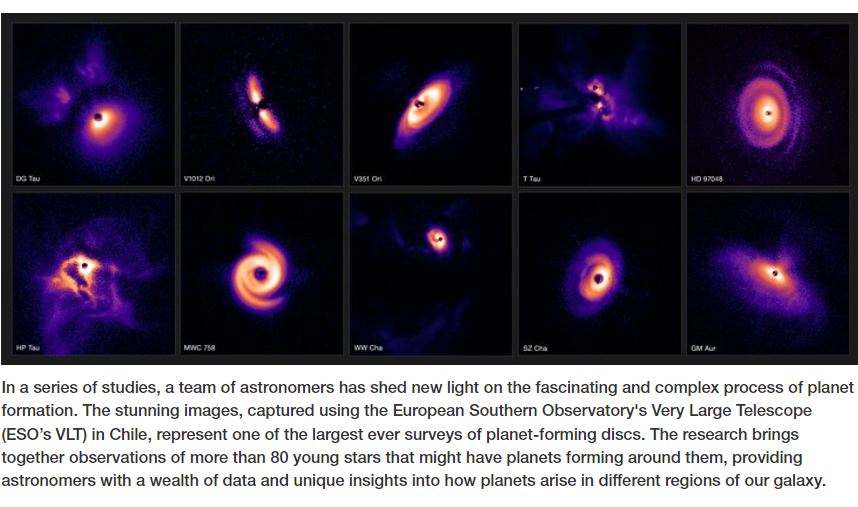
A team of astronomers has shed new light on the fascinating and complex process of planet formation. The research brings together observations of more than 80 young stars that might have planets forming around them, providing astronomers with a wealth of data and unique insights into how planets arise in different regions of our galaxy.

In a series of studies, a team of astronomers has shed new light on the fascinating and complex process of planet formation. The stunning images, captured using the European Southern Observatory’s Very Large Telescope (ESO’s VLT) in Chile, represent one of the largest ever surveys of planet-forming discs...

Read More
What makes Black Holes Grow and New Stars Form? Machine Learning helps Solve the Mystery

Intergalactic scene
A pair of disc galaxies in the late stages of a merger. Credit: NASA.

It takes more than a galaxy merger to make a black hole grow and new stars form: machine learning shows cold gas is needed too to initiate rapid growth — new research finds.

When they are active, supermassive black holes play a crucial role in the way galaxies evolve. Until now, growth was thought to be triggered by the violent collision of two galaxies followed by their merger, however new research led by the University of Bath suggests galaxy mergers alone are not enough to fuel a black hole — a reservoir of cold gas at the centre the host galaxy is needed too.

The new study, published this week in the journal Monthly Notices of the Royal Astronomical Society is believed to be the first to use machine learnin...

Read More

Ultraviolet Radiation from Massive Stars Shapes Planetary Systems

Up to a certain point, very luminous stars can have a positive effect on the formation of planets, but from that point on the radiation they emit can cause the material in protoplanetary discs to disperse.

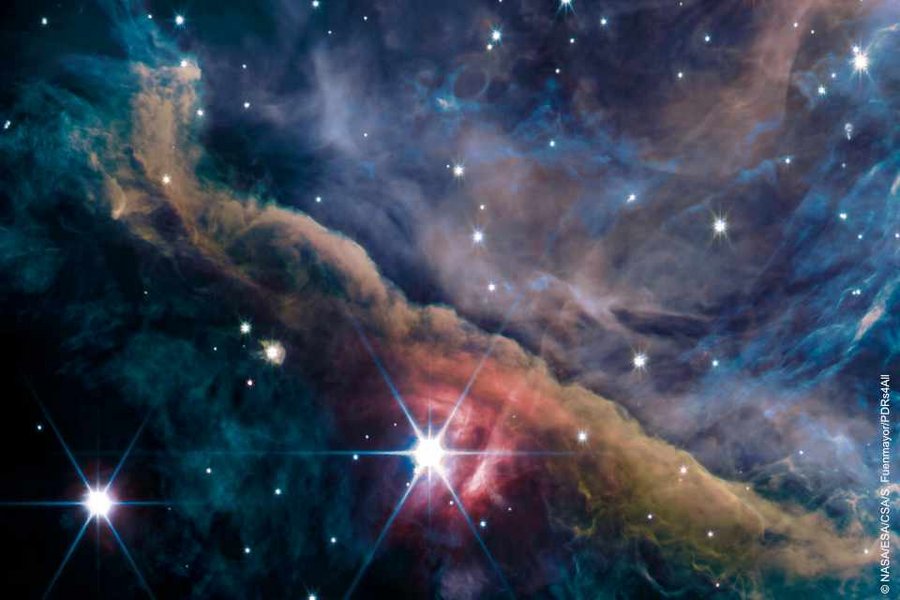
To find out how planetary systems such as our Solar System form, an international research team including scientists from the University of Cologne studied a stellar nursery, the Orion Nebula, using the James Webb Space Telescope (JWST). By observing a protoplanetary disc named d203-506, they discovered the key role massive stars play in the formation of planetary systems that are less than a million years old...

Read More

New Insights on How Galaxies are Formed

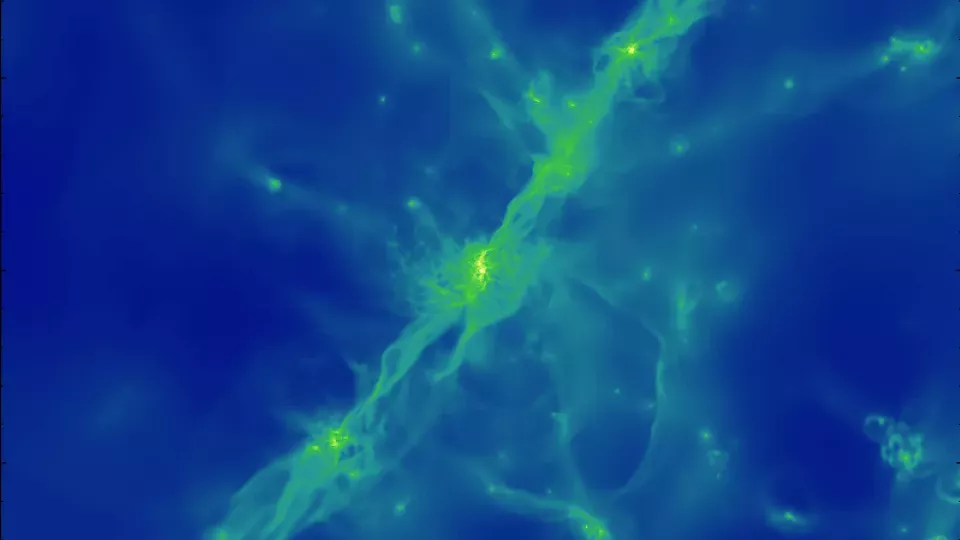
An image from the simulation
Part of the simulated universe. In the center, a galaxy is born through gas that later transforms into stars. The whole process takes billions of years but is simulated in just a few months by supercomputers (Photo: The AGORA Collaboration)

New insights on how galaxies are formed
Astronomers can use supercomputers to simulate the formation of galaxies from the Big Bang 13.8 billion years ago to the present day. But there are a number of sources of error. An international research team, led by researchers in Lund, has spent a hundred million computer hours over eight years trying to correct these.

The last decade has seen major advances in computer simulations that can realistically calculate how galaxies form...

Read More