Category Astronomy/Space

Intriguing Nearby World Sized between Earth, Venus

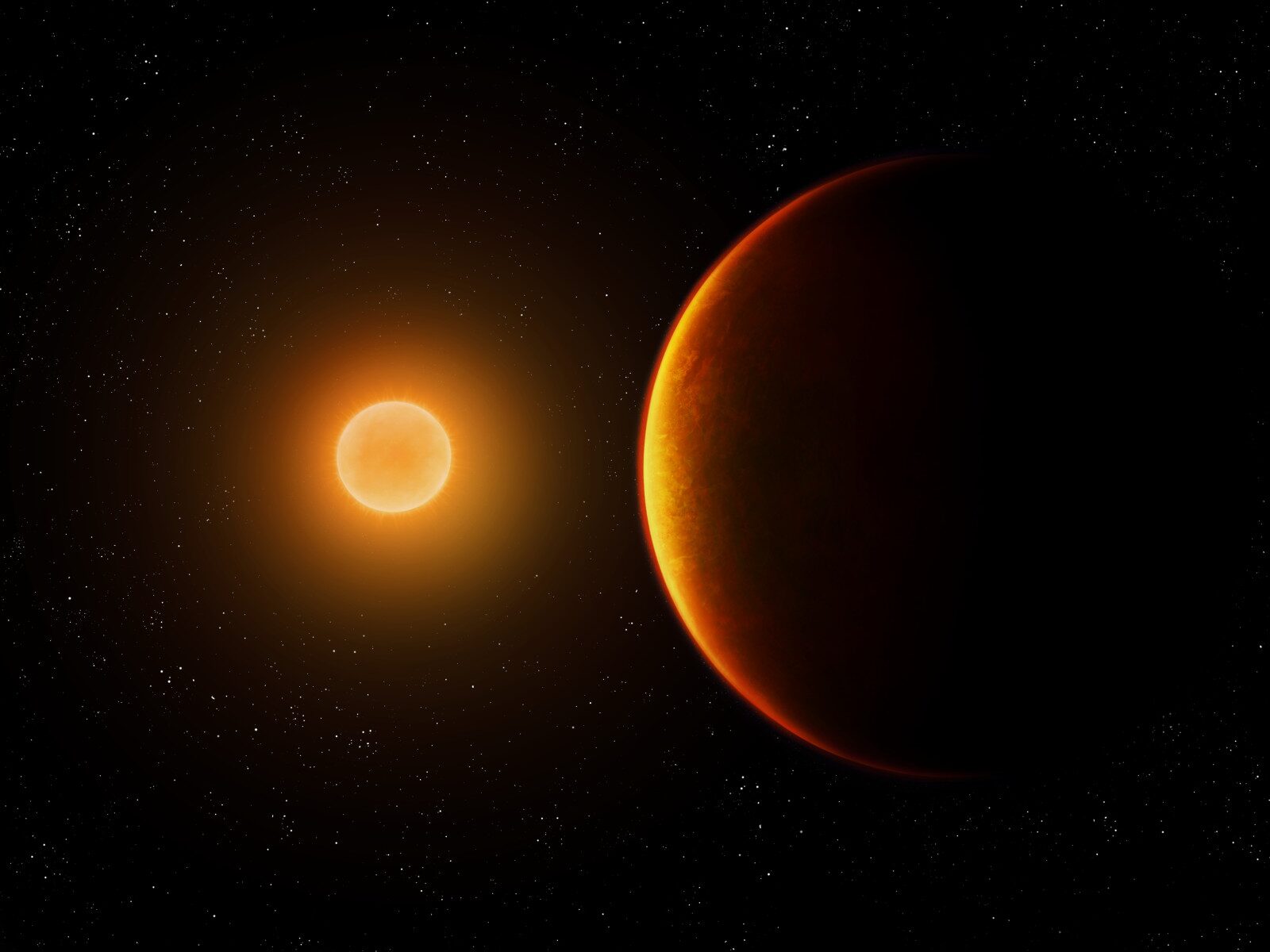
Space scene of a thin atmosphere version of Gliese 12 b
Gliese 12 b, which orbits a cool red dwarf star located just 40 light-years away, promises to tell astronomers more about how planets close to their stars retain or lose their atmospheres. In this artist’s concept, Gliese 12 b is shown retaining a thin atmosphere.
NASA/JPL-Caltech/R. Hurt (Caltech-IPAC)

Using observations by NASA’s TESS (Transiting Exoplanet Survey Satellite) and many other facilities, two international teams of astronomers have discovered a planet between the sizes of Earth and Venus only 40 light-years away. Multiple factors make it a candidate well-suited for further study using NASA’s James Webb Space Telescope.

TESS stares at a large swath of the sky for about a month at a time, tracking the brightness changes of tens of thousands of stars at intervals ranging...

Read More

The Habitable Worlds Observatory could See Lunar and Solar ‘Exo-Eclipses’

Exo-moon
An artist’s conception of an exoplanet with a large orbiting exomoon. Credit: University of Columbia/Helena Valenzuela Widerström

A future space observatory could use exo-eclipses to tease out exomoon populations.

If you’re like us, you’re still coming down from the celestial euphoria that was last month’s total solar eclipse. The spectacle of the moon blocking out the sun has also provided astronomers with unique scientific opportunities in the past, from the discovery of helium to proof for general relativity. Now, eclipses in remote exoplanetary systems could aid in the hunt for elusive exomoons.

A recent study out of the University of Michigan in partnership with Johns Hopkins APL and the Department of Physics and the Kavli Institute for Astrophysics and Space Research at th...

Read More

Complete Stellar Collapse: Unusual Star System Proves that Stars can Die Quietly

University of Copenhagen astrophysicists help explain a mysterious phenomenon, whereby stars suddenly vanish from the night sky. Their study of an unusual binary star system has resulted in convincing evidence that massive stars can completely collapse and become black holes without a supernova explosion.

One day, the star at the center of our own solar system, the Sun, will begin to expand until it engulfs Earth. It will then become increasingly unstable until it eventually contracts into a small and dense object known as a white dwarf.

However, if the Sun were of a weight class roughly eight times greater or more, it would probably go out with a huge bang — as a supernova...

Read More

Webb Cracks Case of Inflated Exoplanet

Graphic titled “Hot Gas-Giant Exoplanet WASP-107 b Transmission Spectrum: Hubble WFC3 Grism Spectroscopy; Webb NIRCam Grism Spectroscopy; Webb MIRI Low-Resolution Spectroscopy” has 3 sets of data points with error bars and a best-fit model on a graph of Amount of Light Blocked on the y-axis versus Wavelength of Light in microns on the x-axis. Y-axis ranges from less light blocked at bottom to more light blocked at top. X-axis ranges from 0.8 to 12 microns. Data are identified in a legend. Hubble WFC3: 30 green data points ranging from 0.9 to 1.6 microns; Webb NIRCam: 177 orange data points ranging from 2.5 to 5 microns; Webb MIRI: 46 pink data points ranging from 5 to 12 microns. Best-fit model is a gray line with numerous peaks and valleys. The model and data are closely aligned. Ten features on the graph are labeled: Water H2O; Water H2O and Carbon Dioxide CO2; Ammonia NH3; Methane CH4; Sulfur Dioxide SO2; Carbon Dioxide CO2; Carbon Monoxide CO; Water H2O; Sulfur Dioxide SO2; and Ammonia NH3.
Warm Gas-Giant Exoplanet WASP-107 b Transmission Spectrum (Hubble WFC3, Webb NIRCam, Webb MIRI)

Why is the warm gas-giant exoplanet WASP-107 b so puffy? Two independent teams of researchers have an answer.

Data collected using NASA’s James Webb Space Telescope, combined with prior observations from NASA’s Hubble Space Telescope, show surprisingly little methane (CH4) in the planet’s atmosphere, indicating that the interior of WASP-107 b must be significantly hotter and the core much more massive than previously estimated.

The unexpectedly high temperature is thought to be a result of tidal heating caused by the planet’s slightly non-circular orbit, and can explain how WASP-107 b can be so inflated without resorting to extreme theories of how it formed.

The results, which were ...

Read More