Category Astronomy/Space

Webb data suggest many Early Galaxies were Long and Thin, not Disk-like or Spherical

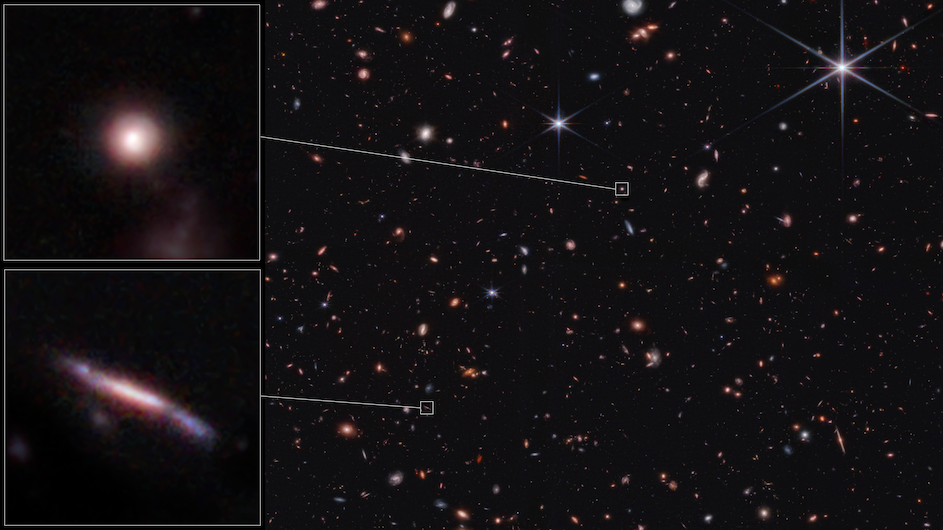
Sample shapes of distant galaxies identified by the James Webb Space Telescope’s Cosmic Evolution Early Release Science (CEERS) survey.
Sample shapes of distant galaxies identified by the James Webb Space Telescope’s Cosmic Evolution Early Release Science (CEERS) survey. [(Credit: NASA, ESA, CSA, STScI, Steve Finkelstein (UT Austin), Micaela Bagley (UT Austin), Rebecca Larson (UT Austin)]

Columbia researchers analyzing images from NASA’s James Webb Space Telescope have found that galaxies in the early universe are often flat and elongated, like breadsticks—and are rarely round, like balls of pizza dough.

“Roughly 50 to 80% of the galaxies we studied appear to be flattened in two dimensions,” explained Viraj Pandya, a NASA Hubble Fellow at Columbia University and the lead author of a new paper slated to appear in The Astrophysical Journal that outlines the findings...

Read More
ALMA Observations show how Double, Triple, Quadruple and Quintuple Star Systems Form Simultaneously in a Molecular Cloud

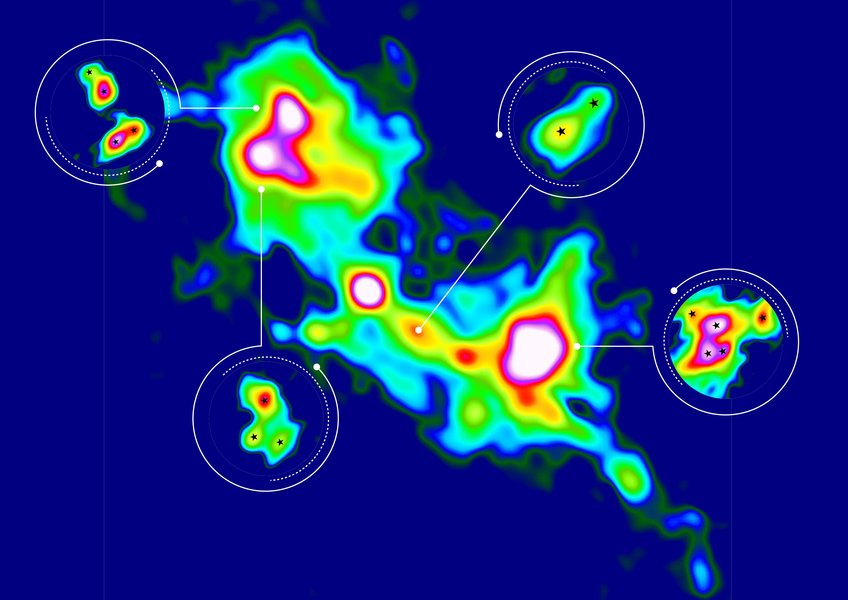
Blue-green-yellow splashes of colour with red-white islands against a blue background.
False-color image of the massive star formation region G333.23–0.06 from data obtained with the ALMA radio observatory. North is to the left. The insets show regions in which Li et al. were able to detect multiple systems of protostars. The star symbols indicate the location of each newly forming stars. The image covers a region 0.62 by 0.78 light-years in size (which on the sky covers a mere 7.5 times 9.5 arc seconds). For comparison: If you look at the sky along an outstretched thumb, it spans a viewing angle of around two degrees. One degree corresponds to 3600 arc seconds.
© S. Li, MPIA / J. Neidel, MPIA Graphics Department / Data: ALMA Observatory

For humans, the chance of giving birth to multiples is less than 2%...

Read More

Discovery of Second Ultra-Large Structure in Distant Space further Challenges Our Understanding of the Universe

Discovery of a second ultra-large structure in distant space further challenges what we understand about the universe
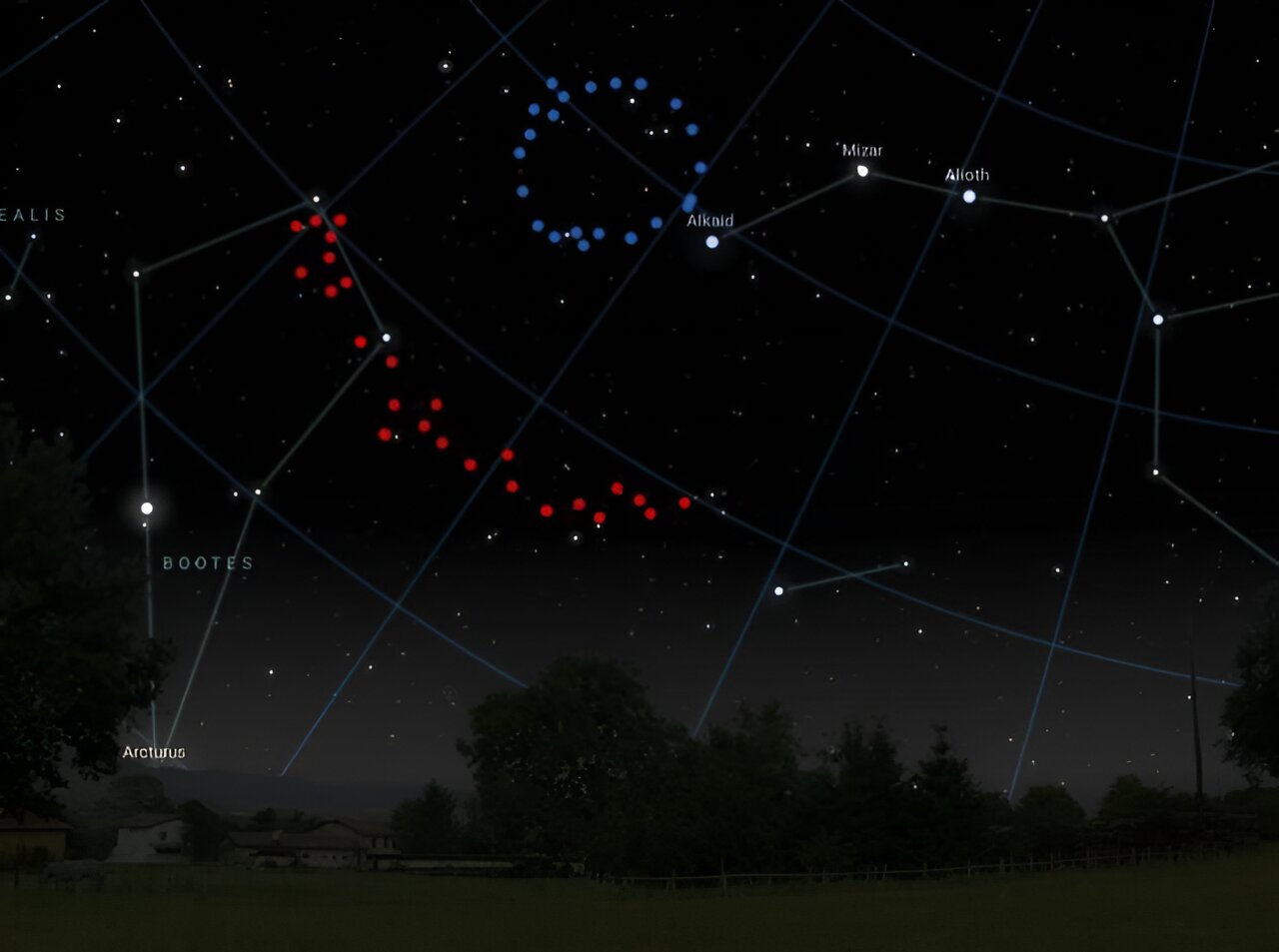
An artistic impression of what the Big Ring (shown in blue) and Giant Arc (shown in red) would look like in the sky. Credit: Stellarium

The Big Ring in the Sky is 9.2 billion light-years from Earth. It has a diameter of about 1.3 billion light-years, and a circumference of about 4 billion light-years. If we could step outside and see it directly, the diameter of the Big Ring would need about 15 full moons to cover it.

It is the second ultra-large structure discovered by University of Central Lancashire (UCLan) Ph.D. student Alexia Lopez who, two years ago, also discovered the Giant Arc in the Sky. Remarkably, the Big Ring and the Giant Arc, which is 3...

Read More

Why is the Universe Ripping Itself Apart? A new study shows Dark Energy may be more complicated than we thought

A small star slurping material from a much larger one.
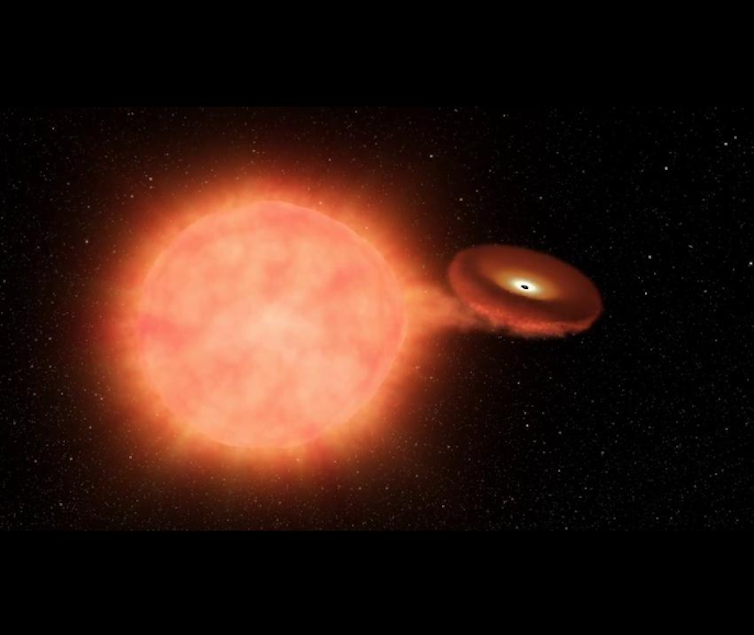
In a Type Ia supernova, a white dwarf slowly pulls mass from a neighboring star before exploding. NASA / JPL-Caltech, CC BY

What is the universe made of? This question has driven astronomers for hundreds of years.

For the past quarter of a century, scientists have believed “normal” stuff like atoms and molecules that make up you, me, Earth, and nearly everything we can see only accounts for 5% of the universe. Another 25% is “dark matter”, an unknown substance we can’t see but which we can detect through how it affects normal matter via gravity.

The remaining 70% of the cosmos is made of “dark energy”. Discovered in 1998, this is an unknown form of energy believed to be making the universe expand at an ever-increasing rate.

In a new study soon to be published in the Astronom...

Read More