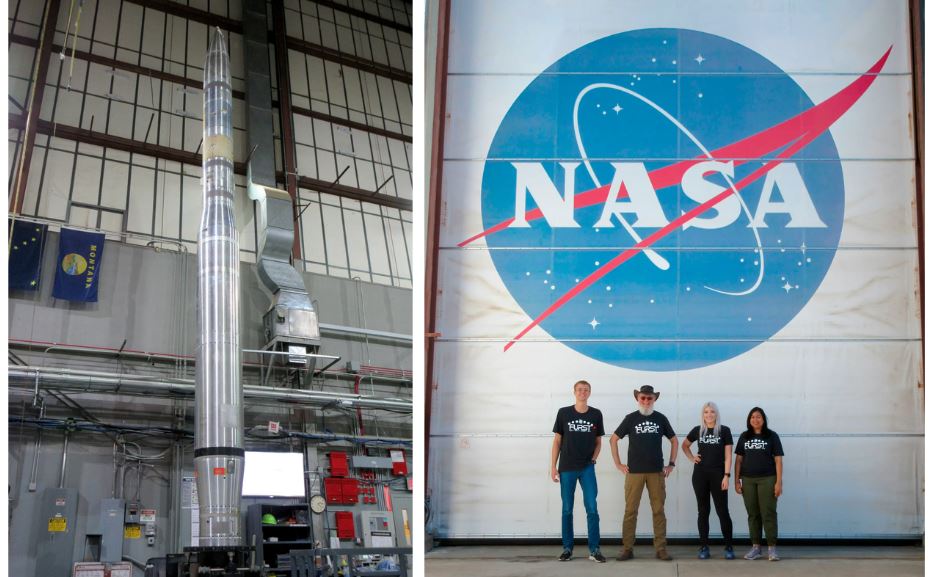
1. The Full-sun Ultraviolet Rocket SpecTrograph (FURST) undergoes testing at White Sands Missile Range in New Mexico in preparation for launch on Aug. 11. FURST will be launched aboard a Black Bryant IX sounding rocket and will observe the Sun in vacuum ultraviolet (VUV). The instrument was designed and built at Montana State University. NASA Marshall provided the camera, supplied avionics, and designed and built its calibration system. Credit: Montana State University 2. Montana State University alumnus Jake Davis, left, Professor Charles Kankelborg, and doctoral students Catharine “Cappy” Bunn and Suman Panda, pose at White Sands Missile Range in New Mexico, where they are preparing for the launch of the FURST rocket mission to observe the sun in far ultraviolet. Credit: Montana State...Read More
The proposed nanoparticle warming method. Credit: Aaron M. Geller, Center for Interdisciplinary Exploration and Research in Astrophysics.
A small team of engineers and geophysicists from Northwestern University, the University of Chicago, and the University of Central Florida has found, via modeling, that creating millions of metal nanorods from material on the Martian surface and then blasting them into the atmosphere would be a more efficient way to heat the planet than generating greenhouse gases. Their paper is published in the journal Science Advances.
Science fiction writers have for many years envisioned a future when Mars is made habitable through terraforming techniques, allowing humans to survive without the need for special buildings and spacesuits...
With far more lithium than expected, the star raises questions about how stars change over time
A new study published in The Astrophysical Journal, led by Assistant Professor of Astronomy Rana Ezzeddine and UF alumnus Jeremy Kowkabany, with collaborators, reports the discovery of a star that challenges astronomers’ understanding of star evolution and formation of chemical elements, and could suggest a new stage in their growth cycle.
It is widely accepted that as stars burn, they lose lighter elements like lithium in exchange for heavier elements like carbon and oxygen, but an analysis of this new star revealed that not only was its lithium content high for its age, but was higher than the normal level for any star at any age.
This star, named J0524-0336 based on its coordinates ...
UV radiation from stellar flares can erode planetary atmospheres
A groundbreaking study has revealed that red dwarf stars can produce stellar flares that carry far-ultraviolet (far-UV) radiation levels much higher than previously believed. This discovery suggests that the intense UV radiation from these flares could significantly impact whether planets around red dwarf stars can be habitable. Led by current and former astronomers from the University of Hawaii Institute for Astronomy (IfA), the research was recently published in the Monthly Notices of the Royal Astronomical Society.
“Few stars have been thought to generate enough UV radiation through flares to impact planet habitability...







Recent Comments