Category Astronomy/Space

Scorching, Seven-Planet system revealed by New Kepler Exoplanet list

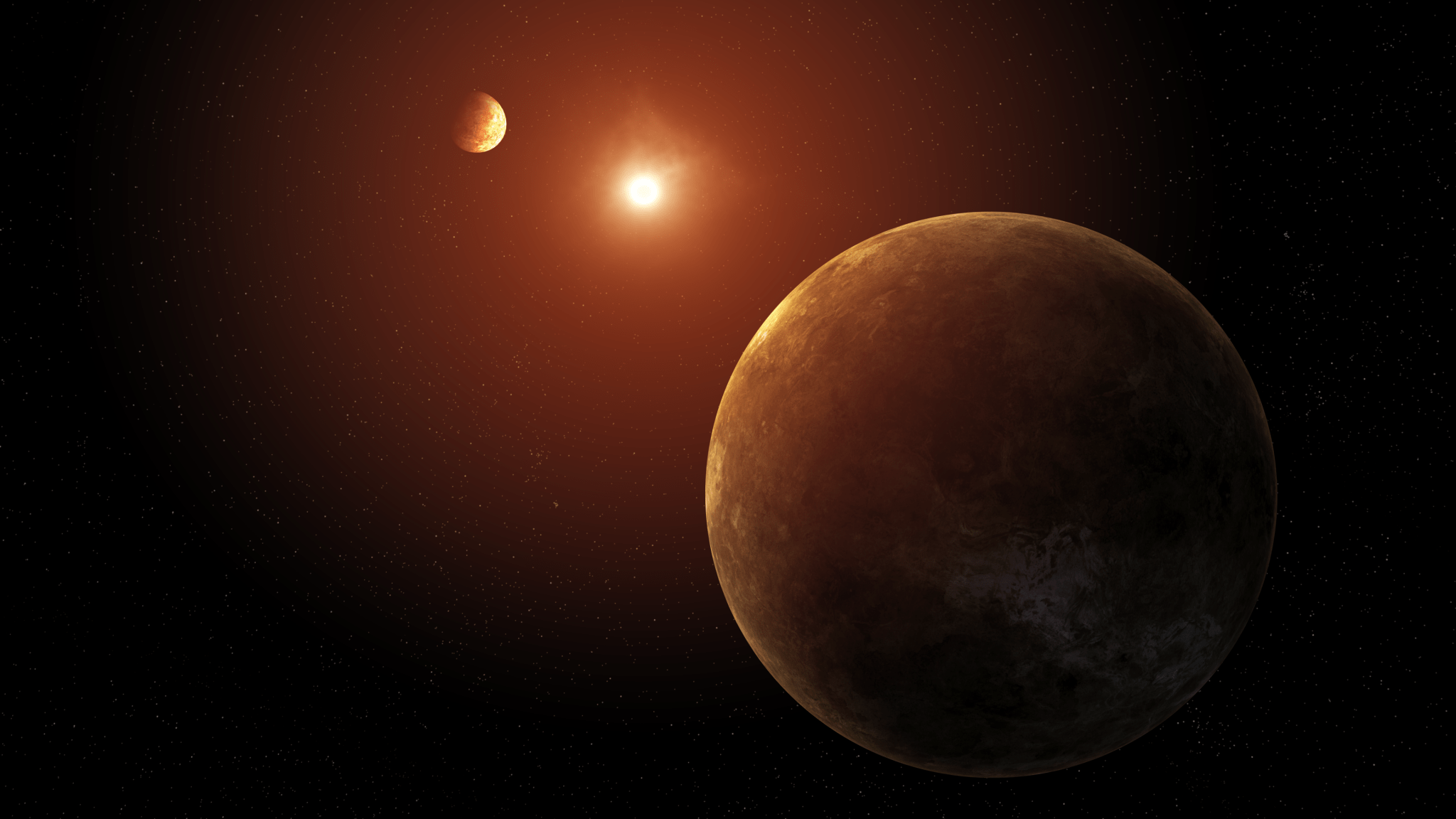
Artist’s concept showing two of the seven planets discovered orbiting a Sun-like star. The system, called Kepler-385, was identified using data from NASA’s Kepler mission.
NASA/Daniel Rutter

A system of seven sweltering planets has been revealed by continued study of data from NASA’s retired Kepler space telescope: Each one is bathed in more radiant heat from their host star per area than any planet in our solar system. Also unlike any of our immediate neighbors, all seven planets in this system, named Kepler-385, are larger than Earth but smaller than Neptune.

It is one of only a few planetary systems known to contain more than six verified planets or planet candidates...

Read More
Astronomers observe Supermassive Black Hole Feeding and Feedback on Sub-Parsec Scales

Black holes are messy eaters
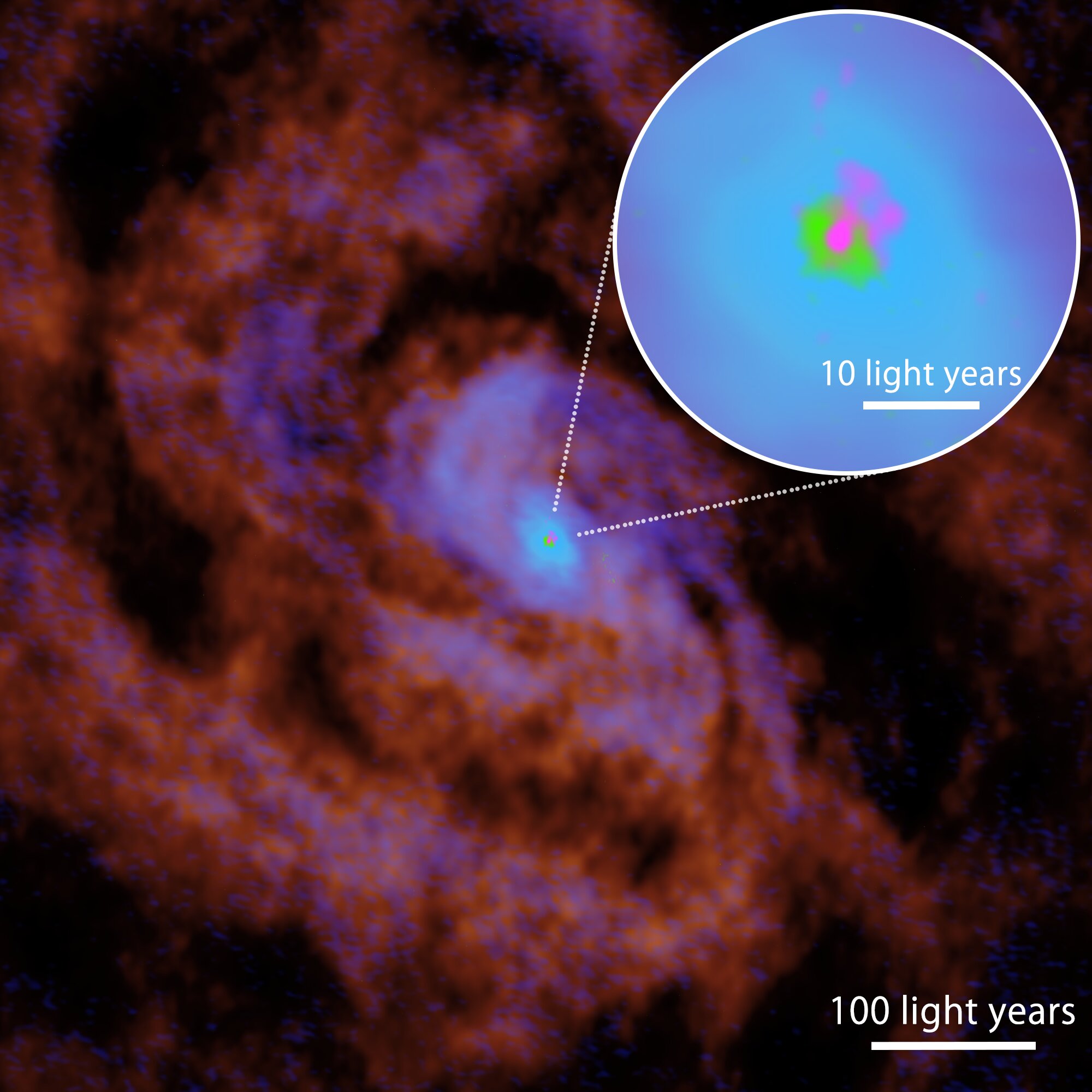
Carbon monoxide (CO; indicating the presence of medium-density molecular gas) is shown in red; atomic carbon (C; indicating the presence of atomic gas) in blue; hydrogen cyanide (HCN; indicating the presence of high density molecular gas) in green; and the hydrogen recombination line (H36α; indicating the presence of ionized gas) in pink. The size of the central dense gas disk (green) is approximately 6 light-years. The plasma outflow travels almost perpendicular to the disk. Credit: ALMA (ESO/NAOJ/NRAO), T. Izumi et al.

An international research team led by Takuma Izumi, an assistant professor at the National Astronomical Observatory of Japan, has achieved a milestone by observing the nearby active galactic nucleus of the Circinus Galaxy, with an extremely high resolution (approximat...

Read More

Giant Planets Cast a Deadly Pall

Giant exoplanet in transit
Artist rendering of a gas-giant exoplanet transiting across the face of its star. (ESA/C. Carreau/NASA)

How they can prevent life in other planetary systems. Giant gas planets can be agents of chaos, ensuring nothing lives on their Earth-like neighbors around other stars. New studies show, in some planetary systems, the giants tend to kick smaller planets out of orbit and wreak havoc on their climates.

Jupiter, by far the biggest planet in our solar system, plays an important protective role. Its enormous gravitational field deflects comets and asteroids that might otherwise hit Earth, helping create a stable environment for life. However, giant planets elsewhere in the universe do not necessarily protect life on their smaller, rocky planet neighbors.

A new Astronomical Journal p...

Read More

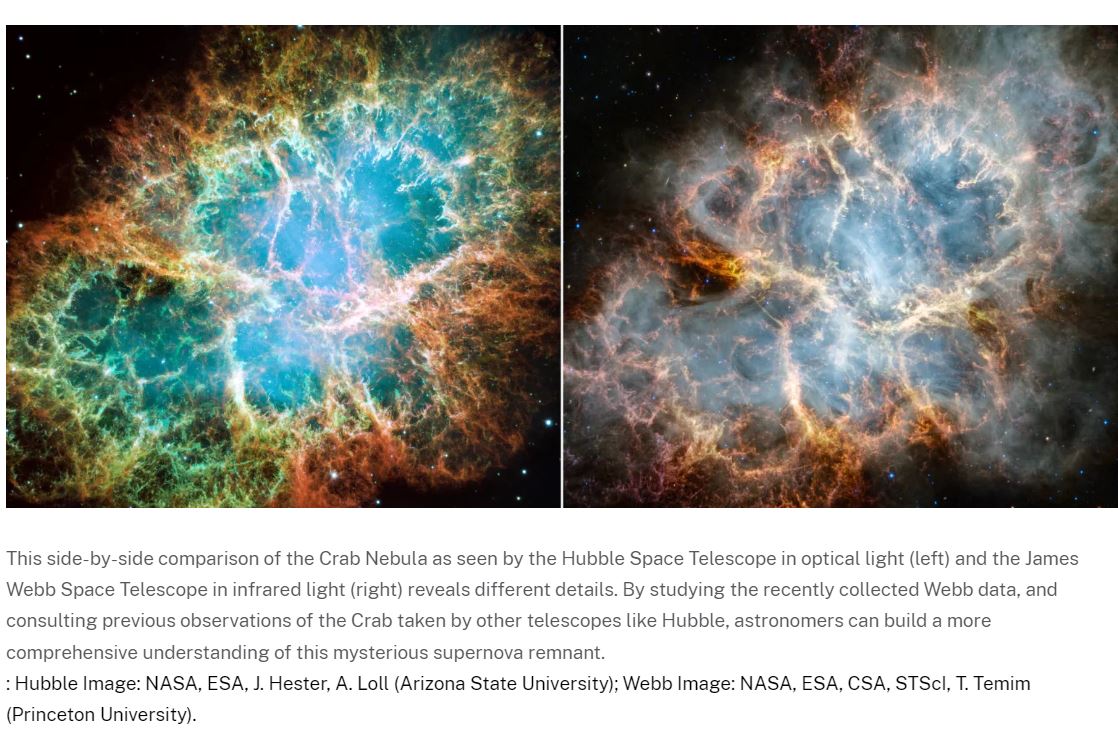
The Crab Nebula seen in New Light by NASA’s Webb

Exquisite, never-before-seen details help unravel the supernova remnant’s puzzling history. NASA’s James Webb Space Telescope has gazed at the Crab Nebula, a supernova remnant located 6,500 light-years away in the constellation Taurus. Since the recording of this energetic event in 1054 CE by 11th-century astronomers, the Crab Nebula has continued to draw attention and additional study as scientists seek to understand the conditions, behavior, and after-effects of supernovae through thorough study of the Crab, a relatively nearby example.

Using Webb’s NIRCam (Near-Infrared Camera) and MIRI (Mid-Infrared Instrument), a team led by Tea Temim at Princeton University is searching for answers about the Crab Nebula’s origins.

“Webb’s sensitivity and spatial resolution allow us to accu...

Read More