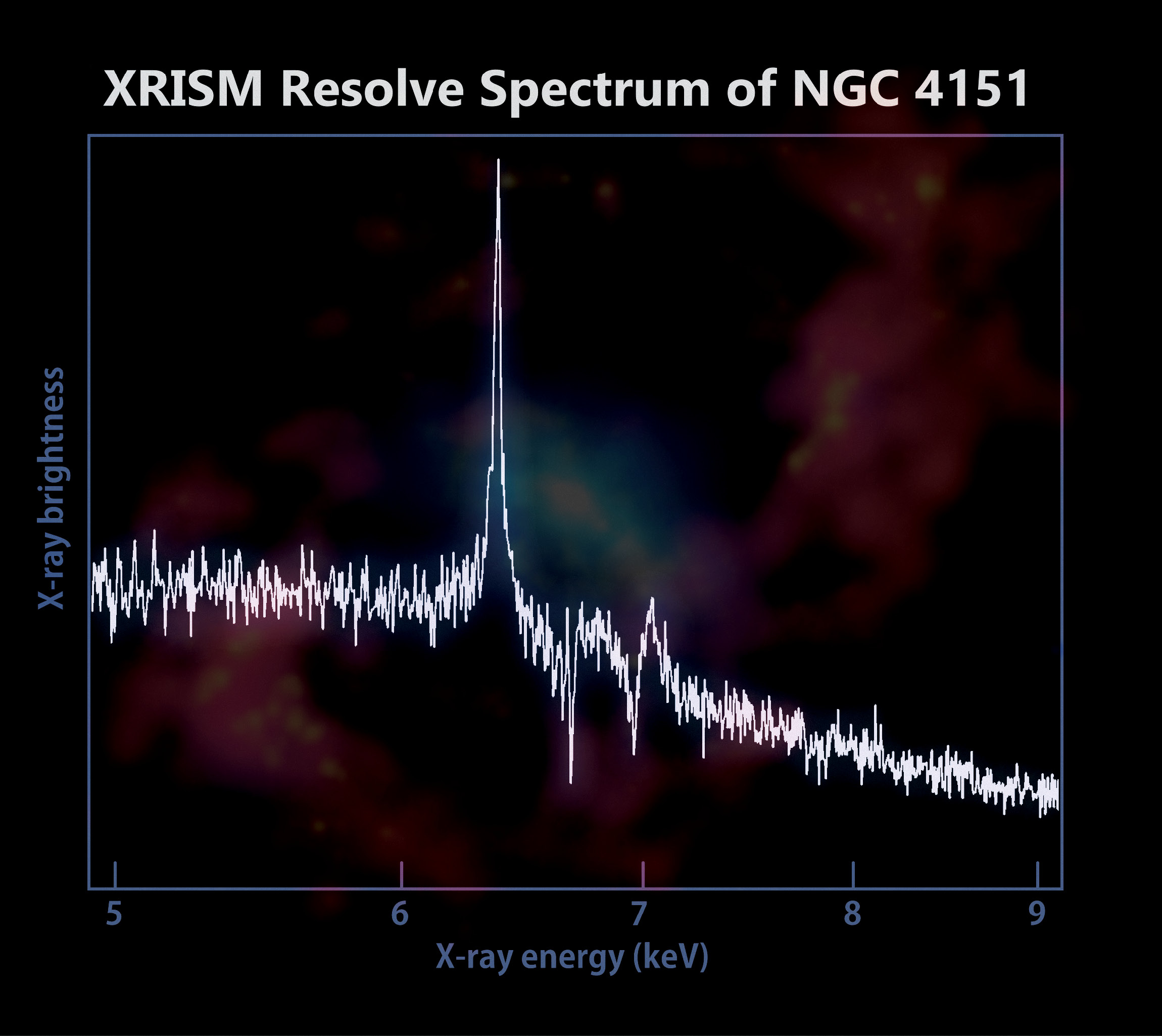
The Resolve instrument aboard XRISM (X-ray Imaging and Spectroscopy Mission) captured data from the center of galaxy NGC 4151, where a supermassive black hole is slowly consuming material from the surrounding accretion disk. The resulting spectrum reveals the presence of iron in the peak around 6.5 keV and the dips around 7 keV, light thousands of times more energetic that what our eyes can see. Background: An image of NGC 4151 constructed from a combination of X-ray, optical, and radio light. Spectrum: JAXA/NASA/XRISM Resolve. Background: X-rays, NASA/CXC/CfA/J.Wang et al.; optical, Isaac Newton Group of Telescopes, La Palma/Jacobus Kapteyn Telescope; radio, NSF/NRAO/VLA
After starting science operations in February, Japan-led XRISM (X-ray Imaging and Spectroscopy Mission) studied the ...
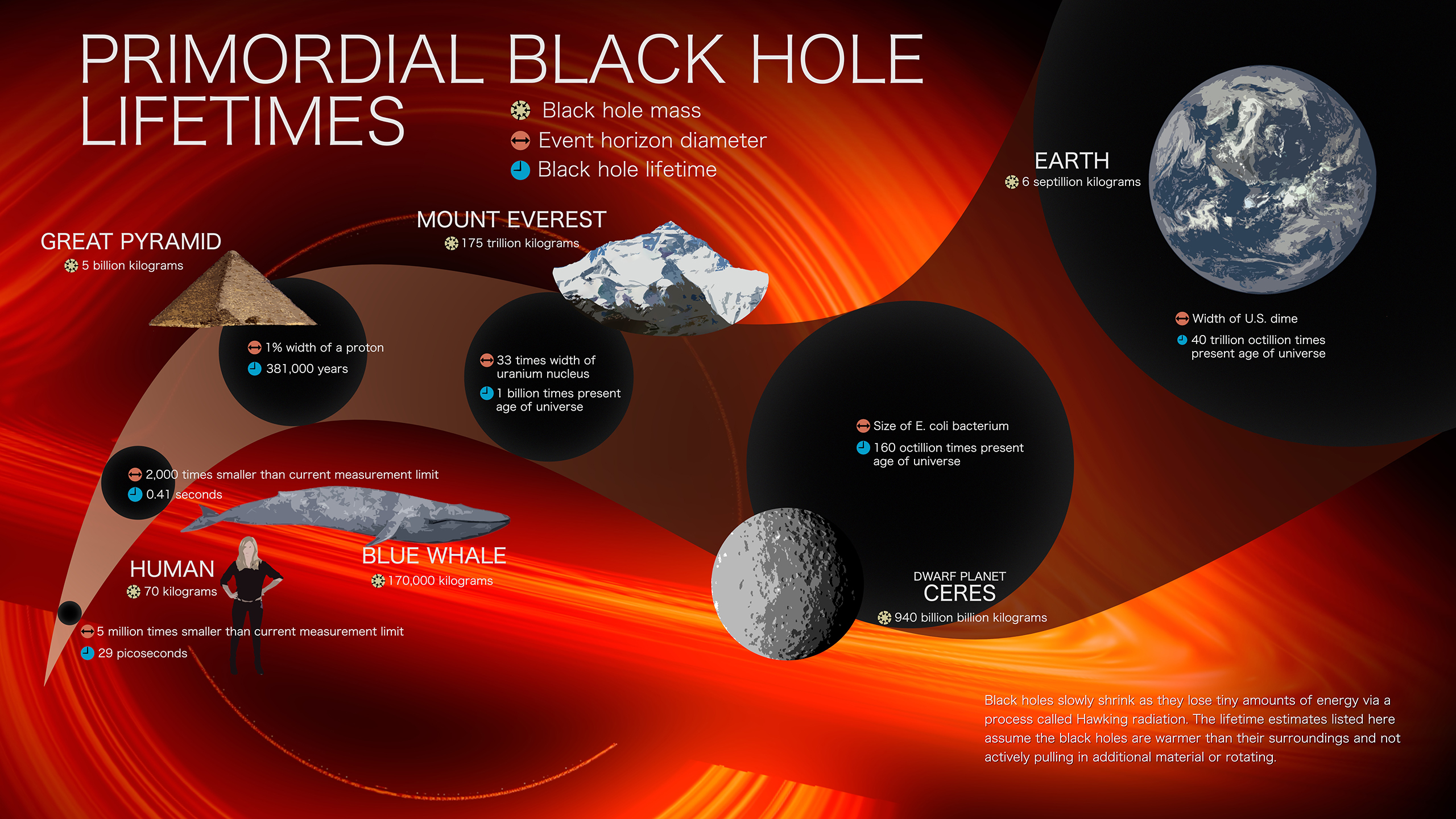
Stephen Hawking theorized that black holes can slowly shrink as radiation escapes. The slow leak of what’s now known as Hawking radiation would, over time, cause the black hole to simply evaporate. This infographic shows the estimated lifetimes and event horizon –– the point past which infalling objects can’t escape a black hole’s gravitational grip –– diameters for black holes of various small masses. NASA’s Goddard Space Flight Center
Astronomers have discovered black holes ranging from a few times the sun’s mass to tens of billions. Now a group of scientists has predicted that NASA’s Nancy Grace Roman Space Telescope could find a class of “featherweight” black holes that has so far eluded detection.
Today, black holes form either when a massive star collapses or wh...
New discoveries about Jupiter could lead to a better understanding of Earth’s own space environment and influence a long-running scientific debate about the solar system’s largest planet. “By exploring a larger space such as Jupiter, we can better understand the fundamental physics governing Earth’s magnetosphere and thereby improve our space weather forecasting,” said Peter Delamere, a professor at the UAF Geophysical Institute and the UAF College of Natural Science and Mathematics.
“We are one big space weather event from losing communication satellites, our power grid assets, or both,” he said.
Space weather refers to disturbances in the Earth’s magnetosphere caused by interactions between the solar wind and the Earth’s magnetic field...
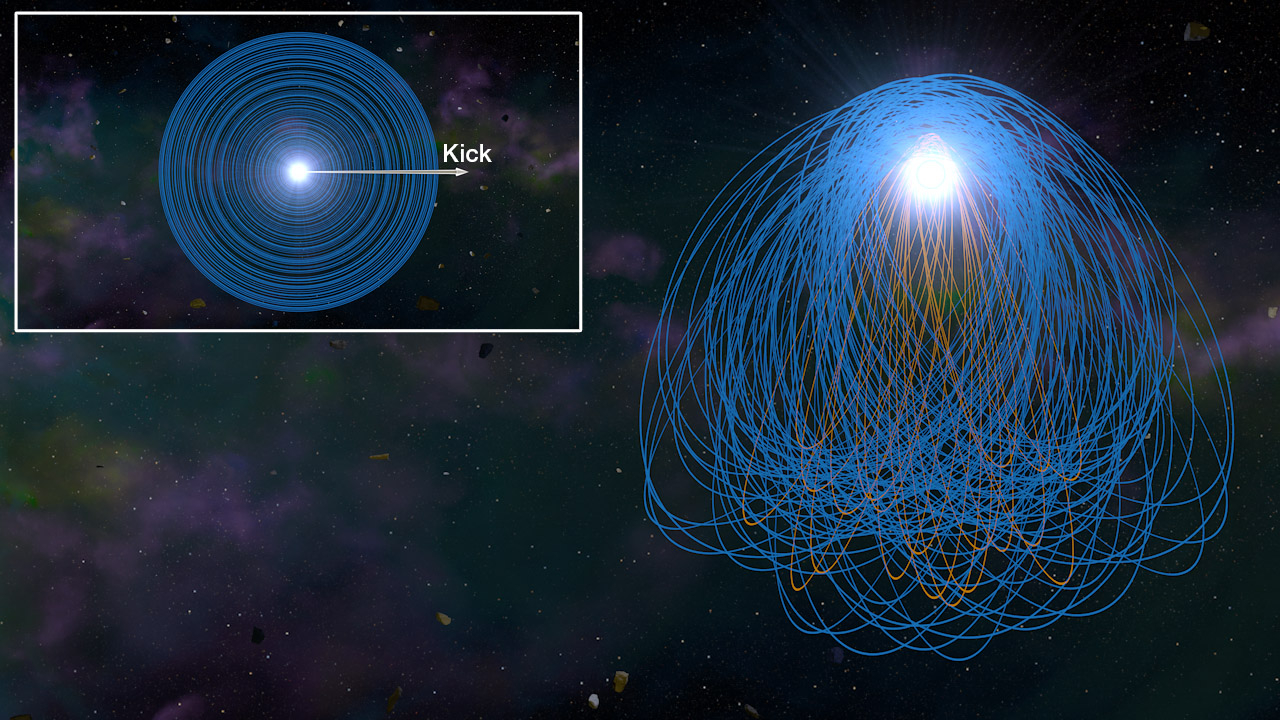
Planetesimal orbits around a white dwarf. Initially, every planetesimal has a circular, prograde orbit. The kick forms an eccentric debris disk which with prograde (blue) and retrograde orbits (orange). Image Credit Steven Burrows/Madigan group
Dead stars known as white dwarfs, have a mass like the sun while being similar in size to Earth. They are common in our galaxy, as 97% of stars are white dwarfs. As stars reach the end of their lives, their cores collapse into the dense ball of a white dwarf, making our galaxy seem like an ethereal graveyard.
Despite their prevalence, the chemical makeup of these stellar remnants has been a conundrum for astronomers for years...






Recent Comments