Category Astronomy/Space

Protostars can Siphon Material from Far Away, says study

Protostars can siphon material from far away
This artist’s conception shows a newly formed protostar surrounded by a swirling protoplanetary disk of dust and gas. Credit: University of Copenhagen/Lars Buchhave

When stars are born, they do it inside a molecular cloud. Astronomers long assumed that the “crèche” supplied all the nutrients that protostars needed to form. However, it turns out they get help from outside the nest.

A new study published in the journal Astronomy & Astrophysics by scientists at the Max Planck Institute for Extraterrestrial Physics delved into the role of streamers and filaments in the star-birth process. Think of them as channels that extend out from the interior of the stellar creche, sometimes out as far as 10,000 astronomical units (about 0.15 light-years)...

Read More
Source of Largest ever Mars Quake Revealed

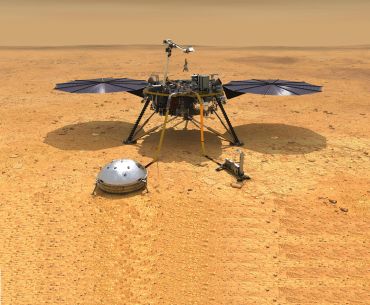
A spacecraft with a tripod structure on the surface of Mars, seen as an arid, desert-like landscape. The spacecraft has an arm-like probe that extends upwards, and two solar panels on either side, which stick out like wings.
An illustration of NASA’s InSight spacecraft with its instruments deployed on the Martian surface. Credits: NASA/JPL-Caltech.

A global team of scientists have announced the results of an unprecedented collaboration to search for the source of the largest ever seismic event recorded on Mars. The study, led by the University of Oxford, rules out a meteorite impact, suggesting instead that the quake was the result of enormous tectonic forces within Mars’ crust.

The quake, which had a magnitude of 4.7 and caused vibrations to reverberate through the planet for at least six hours, was recorded by NASA’s InSight lander on May 4 2022...

Read More

Hypervelocity Impact Experiments Probe the Origin of Organics on the Dwarf Planet Ceres

Hypervelocity impact experiments probe the origin of organics on the dwarf planet Ceres
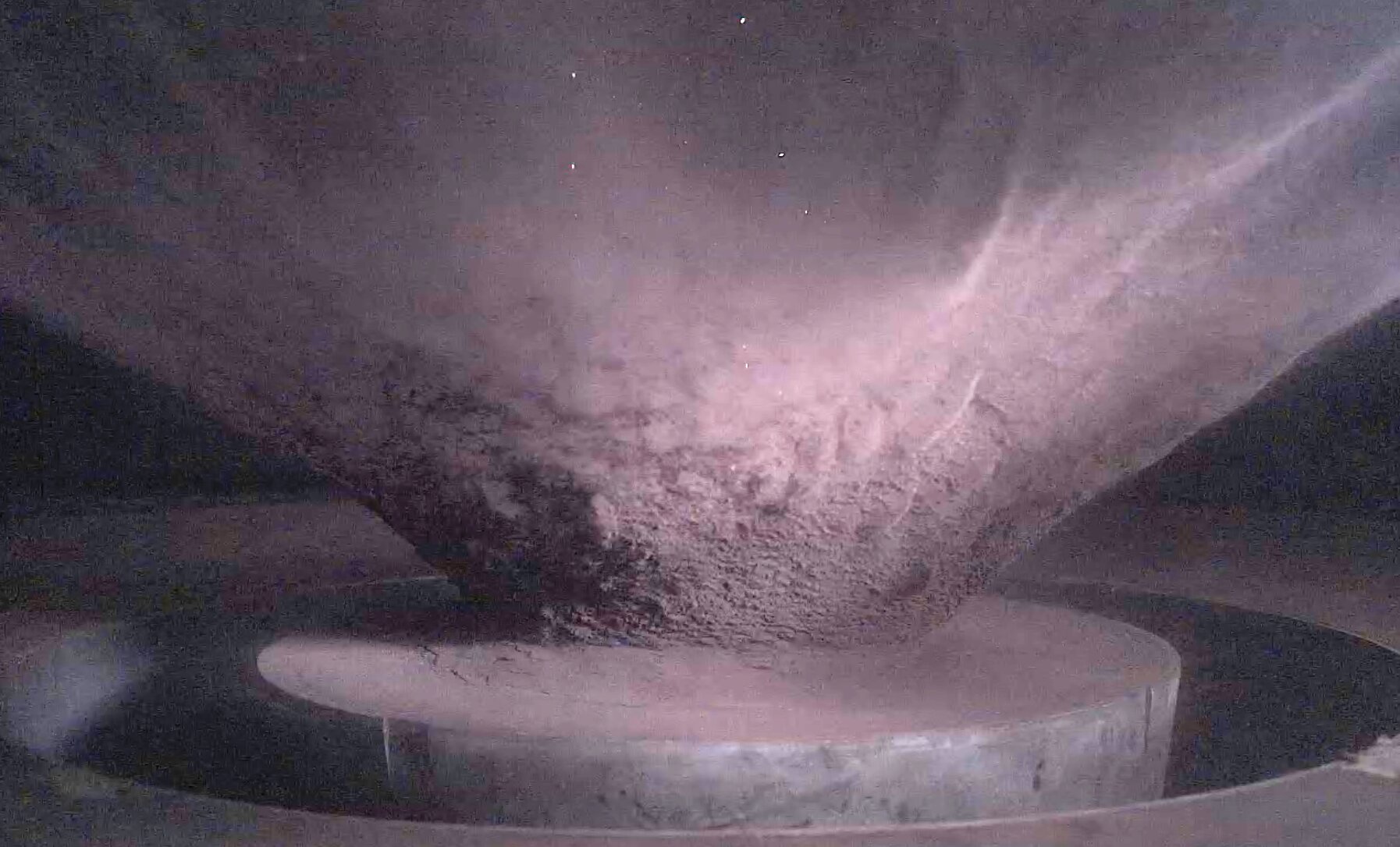
Side view of the ejecta curtain created during a hypervelocity impact experiment at the NASA Ames Vertical Gun Range. The experiment was designed to investigate the effects of impacts on Ceres’ organics. Credit: NASA / Johns Hopkins University Applied Physics Laboratory

One of the most exciting findings from NASA’s Dawn mission is that Ceres, the largest object in the asteroid belt that lies between Mars and Jupiter, hosts complex organics. The discovery of aliphatic molecules, which consist of carbon and hydrogen chains, in conjunction with evidence that Ceres has abundant water ice and may have been an ocean world, means this dwarf planet might have once harbored the main ingredients associated with life as we know it.

How the aliphatic organics originated on Ceres has been the ...

Read More

Study reveals Violent Material Ejection Process of a Dying Massive Star

Study reveals violent material ejection process of a dying massive star
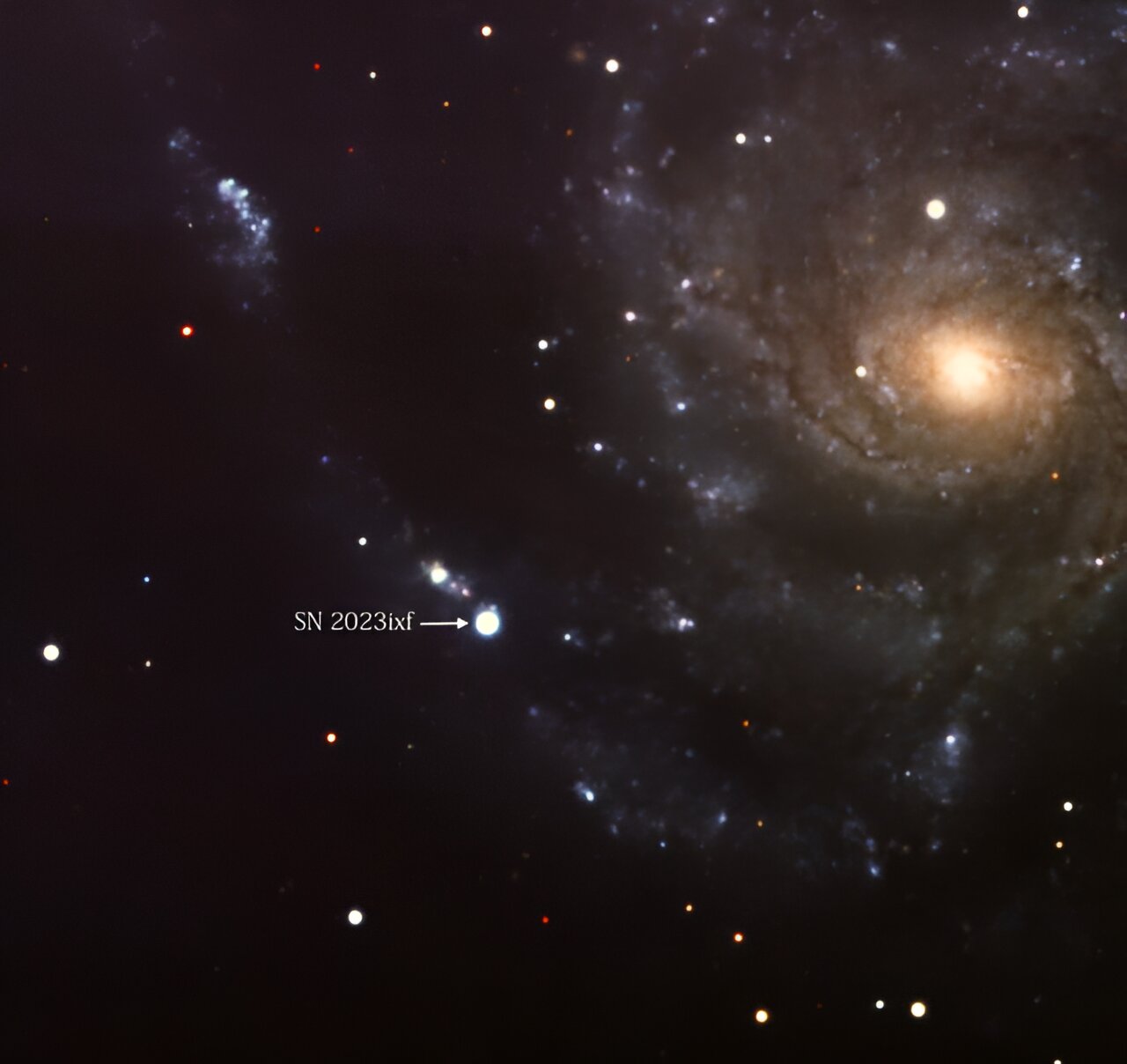
SN 2023ixf and its host galaxy. Credit: Yunnan Observatories

A research team led by Dr. Zhang Jujia from Yunnan Observatories of the Chinese Academy of Sciences and Prof. Wang Xiaofeng from Tsinghua University has revealed the stellar mass violently ejected from a progenitor at the end of its life by observing the once-in-a-decade supernova SN 2023ixf. Such mass loss processes can provide essential information for understanding the final evolution of a massive star.

The study was published in Science Bulletin on Sept. 14.

Type II supernovae (SNe II) are the most common stellar explosions in the universe, for which the final stage of evolution of their hydrogen-rich massive progenitors towards core-collapse explosion is elusive...

Read More