
Category Astronomy/Space

Billion-light-year-wide ‘Bubble of Galaxies’ Discovered

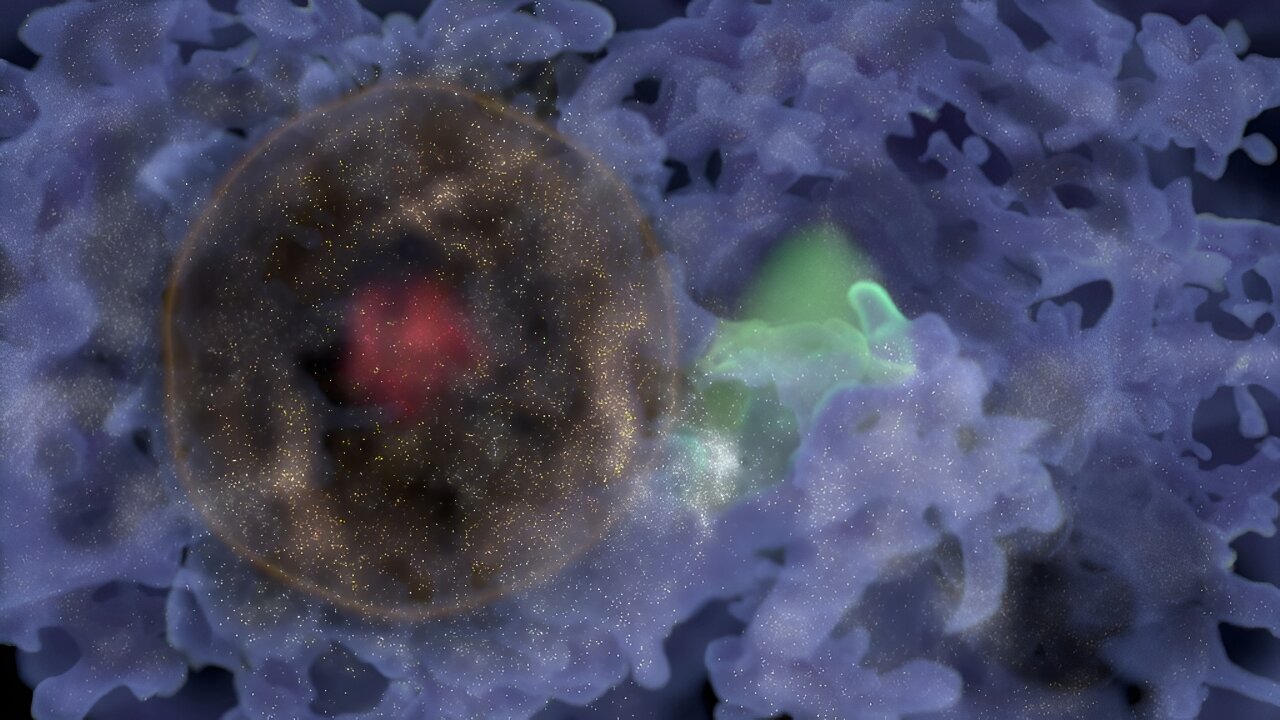
An artist's representation of the 'bubble of galaxies' Ho'oleilana, which spans a billion light years
An artist’s representation of the ‘bubble of galaxies’ Ho’oleilana, which spans a billion light years.

Astronomers have discovered the first “bubble of galaxies,” an almost unimaginably huge cosmic structure thought to be a fossilized remnant from just after the Big Bang sitting in our galactic backyard.

The bubble spans a billion light years, making it 10,000 times wider than the Milky Way galaxy.

Yet this giant bubble, which cannot be seen by the naked eye, is a relatively close 820 million light years away from our home galaxy, in what astronomers call the nearby universe.

The bubble can be thought of as “a spherical shell with a heart,” Daniel Pomarede, an astrophysicist at France’s Atomic Energy Commission, told AFP.

Inside that heart is the Bootes supercluster of gala...

Read More
Study hints at the Existence of the Closest Black Holes to Earth in the Hyades Star Cluster

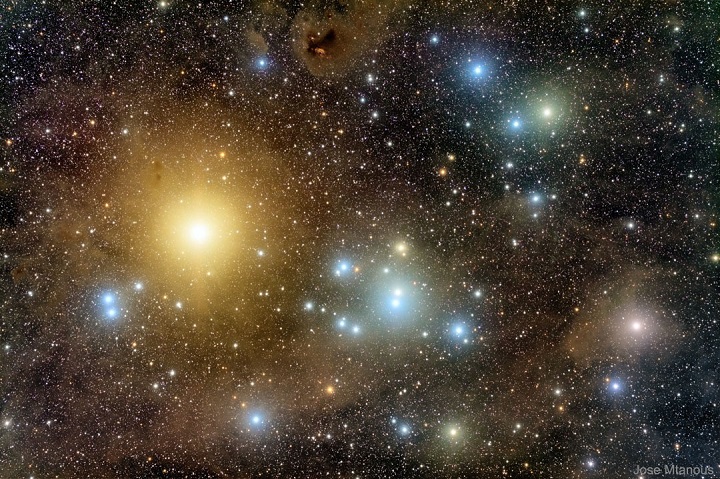
Image of the Hyades star cluster. Image: Jose Mtanous

Black holes are one of the most mysterious and fascinating phenomena in the Universe. A paper published in the journal Monthly Notices of the Royal Astronomical Society hints at the existence of several black holes in the Hyades cluster – the closest open cluster to our solar system – which would make them the closest black holes to Earth ever detected...

Read More

New Cosmological Constraints on the Nature of Dark Matter

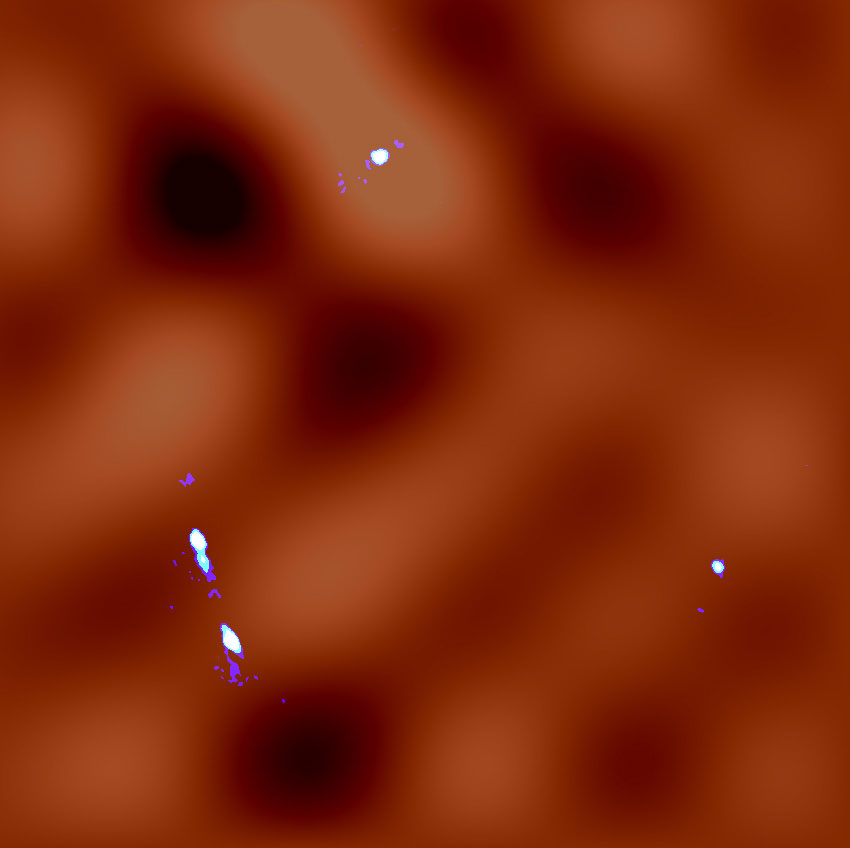
Dark matter fluctuations in the lens system MG J0414+0534. The whitish blue color represents the gravitationally lensed images observed by ALMA. The calculated distribution of dark matter is shown in orange; brighter regions indicate higher concentrations of dark matter and dark orange regions indicate lower concentrations. (Credit: ALMA (ESO/NAOJ/NRAO), K. T. Inoue et al.)

New research has revealed the distribution of dark matter in never before seen detail, down to a scale of 30,000 light-years. The observed distribution fluctuations provide better constraints on the nature of dark matter.

Mysterious dark matter accounts for most of the matter in the Universe. Dark matter is invisible and makes itself know only through its gravitational effects...

Read More

Hot Jupiter Blows its Top

The planet HAT-P-32b is losing so much of its atmospheric helium that the trailing gas tails are among the largest structures yet known any planet outside our solar system. Simulation ‘slice’ through the orbital plane approximating the HAT-P-32 A + b system. Credit: Zhang et al., Sci. Adv. 9, eadf8736 (2023).

A planet about 950 light years from Earth could be the Looney Tunes’ Yosemite Sam equivalent of planets, blowing its atmospheric ‘top’ in spectacular fashion.

The planet called HAT-P-32b is losing so much of its atmospheric helium that the trailing gas tails are among the largest structures yet known of an exoplanet, a planet outside our solar system, according to observations by astronomers.

Three-dimensional (3D) simulations on the Stampede2 supercomputer of the Texas ...

Read More
