Category Astronomy/Space

Can Signs of Life be detected from Saturn’s Frigid Moon?

Artistic rendering of ice moon Enceladus with ice plumes ejected into space.
This artistic rendering shows ice plumes being ejected from Enceladus at speeds of up to 800 miles/hour. (cr: NASA)

Enceladus’ ice plumes may hold the building blocks of life. Researchers have shown unambiguous laboratory evidence that amino acids transported in the ice plumes of Saturn’s moon, Eceladus, can survive impact speeds of up to 4.2 km/s, supporting their detection during sampling by spacecraft.

As astrophysics technology and research continue to advance, one question persists: is there life elsewhere in the universe? The Milky Way galaxy alone has hundreds of billions of celestial bodies, but scientists often look for three crucial elements in their ongoing search: water, energy and organic material...

Read More

Dark Galactic region nicknamed ‘The Brick’ explained with Webb Telescope findings

The Galactic Center is full of stars: There are over half a million in this image. Using JWST’s specialized filters and a little bit of Photoshop, the team was able to remove the stars and show only the filamentary nebula of hot gas that permeates the inner Galaxy.  The bright regions are where hydrogen is a hot plasma, glowing from the energy from the massive stars.  The Brick is the dark region where that glowing plasma is blocked out.  Along the edge of the Brick, the glow is bluer: this blue appearance is caused by the CO ice blocking out the red light, letting only the blue through. Photos courtesy of Adam Ginsburg.

Using the James Webb Space Telescope, astronomers spot unexpected source of carbon monoxide ice at galactic region surprisingly devoid of stars.

In a recent study...

Read More

Meteorites likely Source of Nitrogen for Early Earth

Results of study from Ryugu samples.

Micrometeorites originating from icy celestial bodies in the outer Solar System may be responsible for transporting nitrogen to the near-Earth region in the early days of our solar system. That discovery was published today in Nature Astronomy by an international team of researchers, including University of Hawai’i at Manoa scientists, led by Kyoto University.

Nitrogen compounds, such as ammonium salts, are abundant in material born in regions far from the sun, but evidence of their transport to Earth’s orbital region had been poorly understood.

“Our recent findings suggests the possibility that a greater amount of nitrogen compounds than previously recognized was transported near Earth, potentially serving as building blocks for life on o...

Read More

Discovery of Planet Too Big for its Sun Throws Off Solar System Formation Models

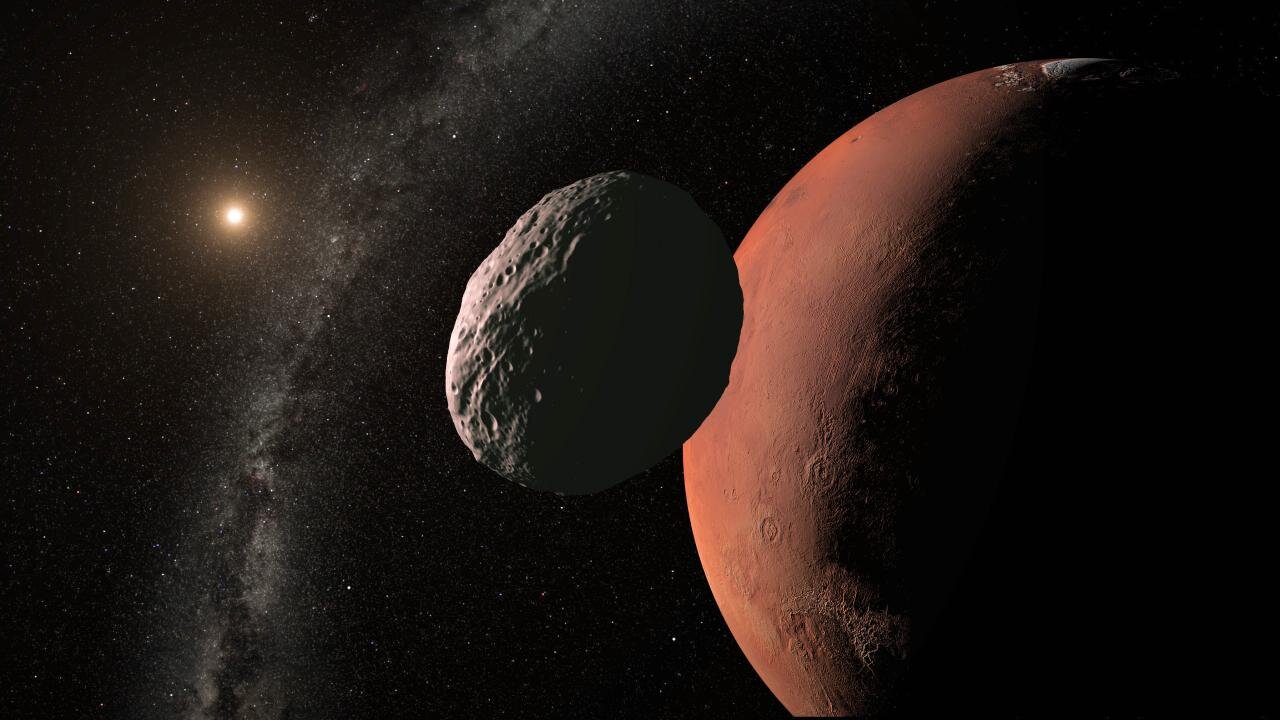
Artistic rendering of the possible view from LHS 3154b towards its low mass host star
Artistic rendering of the possible view from LHS 3154b towards its low mass host star. Given its large mass, LHS 3154b probably has a Neptune-like composition. Credit: Penn State / Penn State. Creative Commons

The discovery of a planet that is far too massive for its sun is calling into question what was previously understood about the formation of planets and their solar systems, according to Penn State researchers.

In a paper published in the journal Science, researchers report the discovery of a planet more than 13 times as massive as Earth orbiting the “ultracool” star LHS3154, which itself is nine times less massive than the sun. The mass ratio of the newly found planet with its host star is more than 100 times higher than that of Earth and the sun.

The finding reveals th...

Read More