Category Astronomy/Space

Astronomers Confirm Maisie’s Galaxy is Among Earliest Ever Observed

Astronomers confirm Maisie's galaxy is among earliest ever observed
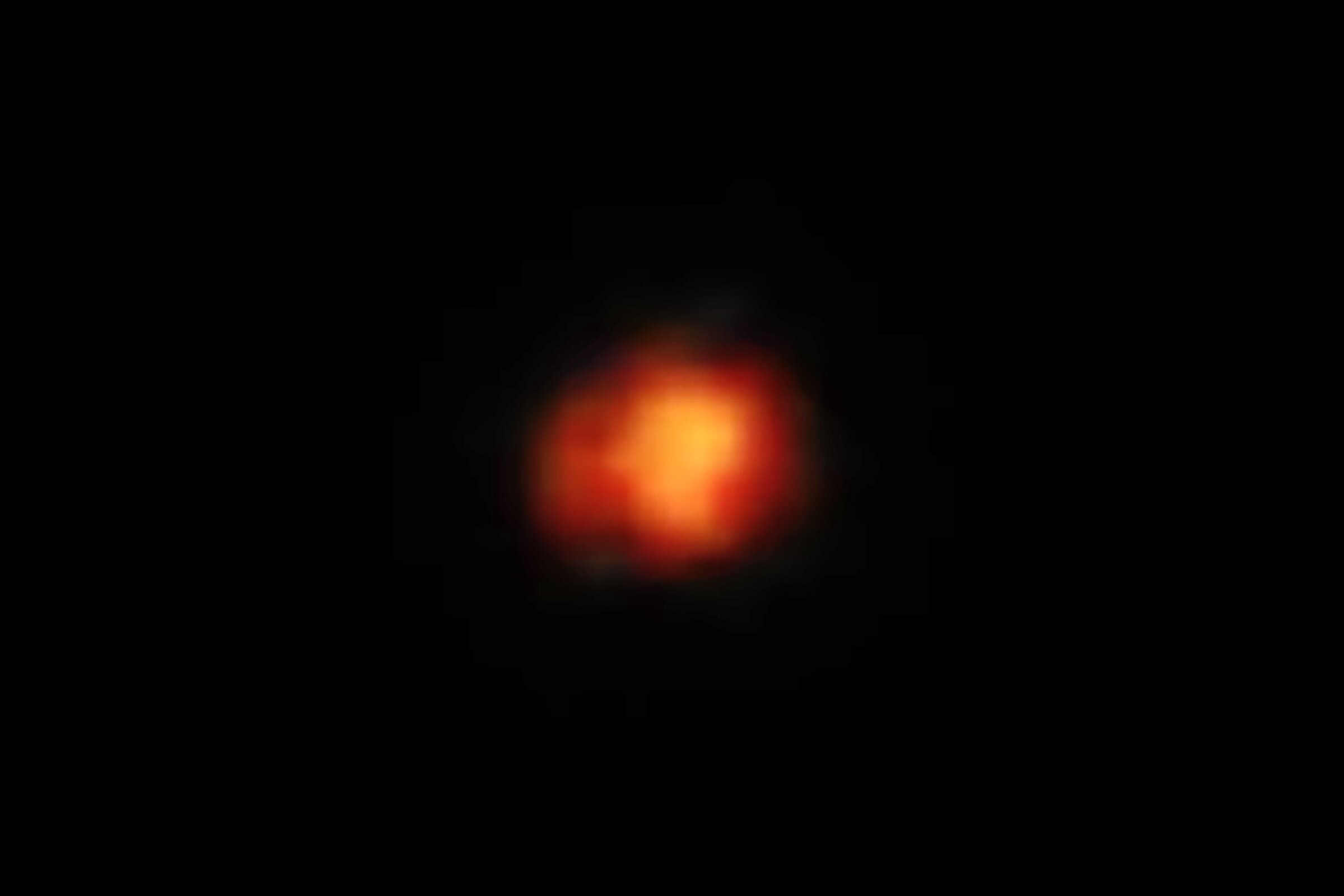
Spectroscopic observations reveal that Maisie’s galaxy, named after Steven Finkelstein’s daughter, was detected 390 million years after the Big Bang. That makes it one of the four earliest confirmed galaxies ever observed. Credit: NASA/STScI/CEERS/TACC/ University of Texas at Austin/S. Finkelstein/M. Bagley

Thanks to the James Webb Space Telescope, astronomers racing to find some of the earliest galaxies ever glimpsed have now confirmed that a galaxy first detected last summer is in fact among the earliest ever found. The findings are published in the journal Nature.

Follow-up observations since first detection of Maisie’s galaxy have revealed that it is from 390 million years after the Big Bang...

Read More
A ‘Jupiter’ Hotter than the Sun

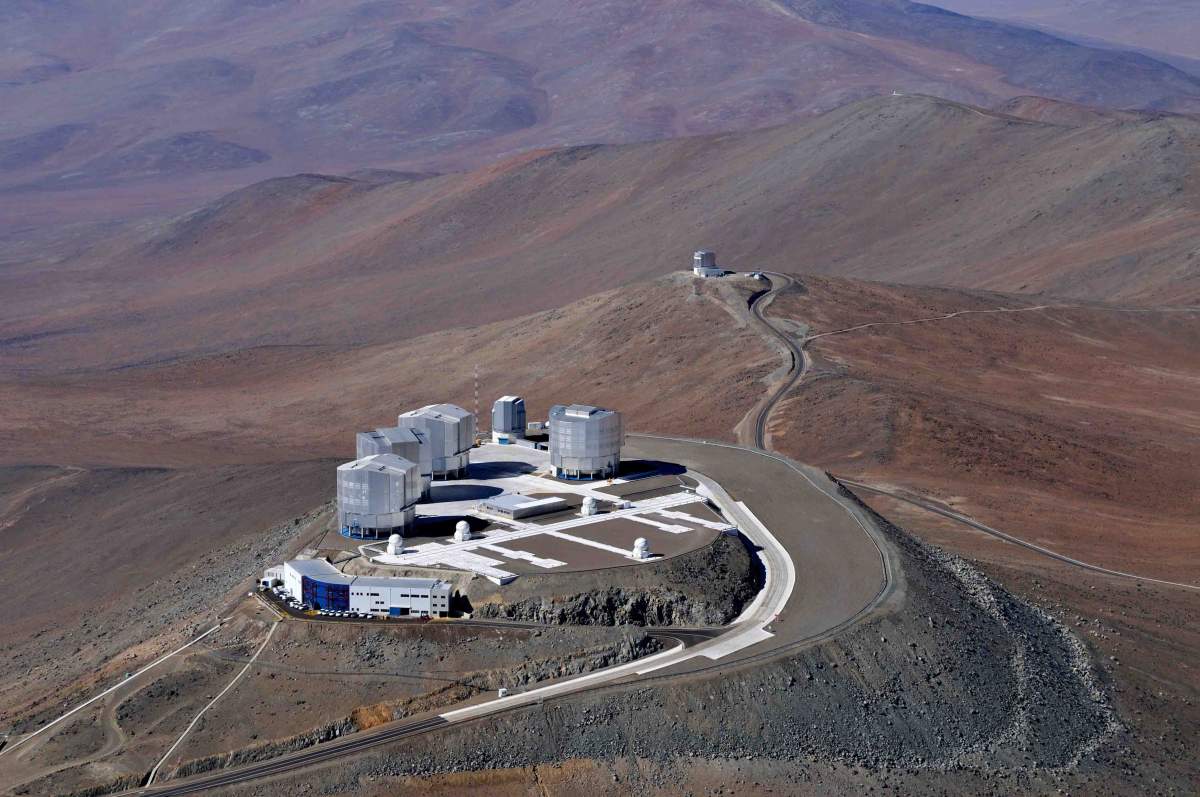
An aerial view of the European Southern Observatory’s Very Large Telescope in Paranal, Chile (Photo: J. L. Dauvergne & G. Hüdepohl, atacamaphoto.com/ESO)

The search for exoplanets—planets that orbit stars located beyond the borders of our solar system—is a hot topic in astrophysics. Of the various types of exoplanets, one is hot in the literal sense: hot Jupiters, a class of exoplanets that are physically similar to the gas giant planet Jupiter from our own neighborhood.

Unlike “our” Jupiter, hot Jupiters orbit very close to their stars, complete a full orbit in just a few days or even hours, and—as their name suggests—have extremely high surface temperatures. They hold great fascination for the astrophysics community...

Read More

Hundred-Year Storms? That’s how long they last on Saturn

closeup of beige planet with stormy swirls at top and shadow of rings at middle
A huge storm dominates the rather featureless surface of Saturn in an image taken by the Cassini spacecraft on Feb. 25, 2011, about 12 weeks after the powerful storm was first detected in the planet’s northern hemisphere. The megastorm is seen overtaking itself as it encircles the entire planet. Astronomers have found deep in the atmosphere the aftereffects of megastorms that occurred hundreds of years ago. The dark stripes are the shadows of Saturn’s rings.
NASA/JPL/Space Science Institute

Megastorms leave marks on Saturn’s atmosphere for centuries. They regularly appear on Saturn, marring the relatively bland surface before disappearing. But radio observations show that the storms have long-lasting effects deeper in the atmosphere, in particular in the distribution of ammonia...

Read More

Stellar Surf’s up: Monster Waves as tall as Three Suns are Crashing upon a Colossal Star

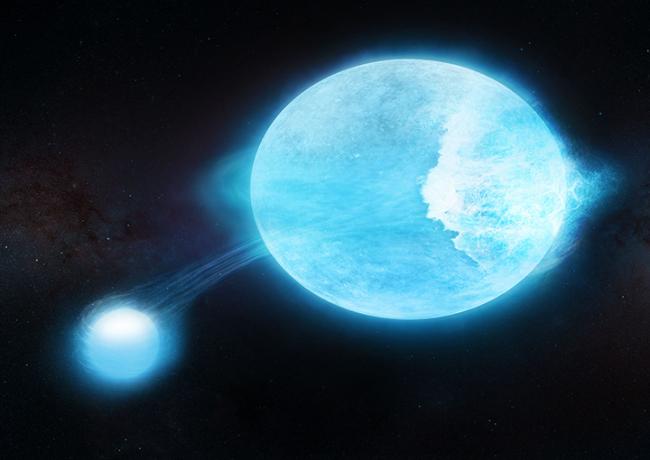
Artist conception of the system, where the smaller star induces breaking surface waves in the more massive companion.
Credit: Melissa Weiss, CfA

An extreme star system is giving new meaning to the phrase “surf’s up.”

The star system intrigued researchers because it is the most dramatic “heartbeat star” on record. Now new models have revealed that titanic waves, generated by tides, are repeatedly breaking on one of the stars in the system—the first time this phenomenon has ever been seen on a star.

Heartbeat stars are stars in close pairs that periodically pulse in brightness, like the rhythm of a beating heart on an EKG machine. The stars in heartbeat systems loop through elongated oval orbits. Whenever they swing close together, the stars’ gravities generate tides—just as the Moon creates ocean tides on Earth...

Read More