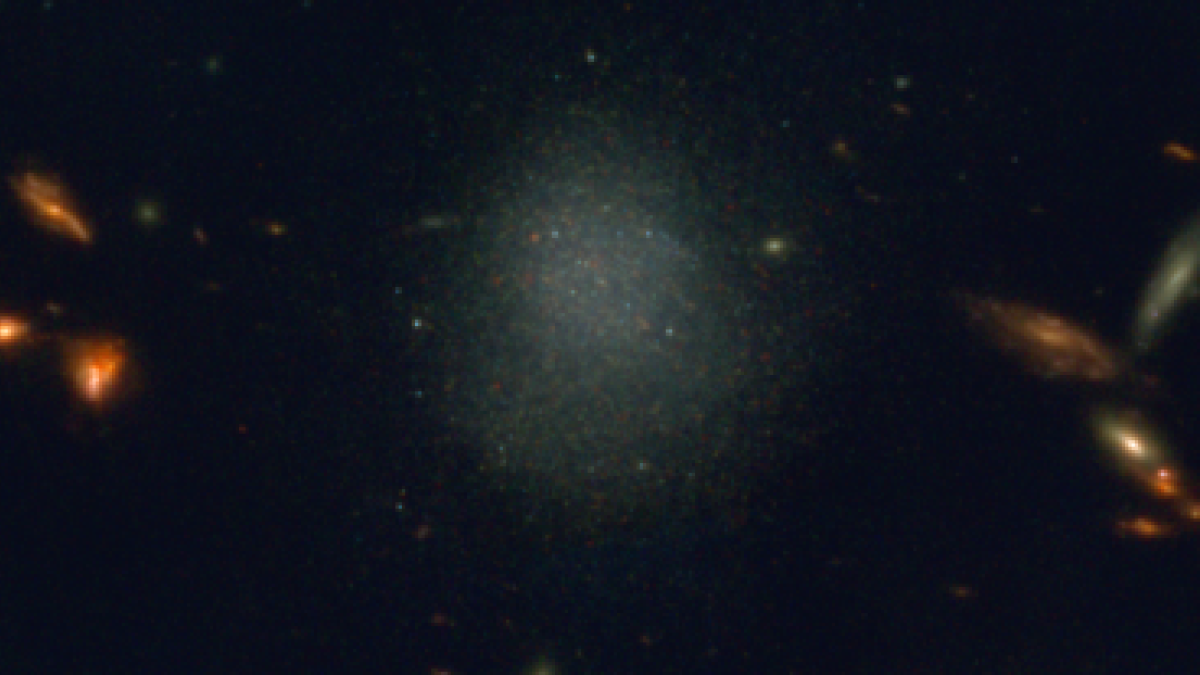
A color-composite image of PEARLSDG made with JWST NIRCAM data. Individual stars are visible as small points of light in the image. Its somewhat dull color and lack of many bright stars is consistent with its old age and lack of ongoing star formation. Image Credit: NASA, ESA, CSA, Jake Summers (ASU), Jordan C. J. D’Silva (UWA), Anton M. Koekemoer (STScI), Aaron Robotham (UWA) and Rogier Windhorst (ASU)
A team of astronomers, led by Arizona State University Assistant Research Scientist Tim Carleton, has discovered a dwarf galaxy that appeared in James Webb Space Telescope imaging that wasn’t the primary observation target.
Galaxies are bound together by gravity and made up of stars and planets, with vast clouds of dust and gas as well as dark matter...
The concept of a space elevator has been championed by some industry experts as a way to overcome the astronomical costs associated with sending people and cargo into space by rocket. 3D Illustration by Getty Images
Humanity’s quest to explore—and, perhaps eventually, colonize—outer space has prompted a great many ideas about how precisely to go about it.
While conventional wisdom suggests that space launch via rockets is the best way to send human beings into orbit, other “non-rocket” methods have been proposed, including a futuristic “space elevator.”
The concept of a space elevator—essentially a sky-high cable that would let humans climb into space—has been championed by some industry experts as a way to overcome the astronomical costs associated with sending people and ca...
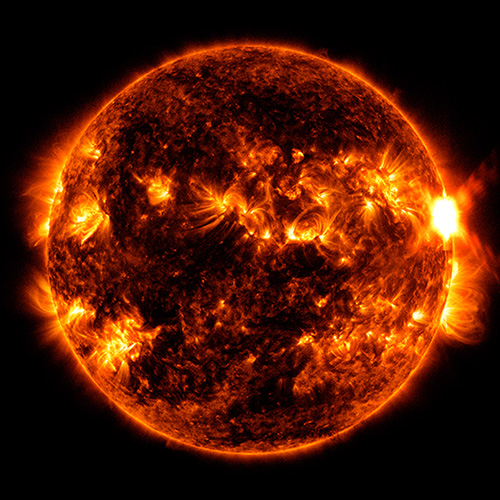
This image, taken on Aug. 5, 2023, shows a blend of extreme ultraviolet light that highlights the intensely hot material in flares and which is colorized in red and orange. (cr: NASA/GSFC/SDO)
Although solar flares have been classified based on the amount of energy they emit at their peak, there has not been significant study into differentiating flares since slow-building flares were first discovered in the 1980s. Scientists have now shown that there is a significant amount of slower-type flares worthy of further investigation.
Solar flares occur when magnetic energy builds up in the Sun’s atmosphere and is released as electromagnetic radiation. Lasting anywhere from a few minutes to a few hours, flares usually reach temperatures around 10 million degrees Kelvin...
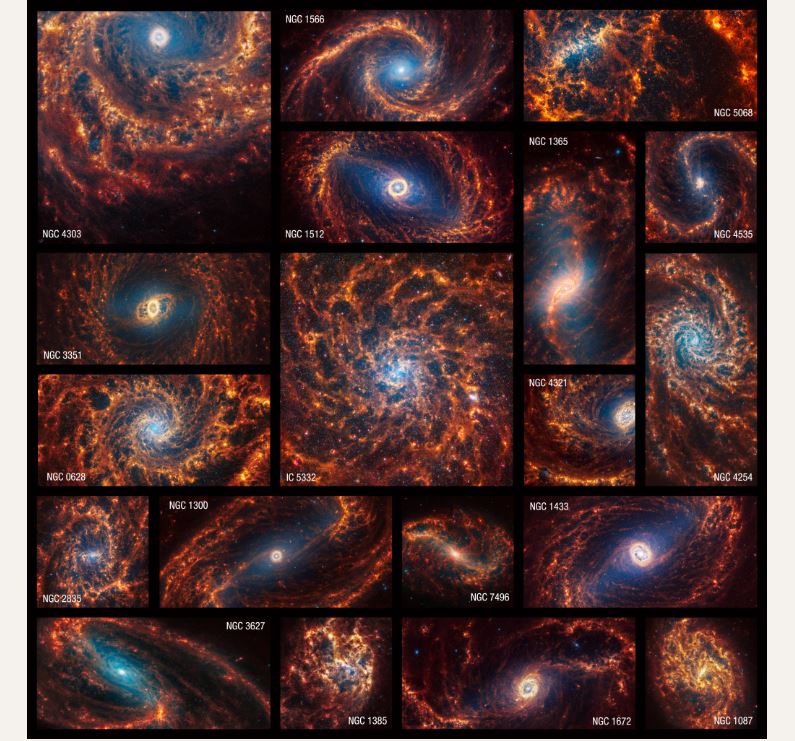
The James Webb Space Telescope observed 19 nearby face-on spiral galaxies in near- and mid-infrared light as part of its contributions to the Physics at High Angular resolution in Nearby GalaxieS (PHANGS) program.
It’s oh-so-easy to be absolutely mesmerized by these spiral galaxies. Follow their clearly defined arms, which are brimming with stars, to their centers, where there may be old star clusters and – sometimes – active supermassive black holes. Only NASA’s James Webb Space Telescope can deliver highly detailed scenes of nearby galaxies in a combination of near- and mid-infrared light — and a set of these images was publicly released today.
These Webb images are part of a large, long-standing project, the Physics at High Angular resolution in Nearby GalaxieS (PHANGS) progr...






Recent Comments