Category Astronomy/Space

Exoplanet may reveal Secrets about the Edge of Habitability

Carl Sagan Institute/R. Payne
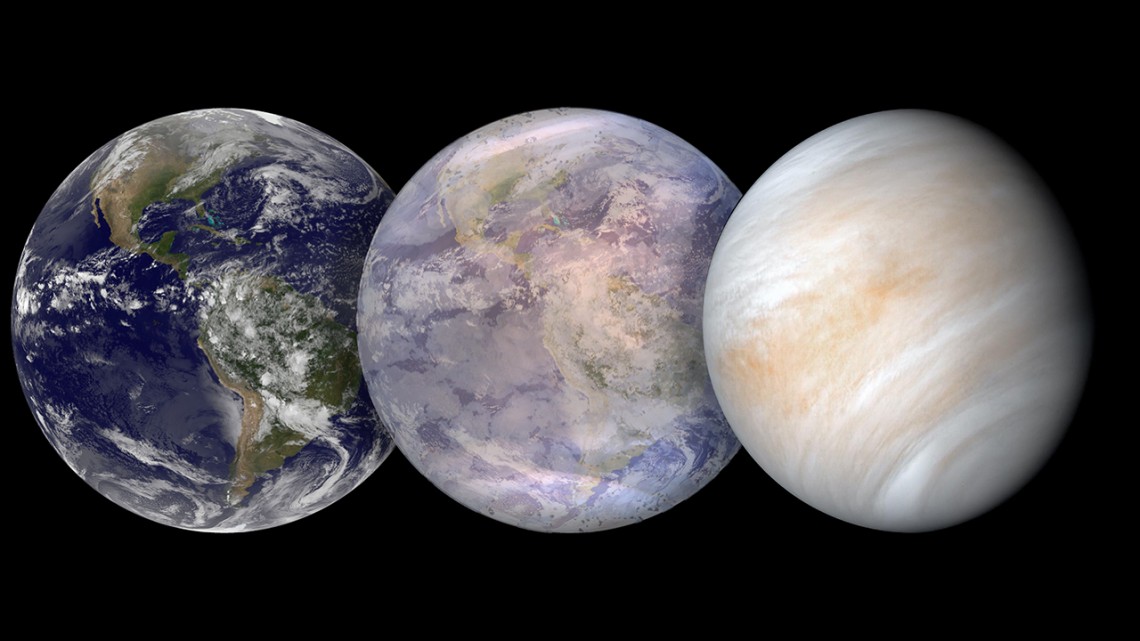
Artist impression showing the exoplanet LP 890-9c’s potential evolution from a hot Earth to a desiccated Venus.

How close can a rocky planet be to a star, and still sustain water and life? A recently discovered exoplanet may be key to solving that Edge of Habitabilitymystery.

“Super-Earth” LP 890-9c (also named SPECULOOS-2c) is providing important insights about conditions at the inner edge of a star’s habitable zone and why Earth and Venus developed so differently, according to new research led by Lisa Kaltenegger, associate professor of astronomy at Cornell University.

Her team found LP 890-9c, which orbits close to the inner edge of its solar system’s habitable zone, would look vastly different depending on whether it still had warm oceans, a ste...

Read More
Discovery of a Brown Dwarf Hotter than the Sun

Discovery of a space object hotter than the sun
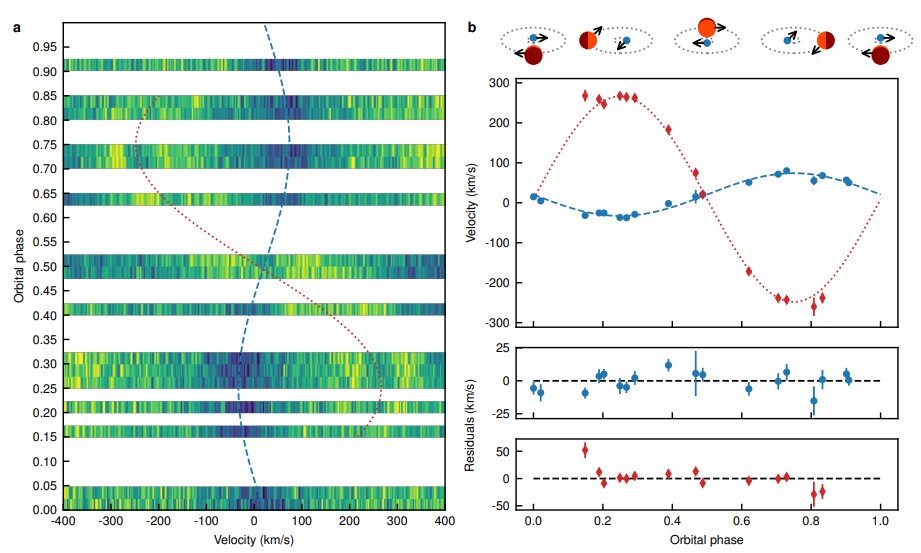
Phased radial-velocity curves of WD 0032−317. a, trailed UVES spectrum for the H𝛼 line of WD 0032−317 (blue represents lower fluxes, and yellow represents higher fluxes), folded over the orbital period (𝑃 = 8340.9090 s). The primary absorption is clearly seen in blue. The emission from the companion (in yellow) appears in anti-phase with the primary, and is visible only from the irradiated day side, between orbital phases ∼ 0.2–0.8. Its “inverted” shape, evident especially near quadrature, is the result of non-local thermodynamic equilibrium (NLTE) effects [40]. b, radial velocity curves (top panel) of the white dwarf (blue circles) and the irradiated companion (red diamonds), folded over the orbital period (𝑃 = 8340.9090 s)...
Read More

Evidence of the Amino Acid Tryptophan found in Space

Evidence of the amino acid tryptophan found in space
Credit: Jorge Rebolo-Iglesias. Background image: NASA/Spitzer Space Telescope (CC BY 4.0)

Using data from the Spitzer space observatory, Dr. Susana Iglesias-Groth, a researcher from The Instituto de Astrofísica de Canarias (IAC), has found evidence for the existence of the amino acid tryptophan in the interstellar material in a nearby star-forming region. The research is published in Monthly Notices of the Royal Astronomical Society.

High amounts of tryptophan were detected in the Perseus molecular complex, specifically in the IC348 star system, a star-forming region that lies 1,000 light years away from Earth—relatively close in astronomical terms. The region is generally invisible to the naked eye, but shines brightly when viewed in infrared wavelengths.

Tryptophan is one of...

Read More

Weigh a Quasar’s Galaxy with Precision

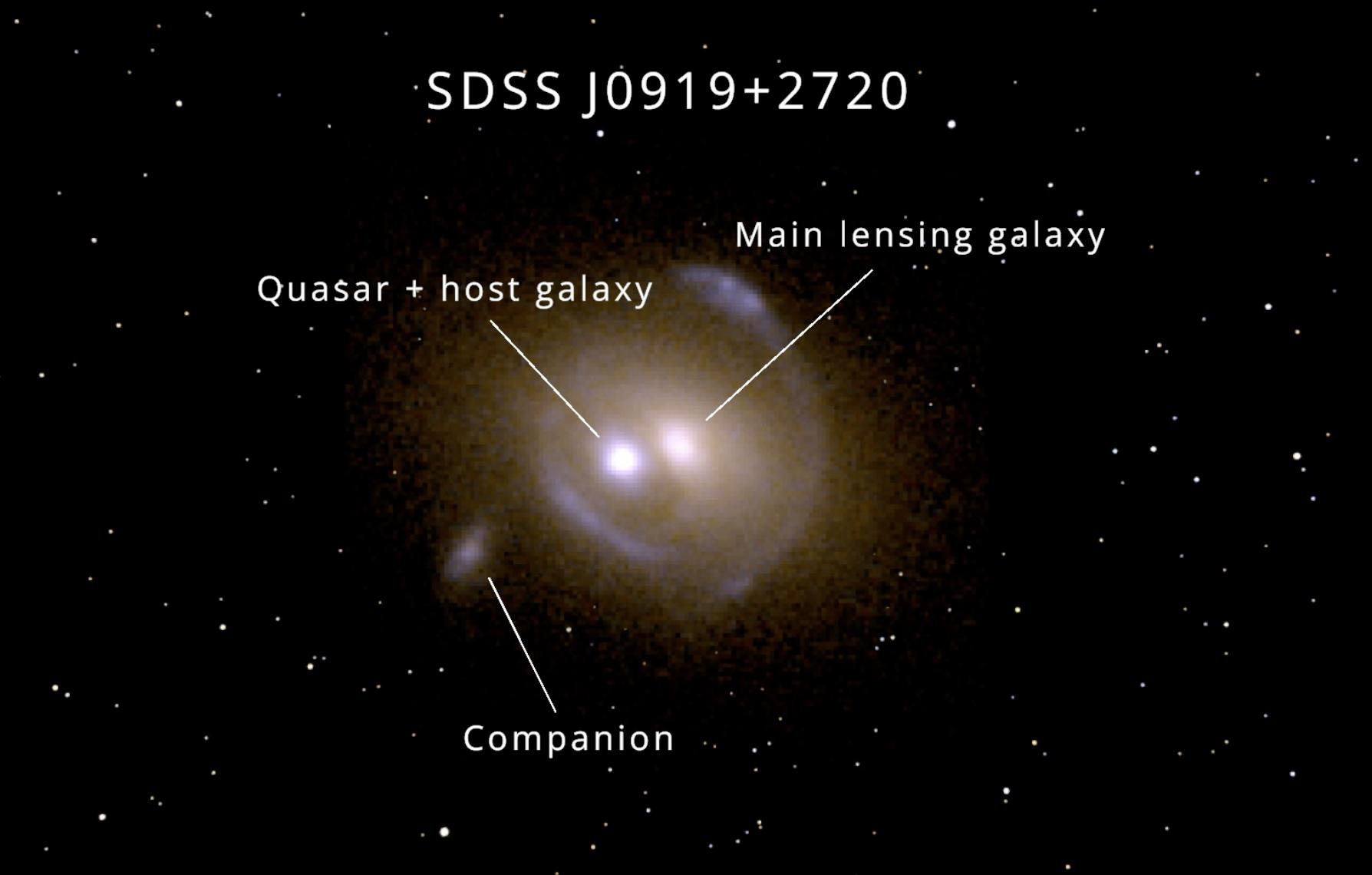
EPFL / Austin Peel, CC-BY-SA.

A team of researchers from EPFL have found a way to use the phenomenon of strong gravitational lensing to determine with precision – about 3 times more precise than any other technique – the mass of a galaxy containing a quasar, as well as their evolution in cosmic time. Knowing the mass of quasar host galaxies provides insight into the evolution of galaxies in the early universe, for building scenarios of galaxy formation and black hole development. The results are published in Nature Astronomy.

“The unprecedented precision and accuracy achieved with gravitational lensing provide a new avenue for obtaining robust mass estimates in the distant Universe, where conventional techniques lack precision and are susceptible to biases,” says EPFL astrophysicist...

Read More