Phenomena called ‘Steve’ and ‘picket fence’ are masquerading as auroras, graduate student argues
The purple and white emissions at the top are referred to as “Steve,” while the green emissions are called “picket fence.” The rare phenomena, which are distinct from the typical aurora, often occur together and may be caused by similar conditions at the edge of space. The photo was taken looking south over Berg Lake toward Mt. Robson in the Canadian Rockies, British Columbia, Canada. Courtesy of Robert Downie, robertdowniephotography.com
While auroras occur at high latitude, the associated phenomena Steve and the picket fence occur farther south and at lower altitude. Their emissions also differ from aurora...
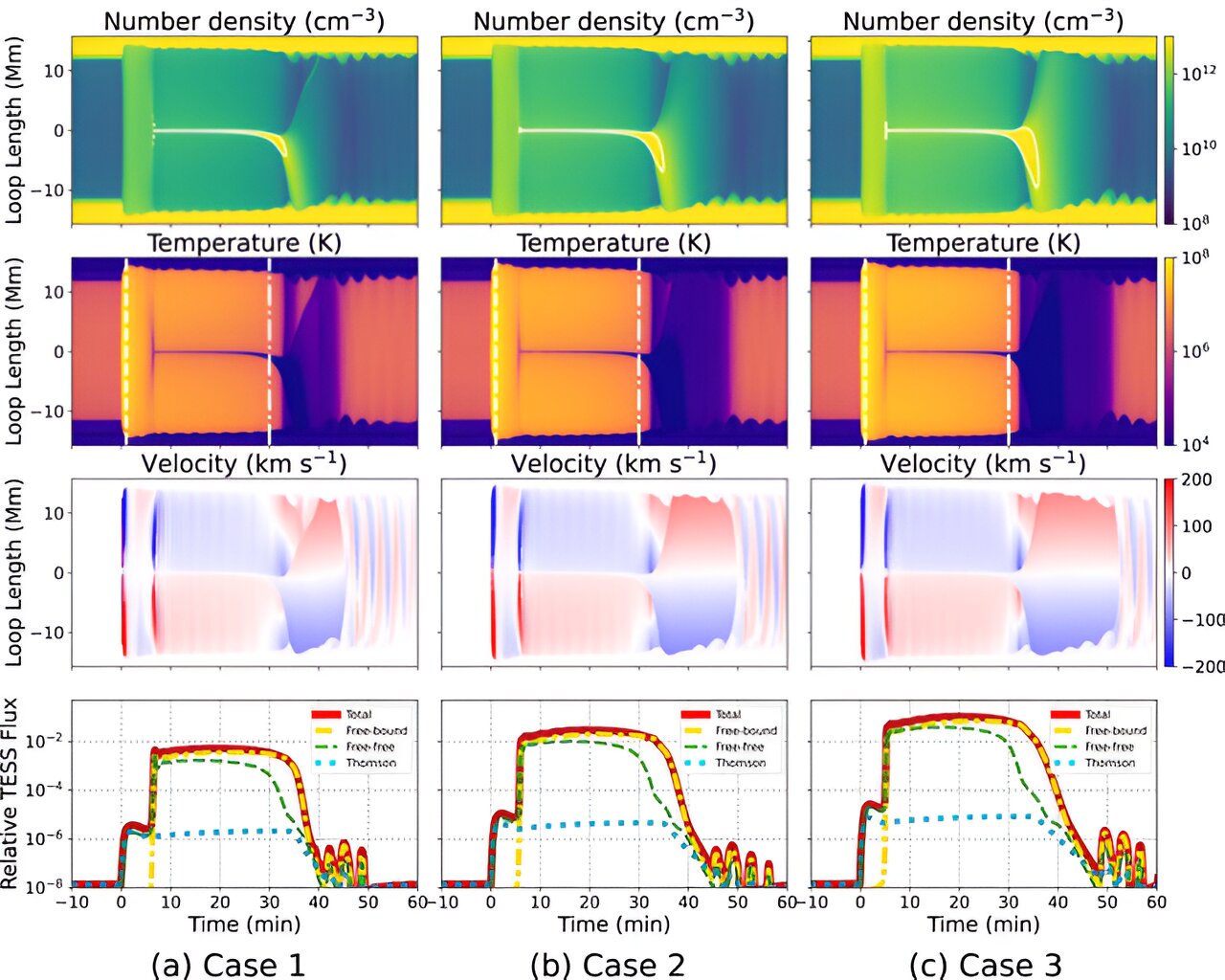
Modeled flare atmosphere and synthesized TESS light curves. Credit: The Astrophysical Journal (2023). DOI: 10.3847/1538-4357/ad077d
Our sun actively produces solar flares that can impact Earth, with the strongest flares having the capacity to cause blackouts and disrupt communications—potentially on a global scale. While solar flares can be powerful, they are insignificant compared to the thousands of “super flares” observed by NASA’s Kepler and TESS missions. “Super flares” are produced by stars that are 100–10,000 times brighter than those on the sun.
The physics are thought to be the same between solar flares and super flares: a sudden release of magnetic energy...
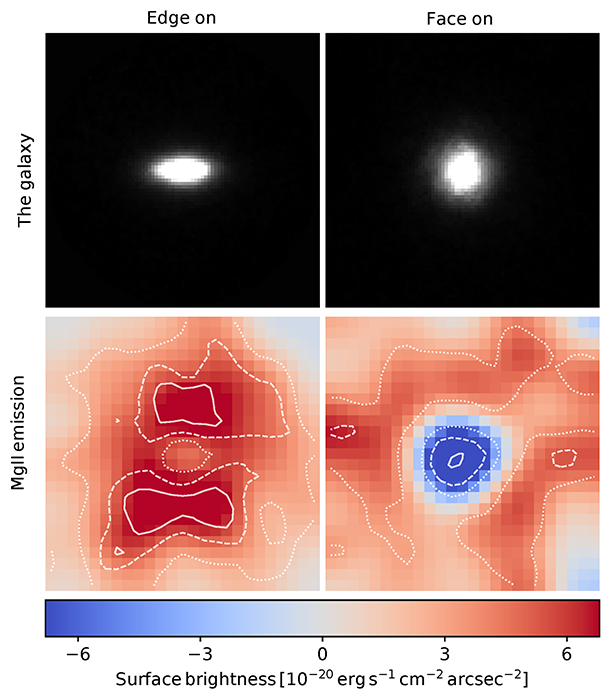
Galactic winds enable the exchange of matter between galaxies and their surroundings. In this way, they limit the growth of galaxies, that is, their star formation rate...
TESS TPF of Sector 17 for TOI-4515. Credit: arXiv (2023). DOI: 10.48550/arxiv.2311.11903
An international team of astronomers has discovered a new warm Jupiter exoplanet orbiting a distant G-type star. The newfound alien world, designated TOI-4515 b, is similar in size to Jupiter but about two times more massive than it. The finding was detailed in a paper published Nov. 20 on the pre-print server arXiv.
TESS is currently performing a survey of approximately 200,000 of the brightest nearby stars with the main goal of searching for transiting exoplanets. So far, it has identified nearly 7,000 candidate exoplanets (TESS Objects of Interest, or TOI), of which 402 have been confirmed.
Warm Jupiters are gas giant planets with orbital periods between 10 and 200 days...






Recent Comments