Category Astronomy/Space

An X-ray look at the Heart of Powerful Quasars

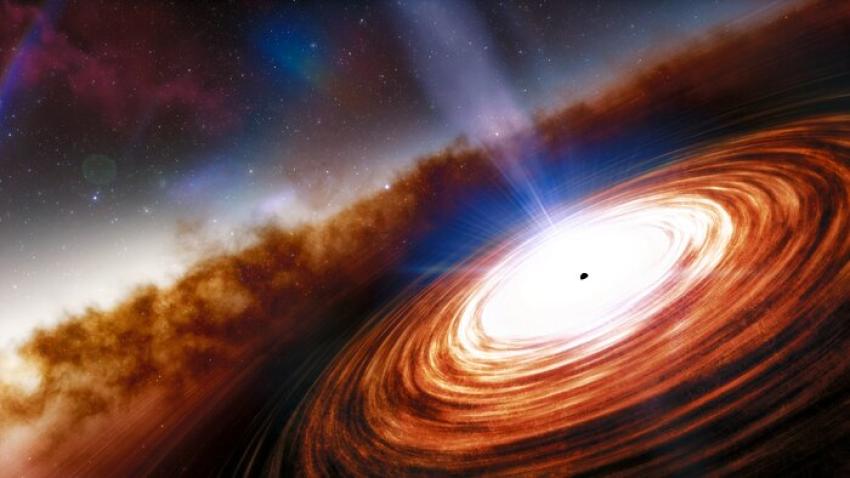
This artist's impression of a quasar shows a bright orange and white disc of material centred around a small black circle. A jet of light emanates from this circle, white and blue in colour.
Artist’s impression of a quasar
Credit
NOIRLab/NSF/AURA/J. da Silva
Licence type
Attribution (CC BY 4.0)

Researchers have observed the X-ray emission of the most luminous quasar seen in the last 9 billion years of cosmic history, known as SMSS J114447.77-430859.3, or J1144 for short. The new perspective sheds light on the inner workings of quasars and how they interact with their environment. The research is published in Monthly Notices of the Royal Astronomical Society.

Hosted by a galaxy 9.6 billion light years away from the Earth, between the constellations of Centaurus and Hydra, J1144 is extremely powerful, shining 100,000 billion times brighter than the Sun...

Read More

Curved Spacetime in a Quantum Simulator

[Translate to English:] Montage aus Astronomie-Foto von Gravitationslinseneffekt und Teilchen

The theory of relativity works well when you want to explain cosmic-scale phenomena—such as the gravitational waves created when black holes collide. Quantum theory works well when describing particle-scale phenomena—such as the behavior of individual electrons in an atom. But combining the two in a completely satisfactory way has yet to be achieved. The search for a “quantum theory of gravity” is considered one of the significant unsolved tasks of science.

This is partly because the mathematics in this field is highly complicated...

Read More

Astronomers find a ‘Red Nova’: A Main-Sequence star just Eating its Planet

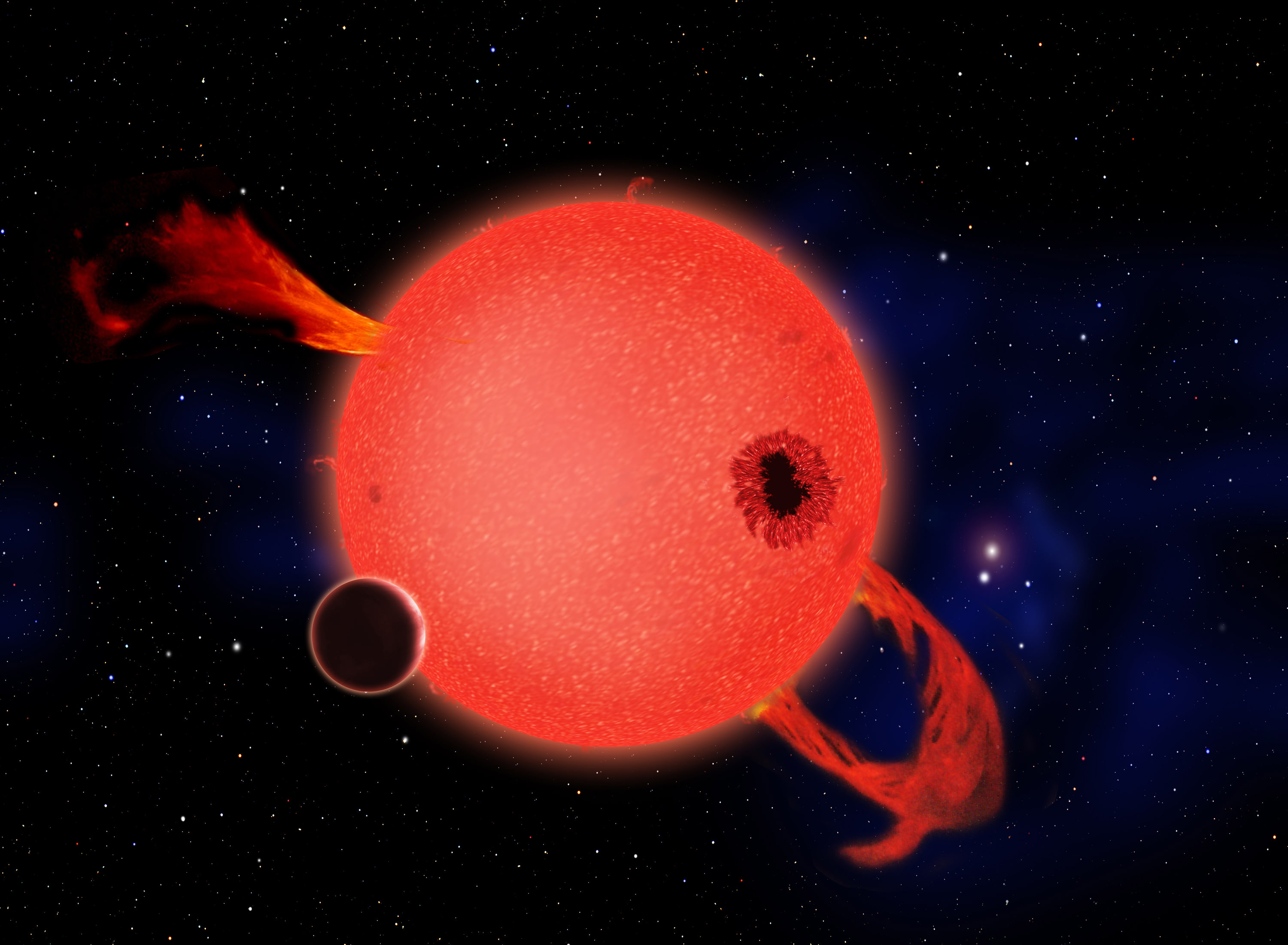
Artist’s impression of a Jupiter-sized exoplanet orbiting an M-dwarf star

Back in 2020 astronomers observed a red nova, which while enormously powerful, is on the low side of energetic events in the universe. Now an astronomer has studied the event in close detail and has come to the conclusion that we have just witnessed a star destroying its own planet.

The technical jargon term for these red nova events are “intermediate luminosity optical transits,” or ILOTs. These are extremely rare events to observe, because they only produce a moderate amount of energy. That makes it hard for us to capture them in observations. But despite the rarity of the events, astronomers suspect that they occur very frequently throughout the universe.

For years astronomers have wondered if these red ...

Read More

Researchers determine Global Thickness and Density of Martian Crust

Researchers de­term­ine global thick­ness and dens­ity of Martian crust
Topographic map of the Martian surface (l.) and representation of the crust thickness (r.). Credit: MOLA Science Team / Doyeon Kim, ETH Zurich

A strong quake in the last year of the NASA Mars InSight mission, enabled researchers at ETH Zurich to determine the global thickness and density of the planet’s crust. On average, the Martian crust much thicker than the Earth’s or the moon’s crust, and the planet’s main source of heat is radioactive.

After more than three years of daily monitoring and with the power levels decreasing on InSight’s seismometer, researchers were rewarded with data from a sizeable Marsquake in May 2022. The surface waves observed from this estimated 4...

Read More