Category Astronomy/Space

New Image Reveals Secrets of Planet Birth

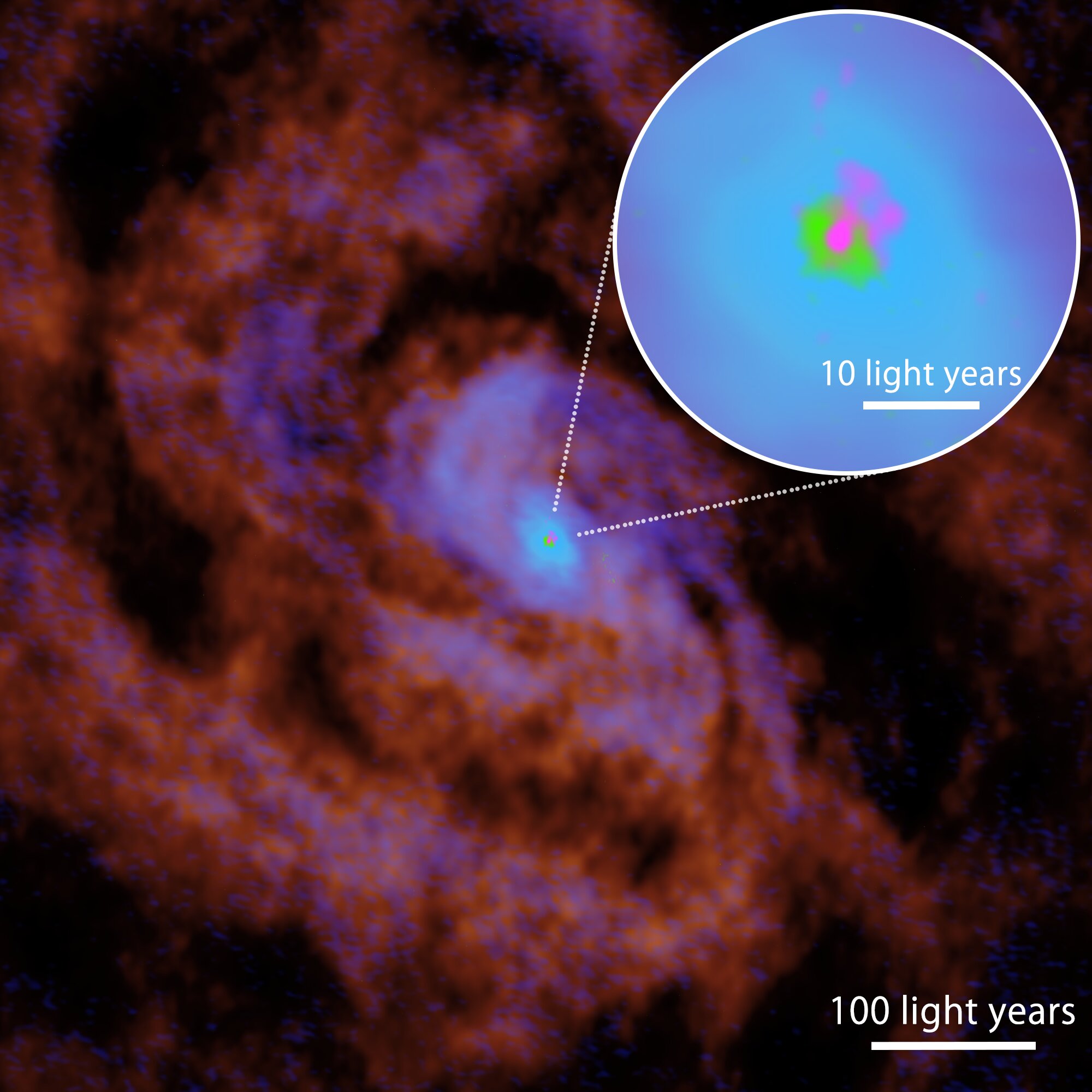
The background of this image is dark, but in its centre lurks a swirling ghostly figure, which extends towards the edge of the picture. At the very centre there is a small bright region and erupting out of it there is a poorly defined, fuzzy edged cloud and blobs of material in yellow and blue, respectively. The yellow cloud extends far out in the image, making an elongated spiral shape that gets dimmer and less defined as it reaches the top and bottom of the frame. Meanwhile, the blue blobs only extend downwards from the centre and to a fraction of the distance of the yellow spiral cloud. The blobs twist away from the central bright region, forming a tight U-shape lying on its right side.
A spectacular new image released today by the European Southern Observatory gives us clues about how planets as massive as Jupiter could form. Using ESO’s Very Large Telescope (VLT) and the Atacama Large Millimeter/submillimeter Array (ALMA), researchers have detected large dusty clumps, close to a young star, that could collapse to create giant planets.

Astronomers have gained new clues about how planets as massive as Jupiter could form. Researchers have detected large dusty clumps, close to a young star, that could collapse to create giant planets.

A spectacular new image released today by the European Southern Observatory gives us clues about how planets as massive as Jupiter could form...

Read More

Webb Detects Water Vapor in Rocky Planet-Forming One

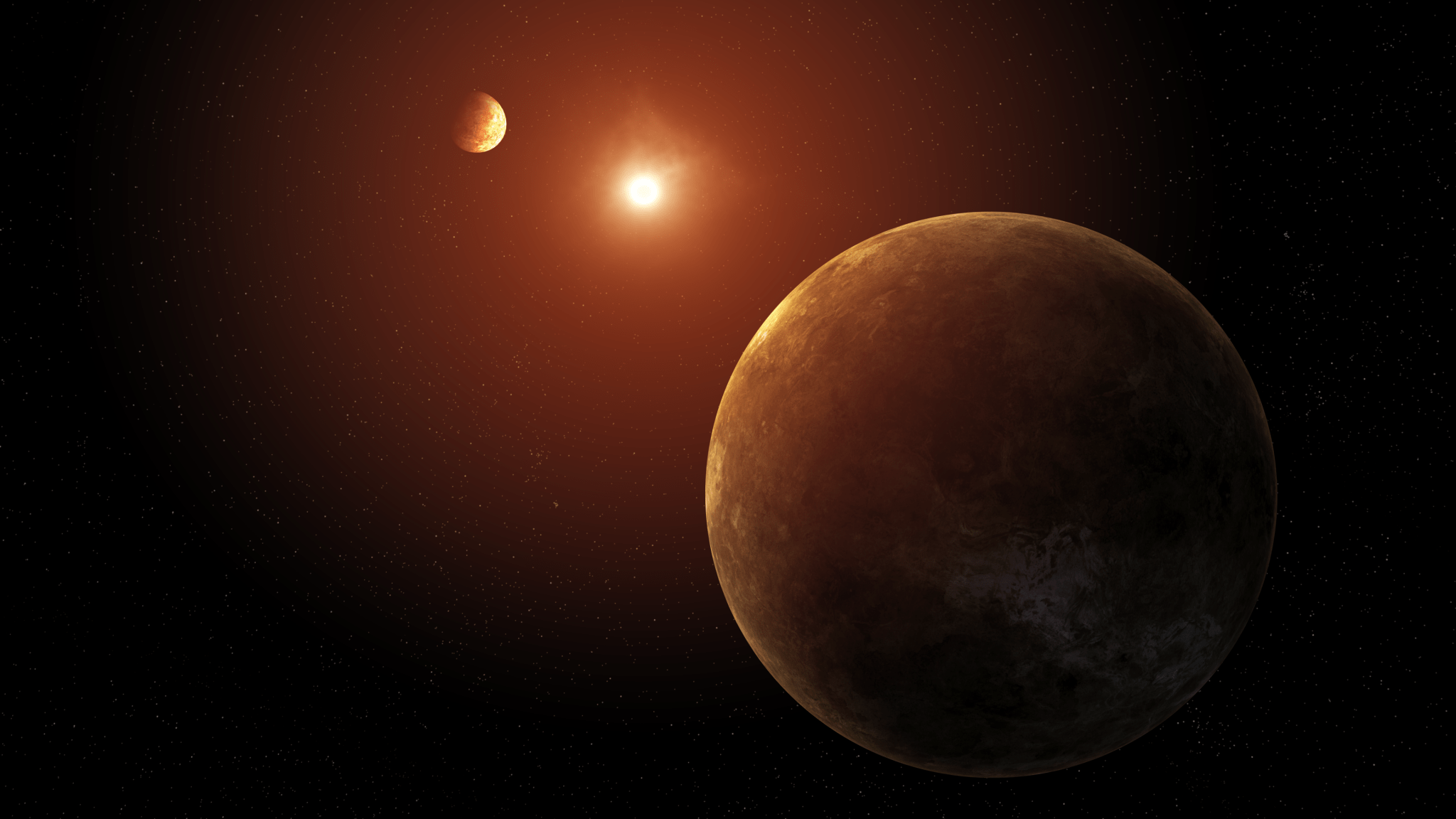
This artist’s concept portrays the star PDS 70 and its inner protoplanetary disk. New measurements by NASA’s James Webb Space Telescope have detected water vapor at distances of less than 100 million miles from the star – the region where rocky, terrestrial planets may be forming. This is the first detection of water in the terrestrial region of a disk already known to host two or more protoplanets, one of which is shown at upper right.
Credits: NASA, ESA, CSA, J. Olmsted (STScI)

Water is essential for life as we know it. However, scientists debate how it reached the Earth and whether the same processes could seed rocky exoplanets orbiting distant stars. New insights may come from the planetary system PDS 70, located 370 light-years away...

Read More

Hydrogen Peroxide found on Jupiter’s Moon Ganymede in Higher Latitudes

Hydrogen peroxide found on Jupiter's moon Ganymede only in higher latitudes
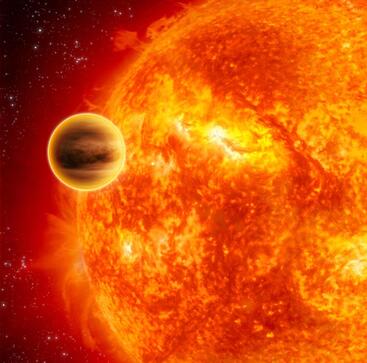
Maps of Ganymede’s 3.5 μm H2O2 absorption compared to those of the 3.1 μm Fresnel peaks of water ice and corresponding projections of the U.S. Geological Survey VoyagerGalileo imaging mosaic. H2O2 appears constrained to the upper latitudes, particularly on the leading hemisphere, which exhibits sharp boundaries at approximately ±30° to 35° latitude. These boundaries are roughly coincident with the onset of Ganymede’s polar frost caps and with the latitudes at which most of the impinging Jovian magnetospheric particles can access the surface. Maps of the Fresnel reflection peak of water ice, which generally track the distribution of ice deduced from shorter-wavelength water bands, also show the areas of greatest H2O2 on the leading hemisphere to be enriched in water ice...
Read More

To Stick or to Bounce: Size determines the Stickiness of Cosmic Dust Aggregates

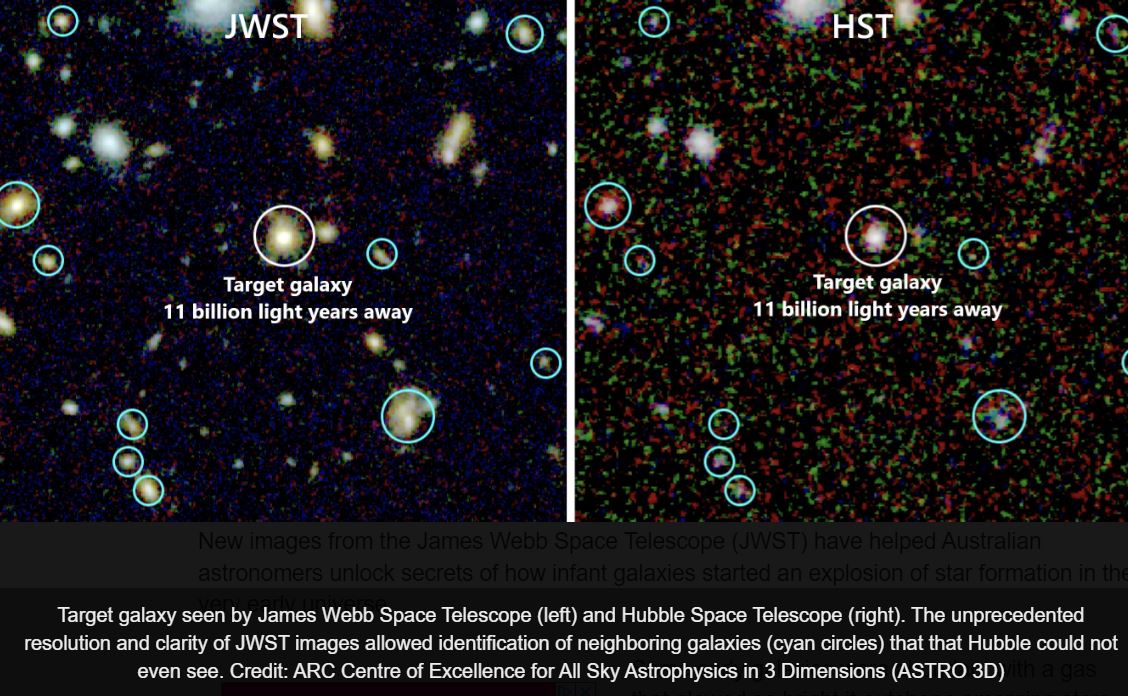
Micrometer-scale dust particles from protoplanetary disks, or sites around stars with particles and hydrogen and/or other gasses, aggregate to form planetesimals, or kilometer-scale building blocks of planets. Planetesimals, in turn, merge due to mutual gravity. ©JAMSTEC

Microparticle dust aggregates, which are thought to play a role in the formation of new planets, are less likely to stick together after a collision when the aggregates are larger.

Current evidence suggests that microparticles of cosmic dust collide and stick together to form larger dust aggregates that may eventually combine and develop into planets...

Read More