Category Astronomy/Space

A Stormy, Active Sun may have Kickstarted Life on Earth

An animation of the sun shows a bright spot, from which erupts a cloud of solar material and burst of bright particles.
A close up of a solar eruption, including a solar flare, a coronal mass ejection, and a solar energetic particle event.
Credits: NASA’s Goddard Space Flight Center

The first building blocks of life on Earth may have formed thanks to eruptions from our sun, a new study finds.

A series of chemical experiments show how solar particles, colliding with gases in Earth’s early atmosphere, can form amino acids and carboxylic acids, the basic building blocks of proteins and organic life. The findings were published in the journal Life.

To understand the origins of life, many scientists try to explain how amino acids, the raw materials from which proteins and all cellular life, were formed...

Read More
Webb finds Water Vapor, but is it from a Rocky Planet or its Star?

Graph showing the transmission spectrum of exoplanet GJ486b. The X-axis shows amount of light blocked, and the Y-axis shows wavelength of light. An orange wave begins at the upper left and a blue at the lower left. White dots show Webb data.
This graphic shows the transmission spectrum obtained by Webb observations of rocky exoplanet GJ 486 b. The science team’s analysis shows hints of water vapor; however, computer models show that the signal could be from a water-rich planetary atmosphere (indicated by the blue line) or from starspots from the red dwarf host star (indicated by the yellow line). The two models diverge noticeably at shorter infrared wavelengths, indicating that additional observations with other Webb instruments will be needed to constrain the source of the water signal.
Credits: NASA, ESA, CSA, Joseph Olmsted (STScI)

GJ486b is about 30% larger than the Earth and three times as massive, which means it is a rocky world with stronger gravity than Earth. It orbits a red dwarf star in just under 1...

Read More

Superflare with Massive, High-Velocity Prominence Eruption

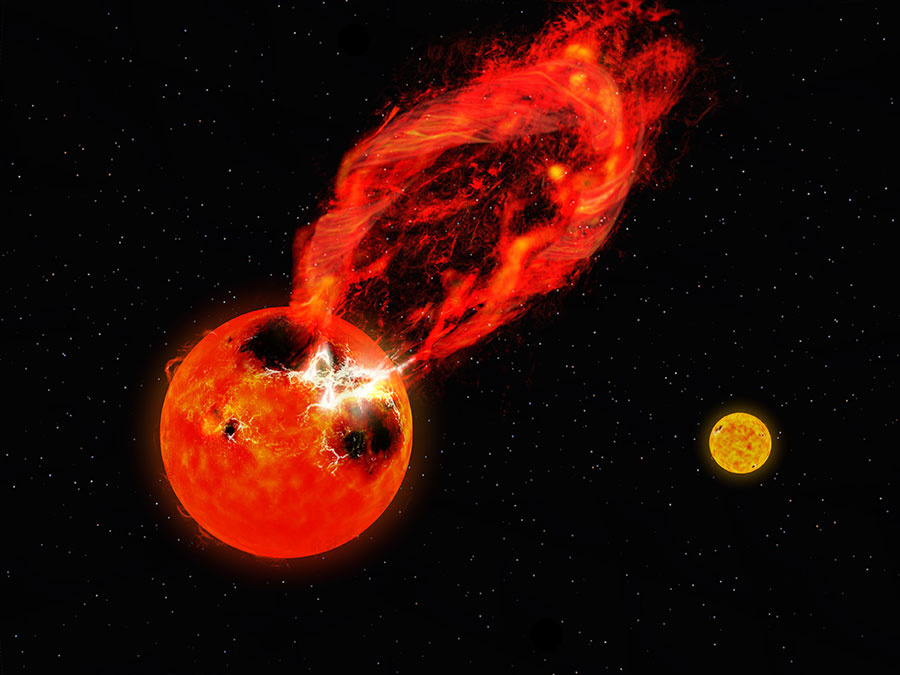
Artist’s impression of the superflare observed on one of the stars in the V1355 Orionis binary star system. The binary companion star is visible in the background on the right. (Credit: NAOJ) 

A team of Japanese astronomers used simultaneous ground-based and space-based observations to capture a more complete picture of a superflare on a star. The observed flare started with a very massive, high-velocity prominence eruption. These results give us a better idea of how superflares and stellar prominence eruptions occur.

Some stars have been seen releasing superflares over 10 times larger than the largest solar flare ever seen on the Sun. The hot ionized gas released by solar flares can influence the environment around the Earth, referred to as space weather...

Read More

Medium-sized Black Holes Eat Stars like Messy Toddlers

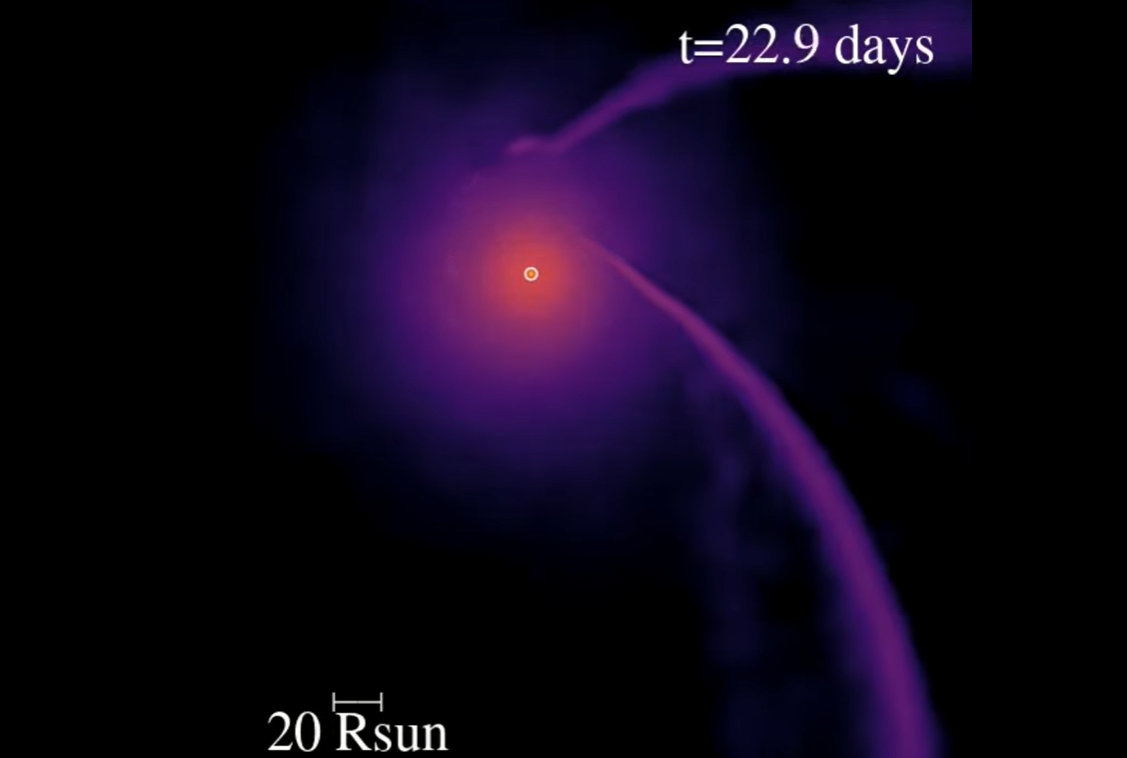
Wayward star meets black hole

Elusive intermediate-mass black holes take a few bites, then eject the leftovers

In new 3D computer simulations, astrophysicists modeled black holes of varying masses and then hurled stars (about the size of our sun) past them to see what might happen. If they exist, intermediate-mass black holes likely devour wayward stars like a messy toddler — taking a few bites and then flinging the remains across the galaxy.

When a star approaches an intermediate-mass black hole, it initially gets caught in the black hole’s orbit, the researchers discovered. After that, the black hole begins its lengthy and violent meal. Every time the star makes a lap, the black hole takes a bite — further cannibalizing the star with each passage...

Read More