Category Astronomy/Space

Evidence of the Amino Acid Tryptophan found in Space

Evidence of the amino acid tryptophan found in space
Credit: Jorge Rebolo-Iglesias. Background image: NASA/Spitzer Space Telescope (CC BY 4.0)

Using data from the Spitzer space observatory, Dr. Susana Iglesias-Groth, a researcher from The Instituto de Astrofísica de Canarias (IAC), has found evidence for the existence of the amino acid tryptophan in the interstellar material in a nearby star-forming region. The research is published in Monthly Notices of the Royal Astronomical Society.

High amounts of tryptophan were detected in the Perseus molecular complex, specifically in the IC348 star system, a star-forming region that lies 1,000 light years away from Earth—relatively close in astronomical terms. The region is generally invisible to the naked eye, but shines brightly when viewed in infrared wavelengths.

Tryptophan is one of...

Read More

Weigh a Quasar’s Galaxy with Precision

EPFL / Austin Peel, CC-BY-SA.

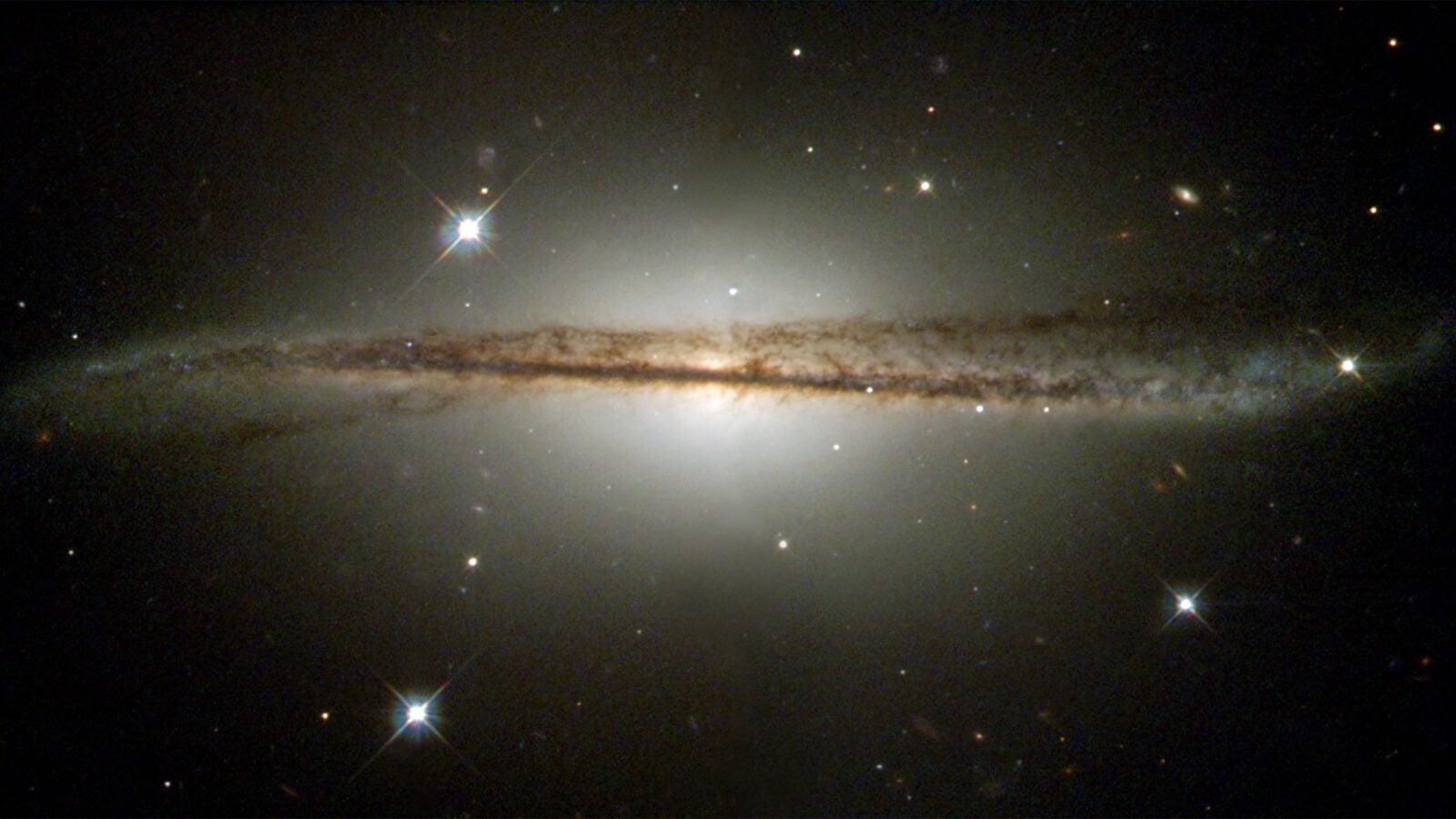
A team of researchers from EPFL have found a way to use the phenomenon of strong gravitational lensing to determine with precision – about 3 times more precise than any other technique – the mass of a galaxy containing a quasar, as well as their evolution in cosmic time. Knowing the mass of quasar host galaxies provides insight into the evolution of galaxies in the early universe, for building scenarios of galaxy formation and black hole development. The results are published in Nature Astronomy.

“The unprecedented precision and accuracy achieved with gravitational lensing provide a new avenue for obtaining robust mass estimates in the distant Universe, where conventional techniques lack precision and are susceptible to biases,” says EPFL astrophysicist...

Read More

Jupiter’s Moon Europa may have had a Slow Evolution

Amid the Jovian system, Europa is of particular interest to scientists because of the strong evidence for nutrients, water and energy to potentially provide a habitable environment for some form of life beyond Earth. In addition, Europa is believed to be made up into four layers (from surface to center): an ice shell, salt water ocean, rocky mantle, and metallic core.Read More

Plate Tectonics Not Required for the Emergence of Life

Plate tectonics involves the horizontal movement and interaction of large plates on Earth’s surface. New research indicates that mobile plate tectonics—thought to be necessary for the creation of a habitable planet—was not occurring on Earth 3.9 billion years ago. (University of Rochester illustration / Michael Osadciw)

The finding contradicts previous assumptions about the role of mobile plate tectonics in the development of life on Earth. New finding contradicts previous assumptions about the role of mobile plate tectonics in the development of life on Earth. Moreover, the data suggests that ‘when we’re looking for exoplanets that harbor life, the planets do not necessarily need to have plate tectonics,’ says the lead author of a new paper.

Scientists have taken a journey ba...

Read More