Category Astronomy/Space

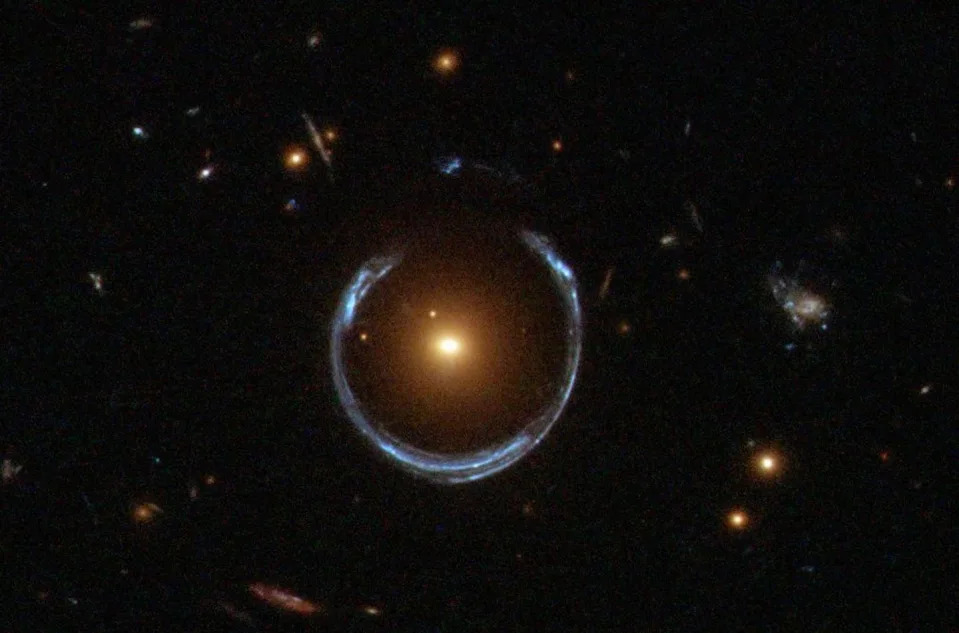
New look at ‘Einstein Rings’ around distant Glaxies just got us Closer to Solving the Dark Matter Debate

ESA / Hubble & NASA
ESA / Hubble & NASA

A study using data from telescopes on Earth and in the sky resolves a problem plaguing astronomers working in the infrared and could help make better observations of the composition of the universe with the James Webb Space Telescope and other instruments. The work is published April 20 in Nature Astronomy.

“We’re trying to measure the composition of gases inside galaxies,” said Yuguang Chen, a postdoctoral researcher working with Professor Tucker Jones in the Department of Physics and Astronomy at the University of California, Davis.

Most elements other than hydrogen, helium and lithium are produced inside stars, so the composition and distribution of heavier elements — especially the ratio of oxygen to hydrogen — can help astronomers understand how many and ...

Read More
Metal-poor Stars are more Life-friendly

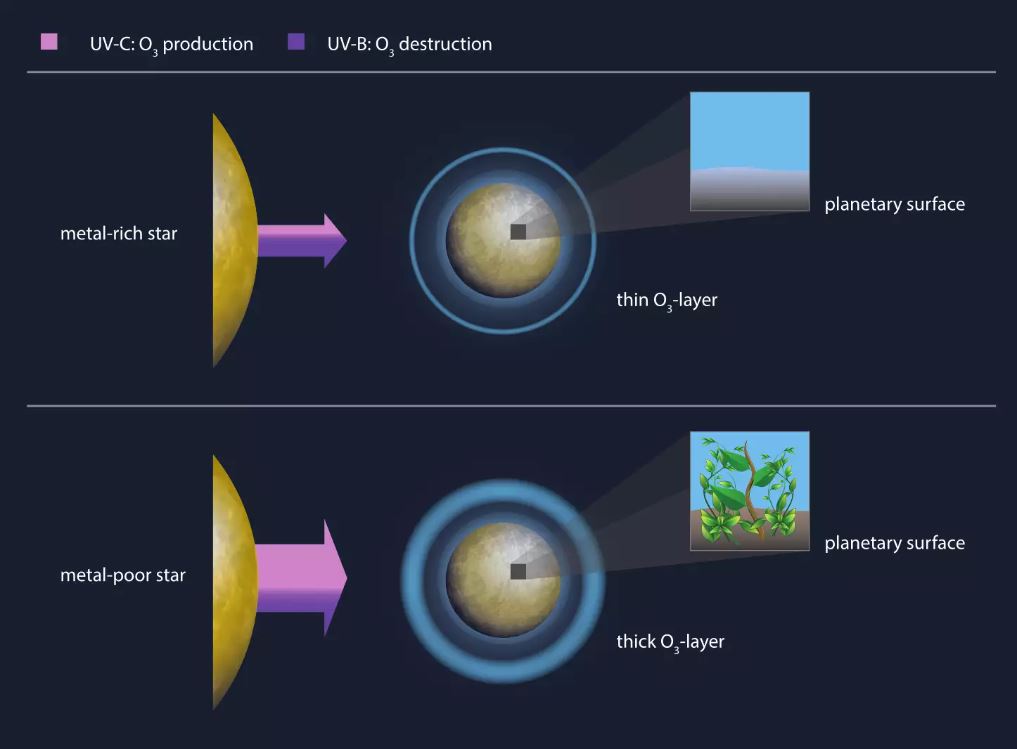
A star’s chemical composition strongly influences the ultraviolet radiation it emits into space and thus the conditions for the emergence of life in its neighborhood.

Stars that contain comparatively large amounts of heavy elements provide less favourable conditions for the emergence of complex life than metal-poor stars, as scientists from the Max Planck Institutes for Solar System Research and for Chemistry as well as from the University of Göttingen have now found. The team showed how the metallicity of a star is connected to the ability of its planets to surround themselves with a protective ozone layer. Crucial to this is the intensity of the ultraviolet light that the star emits into space, in different wavelength ranges...

Read More

Could this Copycat Black Hole be a New type of Star?

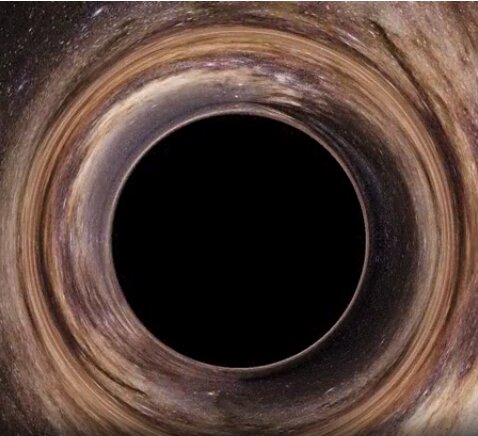
Could this copycat black hole be a new type of star?
Credit: Pierre Heidmann / Johns Hopkins University

It looks like a black hole and bends light like a black hole, but it could actually be a new type of star.

Though the mysterious object is a hypothetical mathematical construction, new simulations by Johns Hopkins researchers suggest there could be other celestial bodies in space hiding from even the best telescopes on Earth. The findings are set to publish in Physical Review D.

“We were very surprised,” said Pierre Heidmann, a Johns Hopkins University physicist who led the study. “The object looks identical to a black hole, but there’s light coming out from its dark spot.”

The detection of gravitational waves in 2015 rocked the world of astrophysics because it confirmed the existence of black holes...

Read More

From Platypus to Parsecs and MilliCrab: Why do Astronomers use such Weird Units?

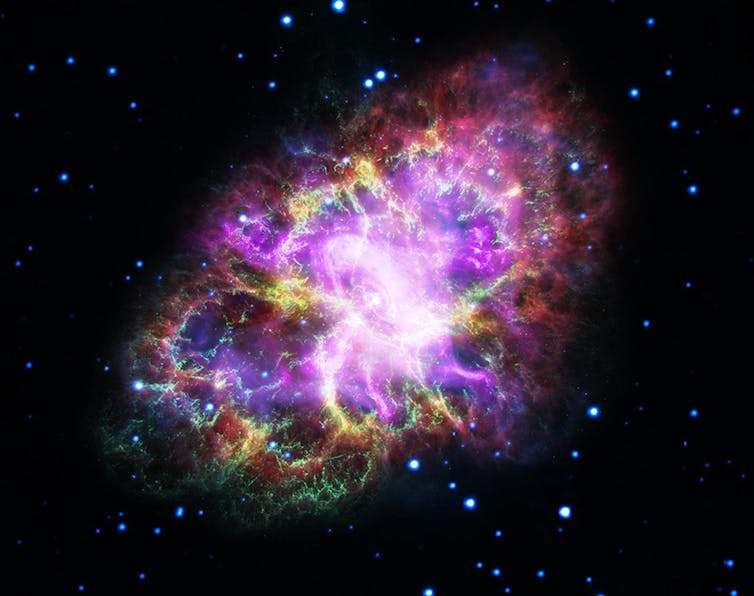
A bright, multi-coloured supernova remnant with dusty, wispy filaments and something resembling a tornado (the pulsar wind nebula) in the centre.
Image of the Crab Nebula where red is radio from the Very Large Array, yellow is infra-red from the Spitzer Space Telescope, green is visible from the Hubble Space Telescope, and blue and purple are X-ray from the XMM-Newton and Chandra X-ray Observatories respectively. NASA, ESA, G. Dubner (IAFE, CONICET-University of Buenos Aires) et al.; A. Loll et al.; T. Temim et al.; F. Seward et al.; VLA/NRAO/AUI/NSF; Chandra/CXC; Spitzer/JPL-Caltech; XMM-Newton/ESA; and Hubble/STScI

You may have heard about an asteroid set to fly near Earth that is the size of 18 platypus, or maybe the one that’s the size of 33 armadillos, or even one the size of 22 tuna fish.

These outlandish comparisons are the invention of Jerusalem Post journalist Aaron Reich (who bills himself as “creator of the giraffe...

Read More