Category Astronomy/Space

New Study Identifies Mechanism driving the Sun’s Fast Wind

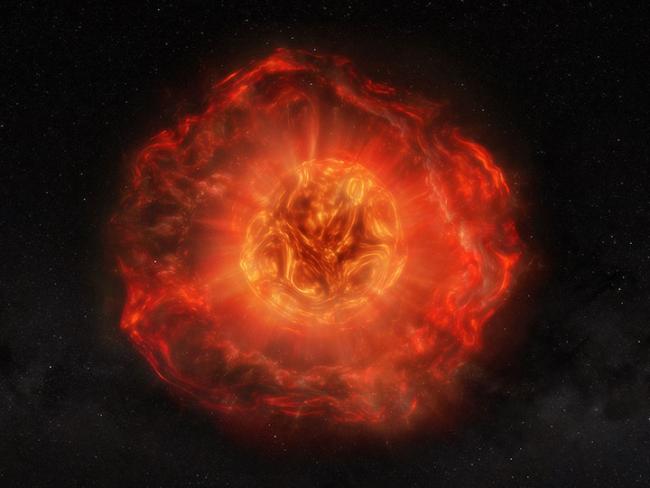
Image credit: Amanda Smith / University of Birmingham

Release of magnetic energy near the sun’s surface enables the solar wind to reach gravity-defying speeds. In a paper published June 7, 2023 in the journal Nature, a team of researchers used data from NASA’s Parker Solar Probe to explain how the solar wind is capable of surpassing speeds of 1 million miles per hour. They discovered that the energy released from the magnetic field near the sun’s surface is powerful enough to drive the fast solar wind, which is made up of ionized particles — called plasma — that flow outward from the sun.

James Drake, a Distinguished University Professor in the University of Maryland’s Department of Physics and Institute for Physical Science and Technology (IPST), co-led this research alongside firs...

Read More

Parker Solar Probe Flies into the Fast Solar Wind and finds its Source

Artist’s concept of the Parker Solar Probe spacecraft approaching the sun. Launched in 2018, the probe is increasing our ability to forecast major space-weather events that impact life on Earth. (Image credit: NASA)

NASA’s Parker Solar Probe (PSP) has flown close enough to the sun to detect the fine structure of the solar wind close to where it is generated at the sun’s surface, revealing details that are lost as the wind exits the corona as a uniform blast of charged particles.

It’s like seeing jets of water emanating from a showerhead through the blast of water hitting you in the face.

In a paper to be published in the journal Nature, a team of scientists led by Stuart D...

Read More

First Detection of Secondary Supermassive Black Hole in a well-known Binary System

Artistic illustration of OJ287 as a binary black hole system.
Artistic illustration of OJ287 as a binary black hole system. The secondary black hole of 150 million solar masses moves around the primary black hole of 18 billion solar masses. A disk of gas surrounds the latter. The secondary black hole is forced to impact on the accretion disk twice during its 12-year orbit. The impact produces a blue flash which was detected in February 2022. In addition, the impact also induces the secondary black hole to bright bursts of radiation several weeks earlier, and these bursts have also been detected as a direct signal from the secondary black hole. Credit: AAS 2018

An international team of astronomers observed the second one of the two supermassive black holes circling each other in an active galaxy OJ 287.

Supermassive black holes that weigh sever...

Read More

Webb Space Telescope Detects Universe’s Most Distant Complex Organic Molecules

Astronomers using the Webb telescope discovered evidence of complex organic molecules in a galaxy more than 12 billion light-years away. The galaxy lines up almost perfectly with a second galaxy only 3 billion light-years away from our perspective on Earth. In this false-color Webb image, the foreground galaxy is shown in blue, while the background galaxy is red. The organic molecules are highlighted in orange.
Graphic courtesy J. Spilker / S. Doyle, NASA, ESA, CSA

Researchers have detected complex organic molecules in a galaxy more than 12 billion light-years away from Earth — the most distant galaxy in which these molecules are now known to exist...

Read More