
Category Astronomy/Space

PSR J0901-4046 is the Most Magnetized Radio Pulsar known, study finds

PSR J0901-4046 is the most magnetized radio pulsar known, study finds
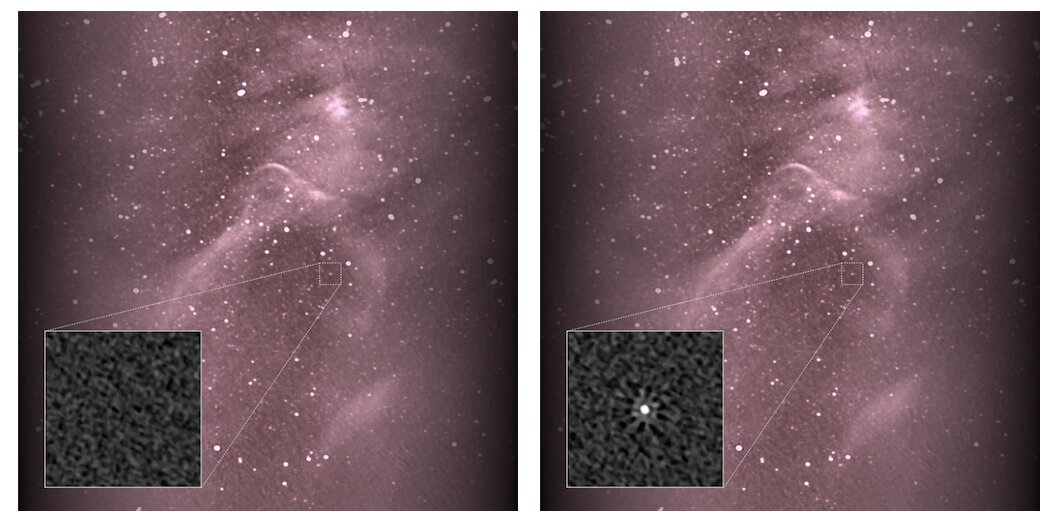
The background for both images shows the 1.28 GHz radio continuum emission from the nebula surrounding the high-mass X-ray binary system Vela X-1, and its newly-discovered radio bow shock (van den Eijnden et al. 2022). On the left and right we can see the MeerKAT images of the pulsar PSR J0901-4046 before and during a pulse, respectively. Credit: Ian Heywood.

Astronomers have investigated an ultraslow radio pulsar known as PSR J0901-4046, finding that it has an extremely high magnetic field—at a level of 30 quadrillion Gauss. The discovery, published April 7 in Physical Review D, makes PSR J0901-4046 the most magnetized radio pulsar known to date.

Extraterrestrial sources of radiation with a regular periodicity, known as pulsars, are usually detected in the form of short bursts of...

Read More
Webb captures the Spectacular Galactic Merger Arp 220

Webb captures the spectacular galactic merger Arp 220
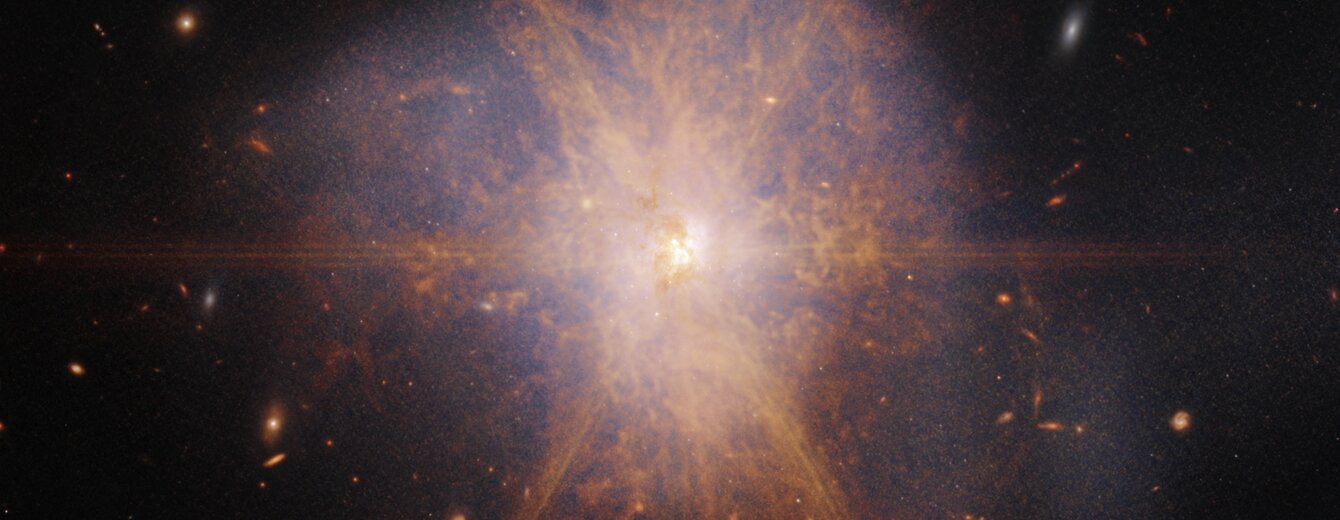
Credit: IMAGE: NASA, ESA, CSA, STScI, Image processing: Alyssa Pagan (STScI)

Shining like a brilliant beacon amidst a sea of galaxies, Arp 220 lights up the night sky in this view from NASA’s James Webb Space Telescope. Actually two spiral galaxies in the process of merging, Arp 220 glows brightest in infrared light, making it an ideal target for Webb. It is an ultra-luminous infrared galaxy (ULIRG) with a luminosity of more than a trillion suns. In comparison, our Milky Way galaxy has a much more modest luminosity of about ten billion suns.

Located 250 million light-years away in the constellation of Serpens, the Serpent, Arp 220 is the 220th object in Halton Arp’s Atlas of Peculiar Galaxies. It is the nearest ULIRG and the brightest of the three galactic mergers closest to Earth.

...Read More

James Webb Space Telescope Images Challenge Theories of how Universe Evolved

Six candidate galaxies
Images of six candidate massive galaxies, seen 500-800 million years after the Big Bang. Image credit: NASA/ESA/CSA/I. Labbe

Astronomers find that six of the earliest and most massive galaxy candidates observed by the James Webb Space Telescope so far appear to have converted nearly 100% of their available gas into stars, a finding at odds with the reigning model of cosmology.

The JWST appears to be finding multiple galaxies that grew too massive too soon after the Big Bang, if the standard model of cosmology is to be believed.

In a study published in Nature Astronomy, Mike Boylan-Kolchin, an associate professor of astronomy at The University of Texas at Austin, finds that six of the earliest and most massive galaxy candidates observed by JWST so far stand to contradict the preva...

Read More

How did Earth get its Water?

How did Earth get its water?
An illustration showing how some Earth’s signature features, such as its abundance of water and its overall oxidized state could potentially be attributable to interactions between the molecular hydrogen atmospheres and magma oceans on the planetary embryos that comprised Earth’s formative years. Credit: Edward Young/UCLA and Katherine Cain/Carnegie Institution for Science.

Earth’s water could have originated from interactions between the hydrogen-rich atmospheres and magma oceans of the planetary embryos that comprised Earth’s formative years, according to new work from Carnegie Science’s Anat Shahar and UCLA’s Edward Young and Hilke Schlichting. Their findings, which could explain the origins of Earth’s signature features, are published in Nature.

For decades, what researchers...

Read More
