Category Astronomy/Space

Dying Stars’ Cocoons could be New Source of Gravitational Waves

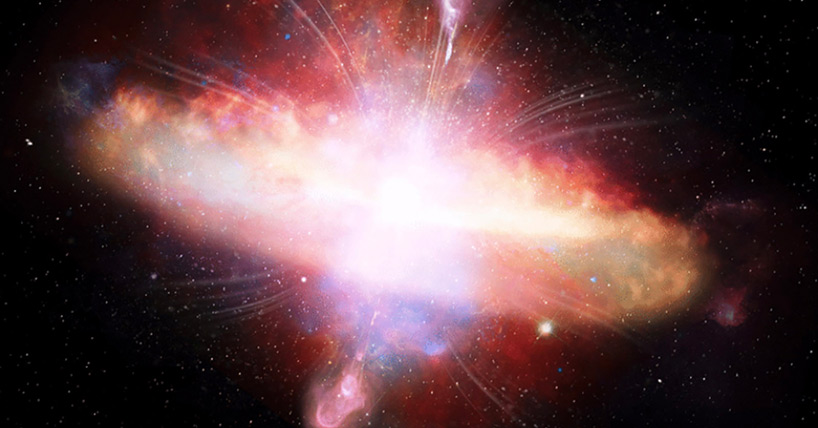
Although astrophysicists theoretically should be able to detect gravitational waves from a single, non-binary source, they have yet to uncover these elusive signals. Now researchers suggest looking at a new, unexpected and entirely unexplored place: The turbulent, energetic cocoons of debris that surround dying massive stars.

For the first time ever, the researchers have used state-of-the-art simulations to show that these cocoons can emit gravitational waves. And, unlike gamma-ray burst jets, cocoons’ gravitational waves should be within the frequency band that the Laser Interferometer Gravitational-Wave Observatory (LIGO) can detect.

“As of today, LIGO has only detected gravitational waves from binary systems, but one day it will detect the first non-binary source of gravitati...

Read More

Eventually Everything Will Evaporate, Not Only Black Holes

New theoretical research by Michael Wondrak, Walter van Suijlekom and Heino Falcke of Radboud University has shown that Stephen Hawking was right about black holes, although not completely. Due to Hawking radiation, black holes will eventually evaporate, but the event horizon is not as crucial as had been believed. Gravity and the curvature of spacetime cause this radiation too. This means that all large objects in the universe, like the remnants of stars, will eventually evaporate.

Using a clever combination of quantum physics and Einstein’s theory of gravity, Stephen Hawking argued that the spontaneous creation and annihilation of pairs of particles must occur near the event horizon (the point beyond which there is no escape from the gravitational force of a black hole)...

Read More

Astrophysicists confirm the Faintest Galaxy ever seen in the Early Universe

Guido Roberts-Borsani/UCLA); original images: NASA, ESA, CSA, Swinburne University of Technology, University of Pittsburgh, STScI

An international research team led by UCLA astrophysicists has confirmed the existence of the faintest galaxy ever seen in the early universe. The galaxy, called JD1, is one of the most distant identified to date, and it is typical of the kinds of galaxies that burned through the fog of hydrogen atoms left over from the Big Bang, letting light shine through the universe and shaping it into what exists today.

The discovery was made using NASA’s James Webb Space Telescope, and the findings are published in the journal Nature.

The first billion years of the universe’s life were a crucial period in its evolution. After the Big Bang, approximately 13...

Read More

NIRISS instrument on Webb Maps an Ultra-hot Jupiter-like Exoplanet’s Atmosphere

NIRISS instrument on Webb maps an ultra-hot Jupiter's atmosphere
The team obtained the thermal emission spectrum of WASP-18 b by measuring the amount of light it emits over the Webb Telescope’s NIRISS SOSS 0.85 – 2.8 micron wavelength range, capturing 65% of the total energy emitted by the planet. WASP-18 b is so hot on the day side of this tidally locked planet that water molecules would be vaporized. Webb directly observed water vapor on the planet in even relatively small amounts, indicating the sensitivity of the observatory. Credit: NASA/JPL-Caltech (R. Hurt/IPAC)

400 light-years out there is something that is so tantalizing that astronomers have been studying it since its discovery in 2009. One orbit for WASP-18 b around its star that is slightly larger than our sun takes just 23 hours. There is nothing like it in our solar system.

A new st...

Read More