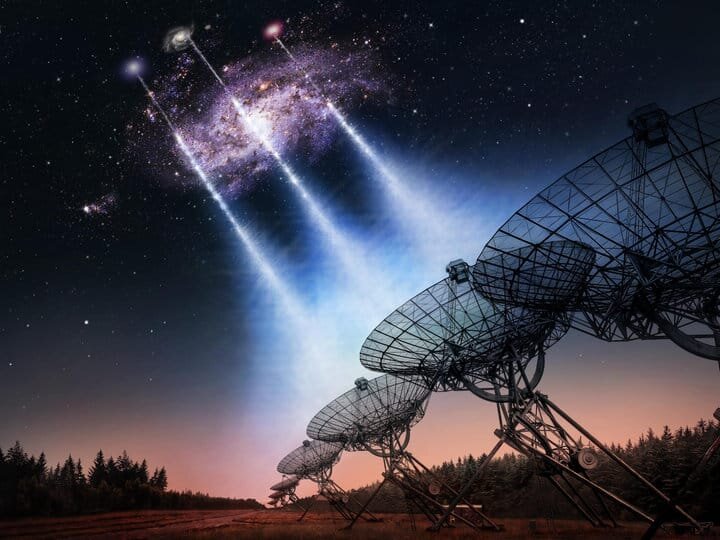
Three new Fast Radio Bursts discovered by the Westerbork telescope were shown to have pierced the halo of our neighbouring Triangulum Galaxy. Invisible electrons in that galaxy deform the FRBs. From sharp, new, live images, astronomers could estimate the maximum number of invisible atoms in the Triangulum Galaxy for the first time. Credit: ASTRON/Futselaar/van Leeuwen
After upgrading the radio telescope array at Westerbork, The Netherlands, astronomers have found five new fast radio bursts. The telescope images, much sharper than previously possible, revealed that multiple bursts had pierced our neighboring Triangulum galaxy. This allowed the astronomers to determine the maximum number of otherwise invisible atoms in this galaxy for the first time...
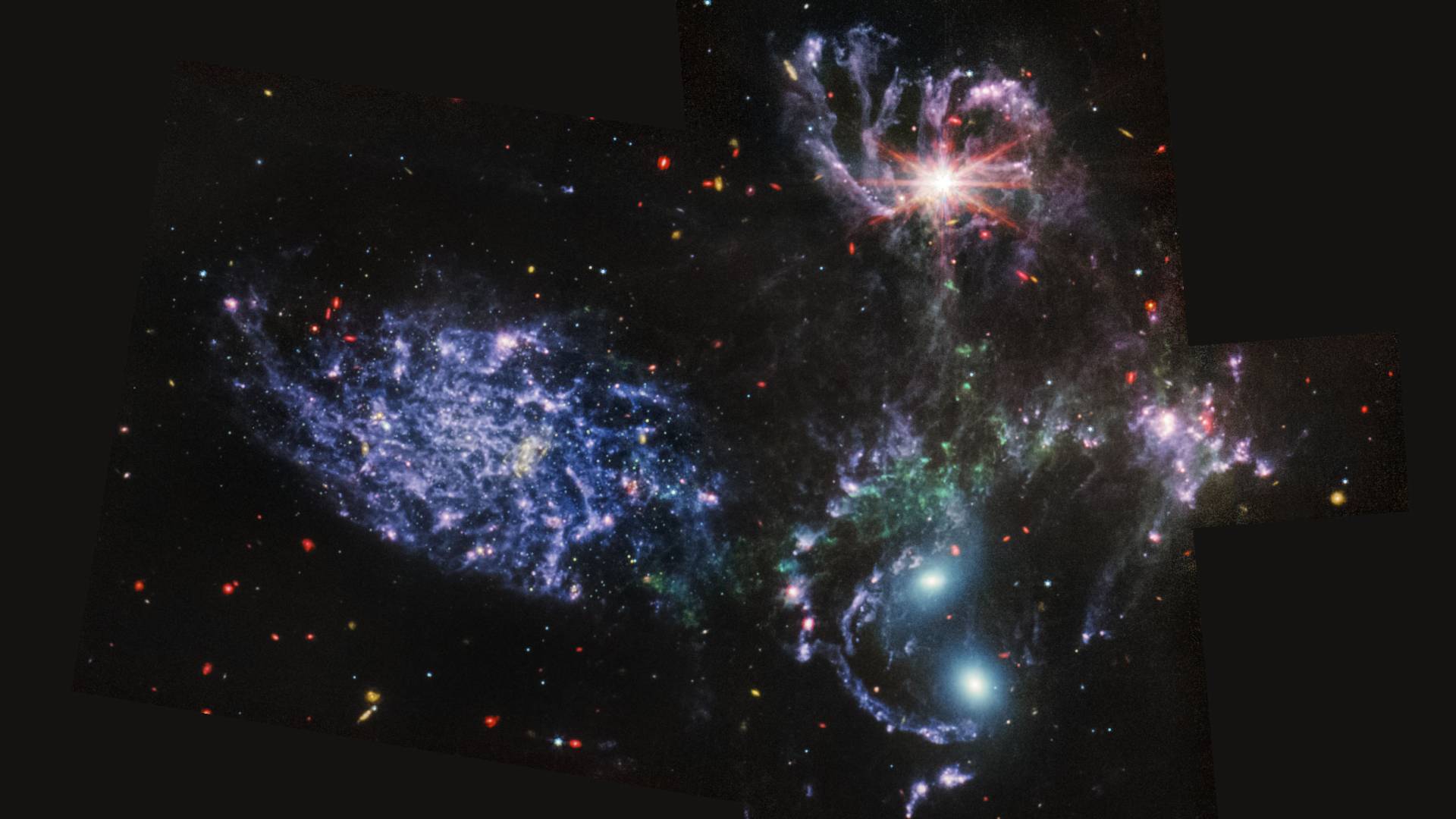
A view of Stephan’s Quintet, a visual grouping of five galaxies from the James Webb Telescope. Image courtesy of NASA, ESA, CSA, STScI
Significant breakthrough in understanding the evolution of the universe. Research by the Atacama Cosmology Telescope collaboration has culminated in a groundbreaking new image that reveals the most detailed map of dark matter distributed across a quarter of the entire sky, reaching deep into the cosmos. Findings provide further support to Einstein’s theory of general relativity, which has been the foundation of the standard model of cosmology for more than a century, and offers new methods to demystify dark matter.
For millennia, humans have been fascinated by the mysteries of the cosmos.
Unlike ancient philosophers imagining the universe’s origi...
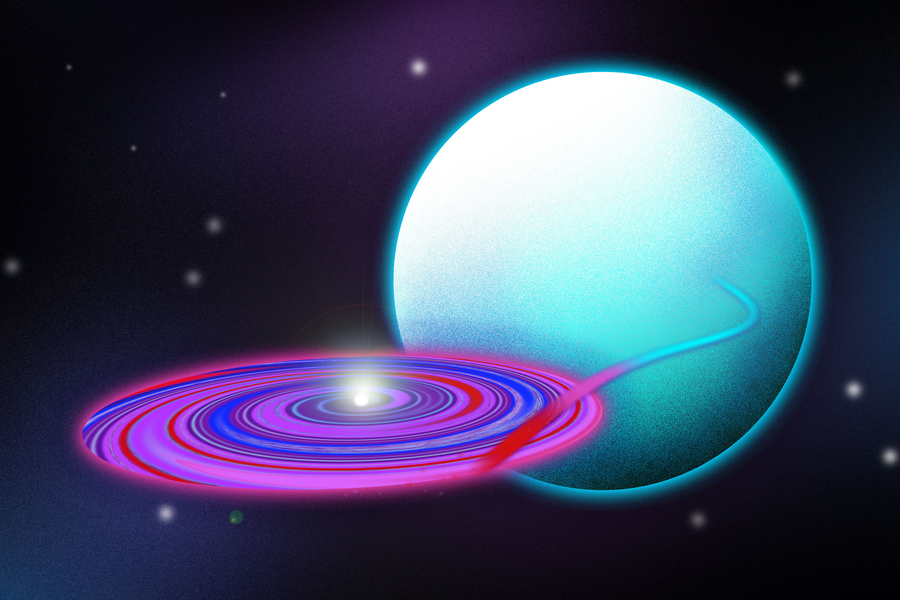
Caption: MIT astronomers mapped the “disk winds” associated with the accretion disk around Hercules X-1, a system in which a neutron star is drawing material away from a sun-like star, represented as the teal sphere. The findings may offer clues to how supermassive black holes shape entire galaxies. Credits:Credit: Jose-Luis Olivares, MIT. Based on an image of Hercules X-1 by D. Klochkov, European Space Agency
The 2D map of this ‘disk wind’ may reveal clues to galaxy formation.
Astronomers have mapped the ‘disk winds’ associated with the accretion disk around Hercules X-1, a system in which a neutron star is drawing material away from a sun-like star. The findings may offer clues to how supermassive black holes shape entire galaxies.
A star is being consumed by a distant supermassive black hole. Astronomers call this a tidal disruption event (TDE). As the black hole rips apart the star, two jets of material moving with almost the speed of light are launched in opposite directions. One of the jets was aimed directly at Earth. Credit: Carl Knox (OzGrav, ARC Centre of Excellence for Gravitational Wave Discovery, Swinburne University of Technology)
Researchers have discovered that in the exotic conditions of the early universe, waves of gravity may have shaken space-time so hard that they spontaneously created radiation.
The physical concept of resonance surrounds us in everyday life. When you’re sitting on a swing and want to go higher, you naturally start pumping your legs back and forth...







Recent Comments