Category Astronomy/Space

Brightest Gamma-Ray Burst ever observed reveals new Mysteries of Cosmic Explosions

This illustration shows the ingredients of a long gamma-ray burst, the most common type.
Credit: NASA’s Goddard Space Flight Center

Scientists believe the gamma-ray emission, which lasted over 300 seconds, is the birth cry of a black hole, formed as the core of a massive and rapidly spinning star collapses under its own weight.

On October 9, 2022, an intense pulse of gamma-ray radiation swept through our solar system, overwhelming gamma-ray detectors on numerous orbiting satellites, and sending astronomers on a chase to study the event using the most powerful telescopes in the world.

The new source, dubbed GRB 221009A for its discovery date, turned out to be the brightest gamma-ray burst (GRB) ever recorded.

In a new study that appears today in the Astrophysical Journal Letters, observations of GRB 221009A spanning from radio waves to gamma-rays, including critica...

Read More
JWST confirms Giant Planet Atmospheres Vary Widely

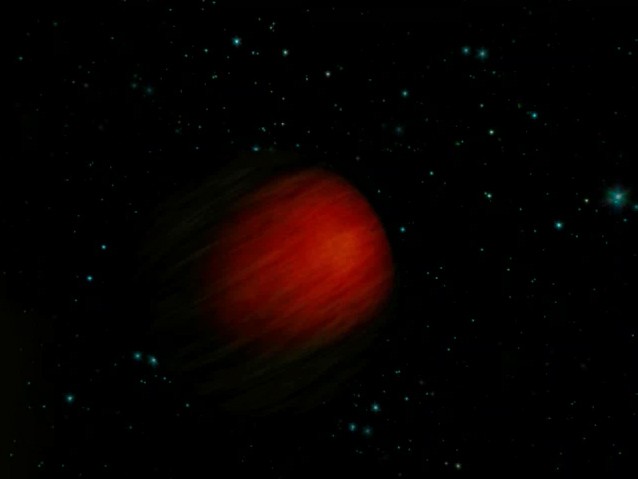
An international team of astronomers has found the atmospheric compositions of giant planets out in the galaxy do not fit our own solar system trend.

Using NASA’s James Webb Space Telescope (JWST), the researchers discovered that the atmosphere of exoplanet HD149026b, a ‘hot Jupiter’ orbiting a star comparable to our sun, is super-abundant in the heavier elements carbon and oxygen — far above what scientists would expect for a planet of its mass.

These findings, published in “High atmospheric metal enrichment for a Saturn-mass planet” in Nature on March 27, provide insight into planet formation.

“It appears that every giant planet is different, and we’re starting to see those differences thanks to JWST,” said Jonathan Lunine, professor in the physical sciences at Cornell Univ...

Read More

For the first time, astronomers have linked a mysterious Fast Radio Burst with Gravitational Waves

For the first time, astronomers have linked a mysterious fast radio burst with gravitational waves
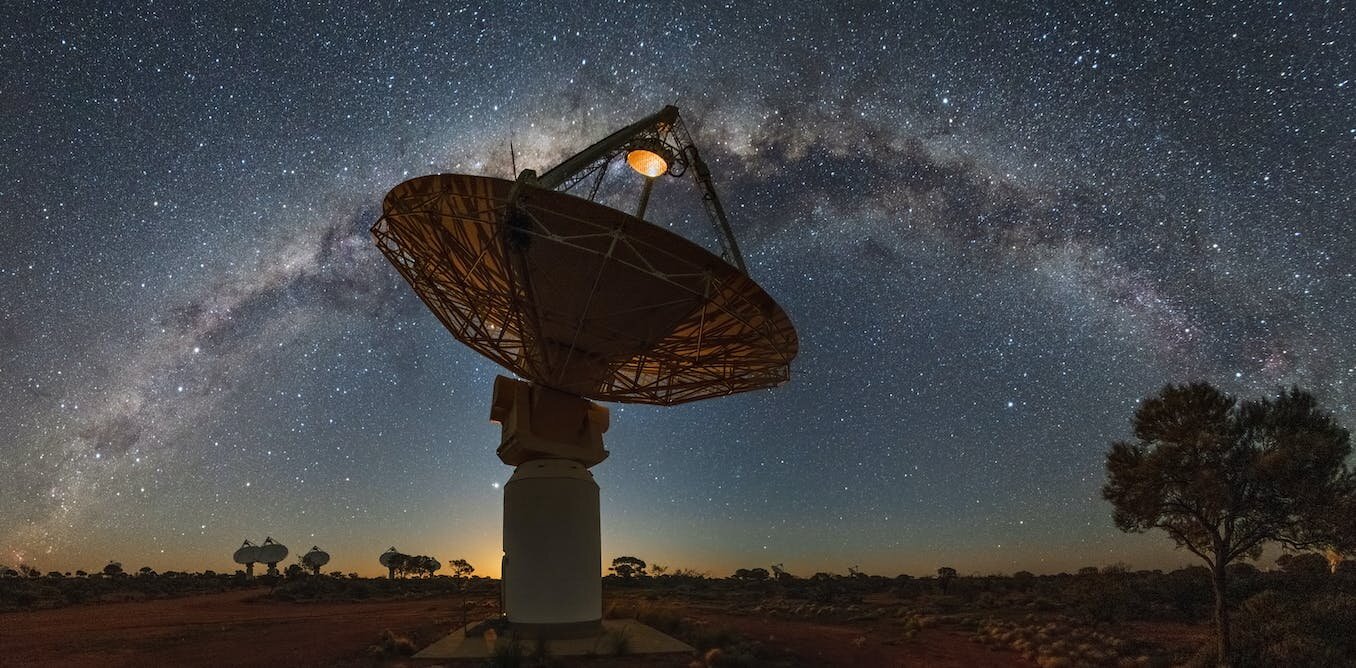
Credit: ASKAP, CSIRO

We have just published evidence in Nature Astronomy for what might be producing mysterious bursts of radio waves coming from distant galaxies, known as fast radio bursts or FRBs.

Two colliding neutron stars—each the super-dense core of an exploded star—produced a burst of gravitational waves when they merged into a “supramassive” neutron star. We found that two and a half hours later they produced an FRB when the neutron star collapsed into a black hole.

Or so we think. The key piece of evidence that would confirm or refute our theory—an optical or gamma-ray flash coming from the direction of the fast radio burst—vanished almost four years ago. In a few months, we might get another chance to find out if we are correct.

Brief and powerful
FRBs are in...

Read More

AI finds the First Stars were Not Alone

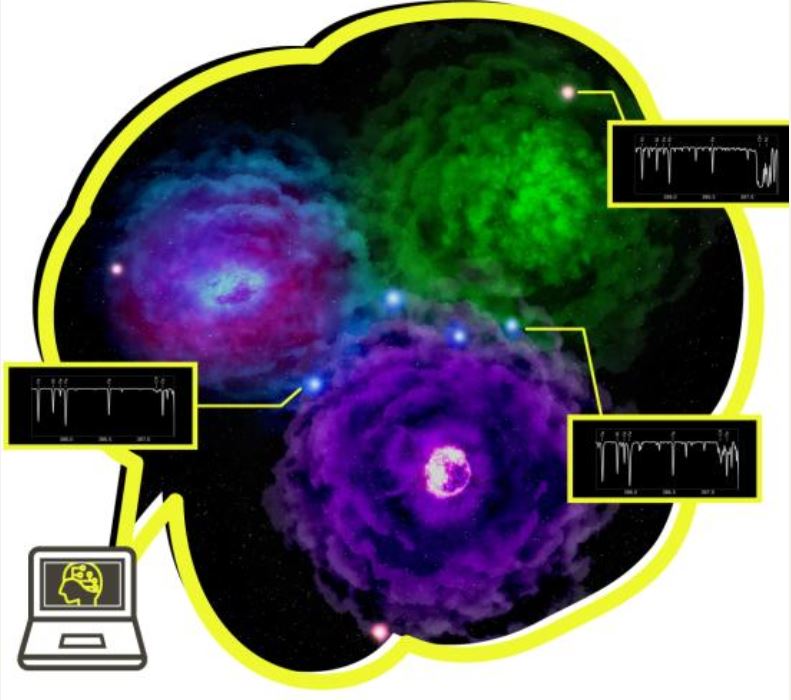
A schematic illustration of the first star’s supernovae and observed spectra of extremely metal-poor stars. Ejecta from the supernovae enrich pristine hydrogen and helium gas with heavy elements in the universe (cyan, green, and purple objects surrounded by clouds of ejected material). If the first stars are born as a multiple stellar system rather than as an isolated single stars, elements ejected by the supernovae are mixed together and incorporated into the next generation of stars. The characteristic chemical abundances in such a mechanism are preserved in the atmosphere of the long-lived low-mass stars observed in our Milky Way Galaxy...
Read More