Category Astronomy/Space

Astronomers find a ‘Red Nova’: A Main-Sequence star just Eating its Planet

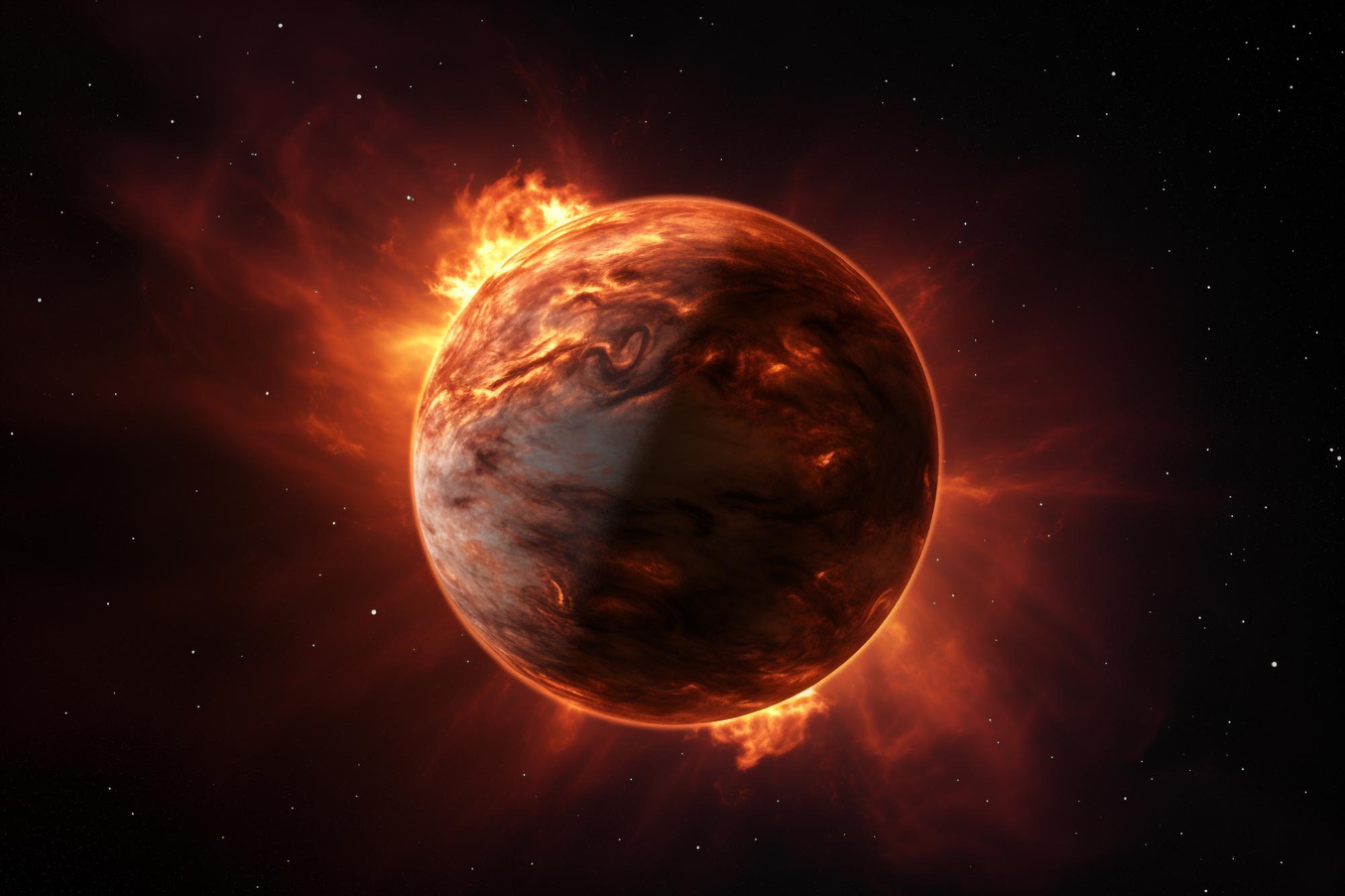
Artist’s impression of a Jupiter-sized exoplanet orbiting an M-dwarf star

Back in 2020 astronomers observed a red nova, which while enormously powerful, is on the low side of energetic events in the universe. Now an astronomer has studied the event in close detail and has come to the conclusion that we have just witnessed a star destroying its own planet.

The technical jargon term for these red nova events are “intermediate luminosity optical transits,” or ILOTs. These are extremely rare events to observe, because they only produce a moderate amount of energy. That makes it hard for us to capture them in observations. But despite the rarity of the events, astronomers suspect that they occur very frequently throughout the universe.

For years astronomers have wondered if these red ...

Read More

Researchers determine Global Thickness and Density of Martian Crust

Researchers de­term­ine global thick­ness and dens­ity of Martian crust
Topographic map of the Martian surface (l.) and representation of the crust thickness (r.). Credit: MOLA Science Team / Doyeon Kim, ETH Zurich

A strong quake in the last year of the NASA Mars InSight mission, enabled researchers at ETH Zurich to determine the global thickness and density of the planet’s crust. On average, the Martian crust much thicker than the Earth’s or the moon’s crust, and the planet’s main source of heat is radioactive.

After more than three years of daily monitoring and with the power levels decreasing on InSight’s seismometer, researchers were rewarded with data from a sizeable Marsquake in May 2022. The surface waves observed from this estimated 4...

Read More

New study puts a Definitive Age on Saturn’s Rings – they’re really Young

Saturn's rings partially in shadow
Saturn’s rings partially in shadow as seen by NASA’s Cassini spacecraft. (Credit: NASA/JPL/Space Science Institute)

Physicists measured the flux of interplanetary dust around Saturn. The researchers concluded that the planet’s rings formed less than 400 million years ago, making them much younger than Saturn itself.

A new study led by physicist Sascha Kempf at the University of Colorado Boulder has delivered the strongest evidence yet that Saturn’s rings are remarkably young — potentially answering a question that has boggled scientists for well over a century.

The research, to be published May 12 in the journal Science Advances, pegs the age of Saturn’s rings at no more than 400 million years old. That makes the rings much younger than Saturn itself, which is about 4...

Read More

New Images reveal the Magnetic Fields in the Horsehead Nebula

Magnetic field detections overlaid on a two-color composite of Hubble Space Telescope image taken at two near-IR wavelengths (Mikulski Archive for Space Telescopes). Black and orange segments show magnetic field orientations inferred from JCMT and Palomar Observatory. Credit: Hwang et al. 2023.

Located near the summit of Maunakea, Hawaii, the 15-meter (~49 ft) James Clerk Maxwell Telescope (JCMT) at the East Asia Observatory (EAO) is the largest telescope in the world designed to operate exclusively in the submillimeter-wavelength. In 2018, Molokai’i High School alumna Mallory Go was awarded time with the JCMT under the Maunakea Scholars program. With the assistance of EAO astronomer Dr...

Read More