Category Astronomy/Space

Superflare with Massive, High-Velocity Prominence Eruption

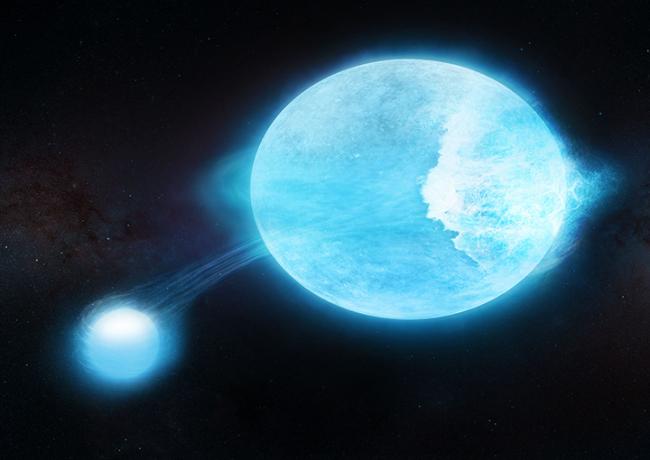
Artist’s impression of the superflare observed on one of the stars in the V1355 Orionis binary star system. The binary companion star is visible in the background on the right. (Credit: NAOJ) 

A team of Japanese astronomers used simultaneous ground-based and space-based observations to capture a more complete picture of a superflare on a star. The observed flare started with a very massive, high-velocity prominence eruption. These results give us a better idea of how superflares and stellar prominence eruptions occur.

Some stars have been seen releasing superflares over 10 times larger than the largest solar flare ever seen on the Sun. The hot ionized gas released by solar flares can influence the environment around the Earth, referred to as space weather...

Read More

Medium-sized Black Holes Eat Stars like Messy Toddlers

Wayward star meets black hole

Elusive intermediate-mass black holes take a few bites, then eject the leftovers

In new 3D computer simulations, astrophysicists modeled black holes of varying masses and then hurled stars (about the size of our sun) past them to see what might happen. If they exist, intermediate-mass black holes likely devour wayward stars like a messy toddler — taking a few bites and then flinging the remains across the galaxy.

When a star approaches an intermediate-mass black hole, it initially gets caught in the black hole’s orbit, the researchers discovered. After that, the black hole begins its lengthy and violent meal. Every time the star makes a lap, the black hole takes a bite — further cannibalizing the star with each passage...

Read More

Asteroid’s Comet-like Tail Is Not made of Dust, solar observatories reveal

The Large Angle and Spectrometric Coronagraph (LASCO) on the Solar and Heliospheric Observatory (SOHO) imaged asteroid Phaethon through different filters as the asteroid passed near the Sun in May 2022. On the left, the sodium-sensitive orange filter shows the asteroid with a surrounding cloud and small tail, suggesting that sodium atoms from the asteroid’s surface are glowing in response to sunlight. On the right, the dust-sensitive blue filter shows no sign of Phaethon, indicating that the asteroid is not producing any detectable dust.
Credits: ESA/NASA/Qicheng Zhang

A weird asteroid has just gotten a little weirder.

We have known for a while that asteroid 3200 Phaethon acts like a comet...

Read More

Study of Small Magellanic Cloud suggests Planets could have Formed during ‘Cosmic Noon’

Study of Small Magellanic Cloud suggests planets could have formed during 'cosmic noon'
NIRCam mosaics of NGC 346. Credit: Nature Astronomy (2023). DOI: 10.1038/s41550-023-01945-7

An international team of space scientists has found evidence suggesting that planets could have formed during the so-called “cosmic noon.” In their study, reported in the journal Nature Astronomy, the group used data from the James Webb Space Telescope (JWST) to study a part of the Small Magellanic Cloud (SMC) to learn more about planet development around young stars.

For many years, astronomers have been studying planet creation and the likelihood of the existence of planets similar to Earth. But it is still not clear how planets could have could come to exist in the early universe when most, if not all of the stars, were small...

Read More