Category Astronomy/Space

Is extracting oxygen from lunar soil the future of space exploration?

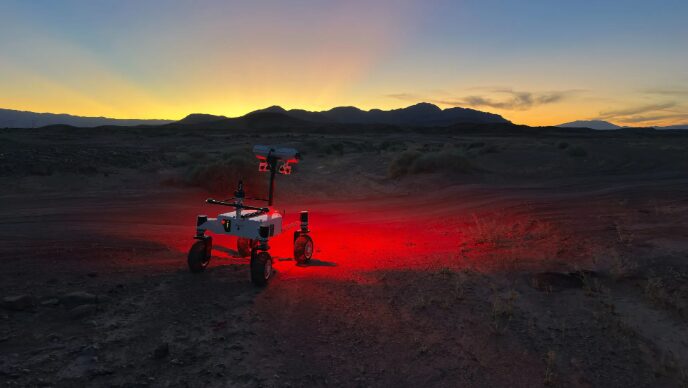
A new race to the moon is emerging between the United States and China. Unlike fifty years ago, the goal is no longer just about landing and leaving, but establishing a base that allows for a sustainable presence and extended stays on the surface of our natural satellite. The objective is now to use the moon as a testing ground for technologies that will enable us to travel further, particularly to Mars.

One of these key technologies is in-situ resource utilization (ISRU), which involves using available resources on-site to produce the consumables necessary for human activities: oxygen, water, rocket fuels, or construction materials...

Read More

Peering into the Milky Way’s far side, Roman could unveil 100,000 worlds

Galactic Neighborhoods infographic
This infographic features artist’s concept views of our Milky Way galaxy: face-on at the left and edge-on at the right. It highlights different galactic environments that could influence the development of planets and potentially life. The center of the galaxy is rich in the elements that form planets (like silicon, oxygen, and magnesium), which are forged by multiple generations of stars and supernova explosions. Planets there may be more common or larger, but they would also be flooded with radiation from densely packed stars (including massive ones that emit enormous amounts of high-energy ultraviolet light and X-rays). In the outskirts of the galaxy, where stars are much more spread out, radiation is far milder but there are also smaller amounts of planet-building materials...
Read More

NASA’s Fermi telescope reveals the power source behind monster supernovae

Composite showing optical and gamma-ray observations of SN 2017egm
This composite image shows two views of SN 2017egm, in visible light (inset) and gamma rays (background). The optical image shows the supernova — the brightest object in the scene — and its host galaxy on July 1, 2017. The background map shows a wide area of the sky surrounding the supernova’s position. Brighter colors indicate greater statistical likelihood that gamma rays are associated with the explosion. The map includes gamma rays detected by Fermi’s Large Area Telescope from July 5, 2017, to Oct. 25, 2017, or from 43 to 155 days after the supernova was discovered.
Background, NASA/DOE/Fermi LAT Collaboration and Acero et. al. 2026; inset, NOT+ALFSOC/Bose et al. 2020

NASA’s Fermi telescope has detected what may be the first confirmed gamma-ray signal from a superluminous su...

Read More

Triply-eclipsing triple star system discovered with TESS

Using NASA’s Transiting Exoplanet Survey Satellite (TESS), astronomers have discovered a triply-eclipsing star system. The newfound system, designated TIC295741342, consists of two sun-like stars in an eclipsing binary and a giant tertiary companion, which orbits the binary. The finding was reported in a paper published May 19 on the arXiv pre-print server.

TESS is conducting a survey of about 200,000 bright stars near the sun with the aim of searching for transiting exoplanets. Besides identifying alien worlds, TESS is also a very useful tool in analyzing binary systems, tracking how mutual stellar eclipses twist and distort gravitational fields.

Triply and triple
Now, a team of astronomers led by Brian P...

Read More