Category Astronomy/Space

James Webb Space Telescope Images Challenge Theories of how Universe Evolved

Six candidate galaxies
Images of six candidate massive galaxies, seen 500-800 million years after the Big Bang. Image credit: NASA/ESA/CSA/I. Labbe

Astronomers find that six of the earliest and most massive galaxy candidates observed by the James Webb Space Telescope so far appear to have converted nearly 100% of their available gas into stars, a finding at odds with the reigning model of cosmology.

The JWST appears to be finding multiple galaxies that grew too massive too soon after the Big Bang, if the standard model of cosmology is to be believed.

In a study published in Nature Astronomy, Mike Boylan-Kolchin, an associate professor of astronomy at The University of Texas at Austin, finds that six of the earliest and most massive galaxy candidates observed by JWST so far stand to contradict the preva...

Read More

How did Earth get its Water?

How did Earth get its water?
An illustration showing how some Earth’s signature features, such as its abundance of water and its overall oxidized state could potentially be attributable to interactions between the molecular hydrogen atmospheres and magma oceans on the planetary embryos that comprised Earth’s formative years. Credit: Edward Young/UCLA and Katherine Cain/Carnegie Institution for Science.

Earth’s water could have originated from interactions between the hydrogen-rich atmospheres and magma oceans of the planetary embryos that comprised Earth’s formative years, according to new work from Carnegie Science’s Anat Shahar and UCLA’s Edward Young and Hilke Schlichting. Their findings, which could explain the origins of Earth’s signature features, are published in Nature.

For decades, what researchers...

Read More

Astronomers discover Fast Radio Bursts that Skewer Nearby Galaxy

Astronomers discover fast radio bursts that skewer nearby galaxy
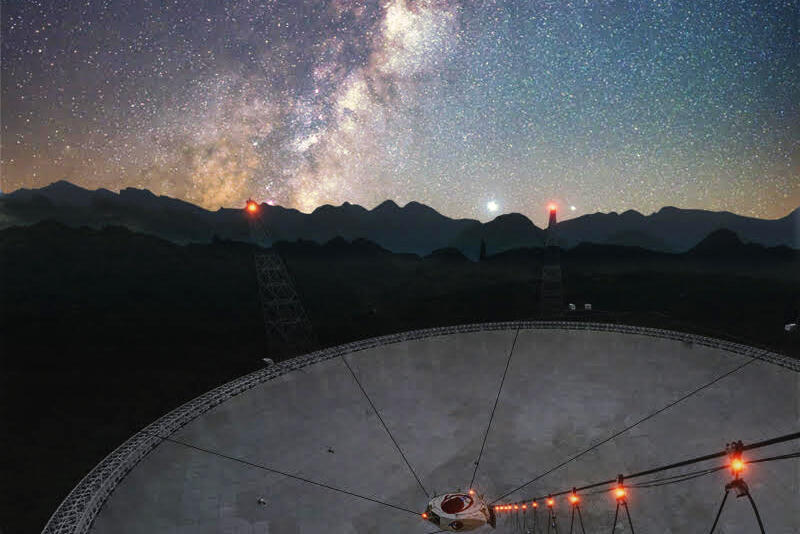
Three new Fast Radio Bursts discovered by the Westerbork telescope were shown to have pierced the halo of our neighbouring Triangulum Galaxy. Invisible electrons in that galaxy deform the FRBs. From sharp, new, live images, astronomers could estimate the maximum number of invisible atoms in the Triangulum Galaxy for the first time. Credit: ASTRON/Futselaar/van Leeuwen

After upgrading the radio telescope array at Westerbork, The Netherlands, astronomers have found five new fast radio bursts. The telescope images, much sharper than previously possible, revealed that multiple bursts had pierced our neighboring Triangulum galaxy. This allowed the astronomers to determine the maximum number of otherwise invisible atoms in this galaxy for the first time...

Read More

New findings that Map the Universe’s Cosmic Growth support Einstein’s Theory of Gravity

A group of five galaxies: The galaxy at the top has a bright reddish core surrounded by swirls of blue and purple. The galaxy on the left is a mass of purple gas surrounding a dim red core.
A view of Stephan’s Quintet, a visual grouping of five galaxies from the James Webb Telescope.
Image courtesy of NASA, ESA, CSA, STScI

Significant breakthrough in understanding the evolution of the universe. Research by the Atacama Cosmology Telescope collaboration has culminated in a groundbreaking new image that reveals the most detailed map of dark matter distributed across a quarter of the entire sky, reaching deep into the cosmos. Findings provide further support to Einstein’s theory of general relativity, which has been the foundation of the standard model of cosmology for more than a century, and offers new methods to demystify dark matter.

For millennia, humans have been fascinated by the mysteries of the cosmos.

Unlike ancient philosophers imagining the universe’s origi...

Read More