Category Astronomy/Space

Action of 2 Protostars appears to be making conditions right for Planet Formation

Action of two protostars appears to be making conditions right for planet formation
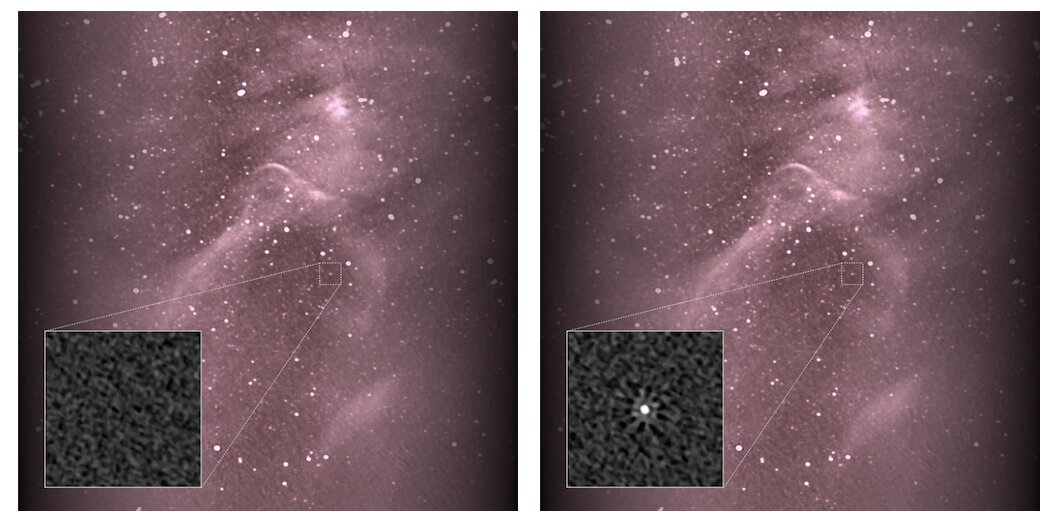
Left: ALMA 1.3 mm observations toward the triple class 0 system IRAS 16293–2422. The observations have a resolution of ∼35 au and were published in Sadavoy et al. (2018). Right: ALMA 1.3 and 3 mm observations of the southern binary system at a resolution of ∼13 and ∼7 au, respectively. Similar maps for source B are presented in Zamponi et al. (2021). In all panels, the positions of the protostars are marked by stars. Additional continuum peaks around the A1 and A2 protostars are labeled and marked with plus signs in the right panels. The beam is shown in the bottom left corner of each panel. Credit: The Astrophysical Journal Letters (2022). DOI: 10.3847/2041-8213/aca53a

A team of researchers at Max Planck Institute for Extraterrestrial Physics, working with a colleague at the U...

Read More

Planetary Interiors in TRAPPIST-1 System could be affected by Solar Flares

Credit: NASA/JPL-Caltech

In a recent study published in the Astrophysical Journal Letters, an international team of researchers led by the University of Cologne in Germany examined how solar flares erupted by the TRAPPIST-1 star could affect the interior heating of its orbiting exoplanets.

This study holds the potential to help us better understand how solar flares affect planetary evolution. The TRAPPIST-1 system is an exoplanetary system located approximately 39 light-years from Earth with at least seven potentially rocky exoplanets in orbit around a star that has 12 times less mass than our own sun. Since the parent star is much smaller than our own sun, then the the planetary orbits within the TRAPPIST-1 system are much smaller than our own solar system, as well...

Read More

Exotic Clasts in Chang’e-5 Samples indicate Unexplored Terrane on Moon

Exotic clasts in Chang'e-5 samples indicate unexplored terrane on moon
Graphical depiction of exotic igneous clasts in Chang’e-5 lunar regolith. Credit: IGCAS

The Chang’e-5 mission touched down in the Mons Rümker region of the northern Oceanus Procellarum of the moon and returned 1.731 kg of lunar regolith. Recognizing exotic clasts (i.e., non-Chang’e-5 locally derived materials) in the Chang’e-5 regolith could provide critical information about the lithological diversity and regolith gardening process in the young mare region of the moon.

Recently, Dr. Zeng Xiaojia, Prof. Li Xiongyao and Prof. Liu Jianzhong from the Institute of Geochemistry of the Chinese Academy of Sciences (IGCAS) have identified seven exotic igneous clasts in Chang’e-5 samples from more than 3,000 of Chang’e-5 regolith particles.

This work was published in Nature Astronomy on ...

Read More

NASA Explores a Winter Wonderland on Mars

The HiRISE camera aboard NASA’s Mars Reconnaissance Orbiter captured these images of sand dunes covered by frost just after winter solstice. The frost here is a mixture of carbon dioxide (dry) ice and water ice and will disappear in a few months when spring arrives. Credit: NASA/JPL-Caltech/University of Arizona

Cube-shaped snow, icy landscapes, and frost are all part of the Red Planet’s coldest season.
When winter comes to Mars, the surface is transformed into a truly otherworldly holiday scene. Snow, ice, and frost accompany the season’s sub-zero temperatures. Some of the coldest of these occur at the planet’s poles, where it gets as low as minus 190 degrees Fahrenheit (minus 123 degrees Celsius).

Cold as it is, don’t expect snow drifts worthy of the Rocky Mountains...

Read More