Using the Atacama Large Millimeter/submillimeter Array (ALMA), of which ESO is a partner, astronomers have discovered a large reservoir of hot gas in the still-forming galaxy cluster around the Spiderweb galaxy — the most distant detection of such hot gas yet. Galaxy clusters are some of the largest objects known in the Universe and this result, published today in Nature, further reveals just how early these structures begin to form.
Astronomers have discovered a large reservoir of hot gas in the still-forming galaxy cluster around the Spiderweb galaxy — the most distant detection of such hot gas yet. Galaxy clusters are some of the largest objects known in the Universe and this result further reveals just how early these structures begin to form.
A composite closeup of the bright center of spiral galaxy NGC 253.
Researchers model how elements move across star-forming regions. Much like how wind plays a key role in life on Earth by sweeping seeds, pollen and more from one place to another, galactic winds — high-powered streams of charged particles and gases — can change the chemical makeup of the host galaxies they form in, simply by blowing in a specific direction.
Using observations made by NASA’s Chandra X-ray Observatory, a new study details how these energetic winds, once released from the center of a galaxy, directly influence the temperature and metal distribution of the rest of the region.
“Galactic winds are a large part of galaxy evolution in general,” said Sebastian Lopez, lead author of the study and a graduate...
Scientists believe the gamma-ray emission, which lasted over 300 seconds, is the birth cry of a black hole, formed as the core of a massive and rapidly spinning star collapses under its own weight.
On October 9, 2022, an intense pulse of gamma-ray radiation swept through our solar system, overwhelming gamma-ray detectors on numerous orbiting satellites, and sending astronomers on a chase to study the event using the most powerful telescopes in the world.
The new source, dubbed GRB 221009A for its discovery date, turned out to be the brightest gamma-ray burst (GRB) ever recorded.
In a new study that appears today in the Astrophysical Journal Letters, observations of GRB 221009A spanning from radio waves to gamma-rays, including critica...
An international team of astronomers has found the atmospheric compositions of giant planets out in the galaxy do not fit our own solar system trend.
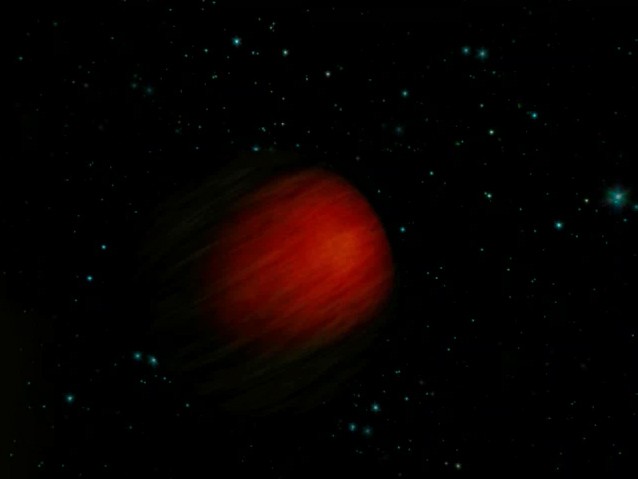
Using NASA’s James Webb Space Telescope (JWST), the researchers discovered that the atmosphere of exoplanet HD149026b, a ‘hot Jupiter’ orbiting a star comparable to our sun, is super-abundant in the heavier elements carbon and oxygen — far above what scientists would expect for a planet of its mass.
These findings, published in “High atmospheric metal enrichment for a Saturn-mass planet” in Nature on March 27, provide insight into planet formation.
“It appears that every giant planet is different, and we’re starting to see those differences thanks to JWST,” said Jonathan Lunine, professor in the physical sciences at Cornell Univ...





Recent Comments