Category Astronomy/Space

James Webb catches an exoplanet losing its atmosphere in real time

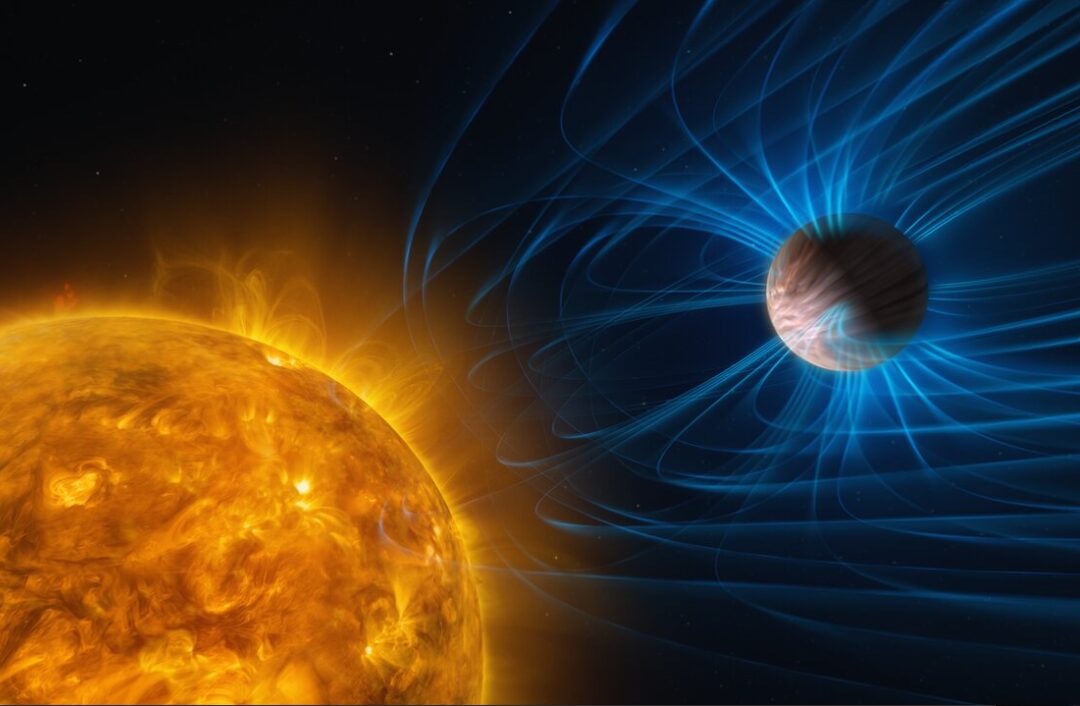
WASP-121b, a scorching gas giant orbiting its star every 30 hours, is literally bleeding its atmosphere into space. Astronomers from the University of Geneva (UNIGE), the National Centre of Competence in Research PlanetS, and the Trottier Institute for Research on Exoplanets (IREx) at the University of Montreal (UdeM) have made a major breakthrough using the James Webb Space Telescope (JWST). For the first time, researchers have followed gas escaping from an exoplanet’s atmosphere continuously over a full orbit around its star.

The observations revealed an unexpected and dramatic result. The gas giant WASP-121b is surrounded by not one, but two enormous streams of helium that stretch across more than half of its orbit...

Read More

Polar weather on Jupiter and Saturn hints at the planets’ interior details

Jupiter’s North Pole showing multiple vortexes
Caption:This infrared 3D image of Jupiter’s north pole shows a ring of 8 vortices surrounding a central cyclone. MIT researchers have now identified a mechanism that determines whether a gas giant evolves one versus multiple polar vortices.
Credits:Credit: NASA/JPL-Caltech/SwRI/ASI/INAF/JIRAM

Over the years, passing spacecraft have observed mystifying weather patterns at the poles of Jupiter and Saturn. The two planets host very different types of polar vortices, which are huge atmospheric whirlpools that rotate over a planet’s polar region. On Saturn, a single massive polar vortex appears to cap the north pole in a curiously hexagonal shape, while on Jupiter, a central polar vortex is surrounded by eight smaller vortices, like a pan of swirling cinnamon rolls.

Given that both planet...

Read More

Experiments bring Enceladus’ subsurface ocean into the lab

Experiments bring Enceladus' subsurface ocean into the lab
Plumes erupt from Enceladus’ southern polar regions. Credit: NASA/JPL-Caltech

Through new experiments, researchers in Japan and Germany have recreated the chemical conditions found in the subsurface ocean of Saturn’s moon, Enceladus. Published in Icarus, the results show that these conditions can readily produce many of the organic compounds observed by the Cassini mission, strengthening evidence that the distant world could harbor the molecular building blocks of life.

Beneath its thick outer shell of ice, astronomers widely predict that Saturn’s sixth largest moon hosts an ocean of liquid water in its south polar region...

Read More

Astronomer uses ‘China Sky Eye’ to reveal binary origin of fast radio bursts

Astronomer uses 'China Sky Eye' to reveal binary origin of fast radio bursts
Credit: Y. Liu, X. Yang, Y.F. Liang, W.L. Zhang and Y. Li (PMO)

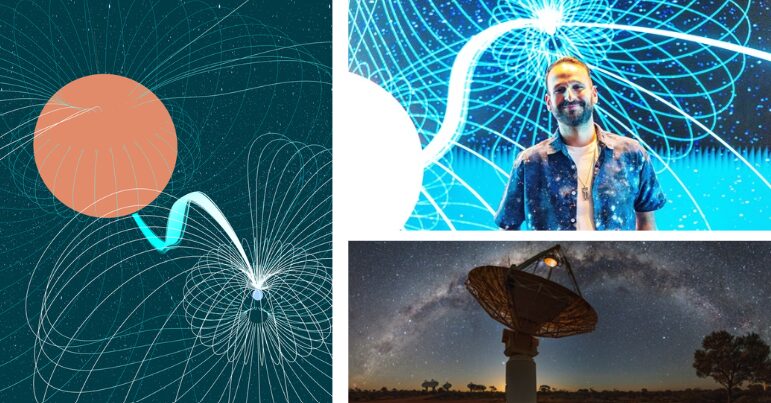
An international team of astronomers, including researchers from the Department of Physics at The University of Hong Kong (HKU), has uncovered the first decisive evidence that at least some fast radio burst (FRB) sources—brief but powerful flashes of radio waves from distant galaxies—reside in binary stellar systems. This means the FRB source is not an isolated star, as previously assumed, but part of a binary stellar system in which two stars orbit each other.

Using the Five-hundred-meter Aperture Spherical Telescope (FAST) located in Guizhou, also known as the “China Sky Eye,” the team detected a distinctive signal that reveals the presence of a nearby companion star orbiting the FRB source.

The discovery, publ...

Read More