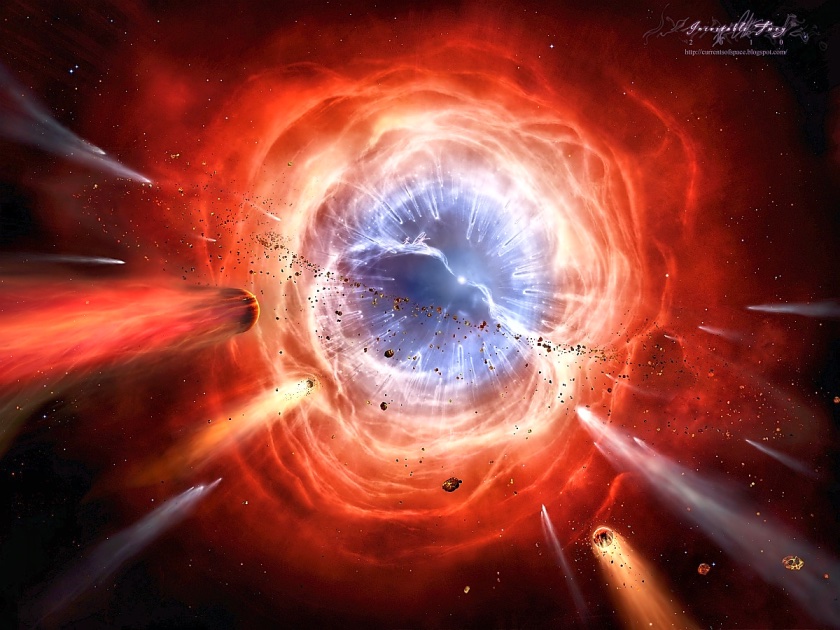
The protostar within the dark cloud L1527, shown in this image from NASA’s James Webb Space Telescope Near-Infrared Camera (NIRCam), is embedded within a cloud of material feeding its growth. Ejections from the star have cleared out cavities above and below it, whose boundaries glow orange and blue in this infrared view. The upper central region displays bubble-like shapes due to stellar “burps,” or sporadic ejections. Credits: NASA, ESA, CSA, and STScI. Image processing: J. DePasquale, A. Pagan, and A. Koekemoer (STScI)
NASA’s James Webb Space Telescope has revealed the once-hidden features of the protostar within the dark cloud L1527, providing insight into the beginnings of a new star...
Fragment of Winchcombe meteorite held by researcher. (The Trustees of the Natural History Museum, London)
The Winchcombe meteorite, a rare carbonaceous meteorite which crashed onto a driveway in Gloucestershire in 2021, has been found to contain extra-terrestrial water and organic compounds that reveal insights into the origin of Earth’s oceans.
A new study, published today by Science Advances, led by experts from the Natural History Museum and the University of Glasgow reports the orbital history and first laboratory analyses of the Winchcombe meteorite, which was recovered only hours after its spectacular fireball lit up the skies over the U.K. in February 2021.
Denis Vida, a Western physics and astronomy postdoctoral associate, was a key contributor to the study...
The study of the sound speed has revealed that heavy neutron stars have a stiff mantle and a soft core, while light neutron stars have a soft mantle and a stiff core – much like different chocolate pralines (image: P. Kiefer/L. Rezzolla)
Physicists model more than one million equations of state. Through extensive model calculations, physicists have reached general conclusions about the internal structure of neutron stars, where matter reaches enormous densities: depending on their mass, the stars can have a core that is either very stiff or very soft.
So far, little is known about the interior of neutron stars, those extremely compact objects that can form after the death of a star: the mass of our sun or even more is compressed into a sphere with the diameter of a large city...
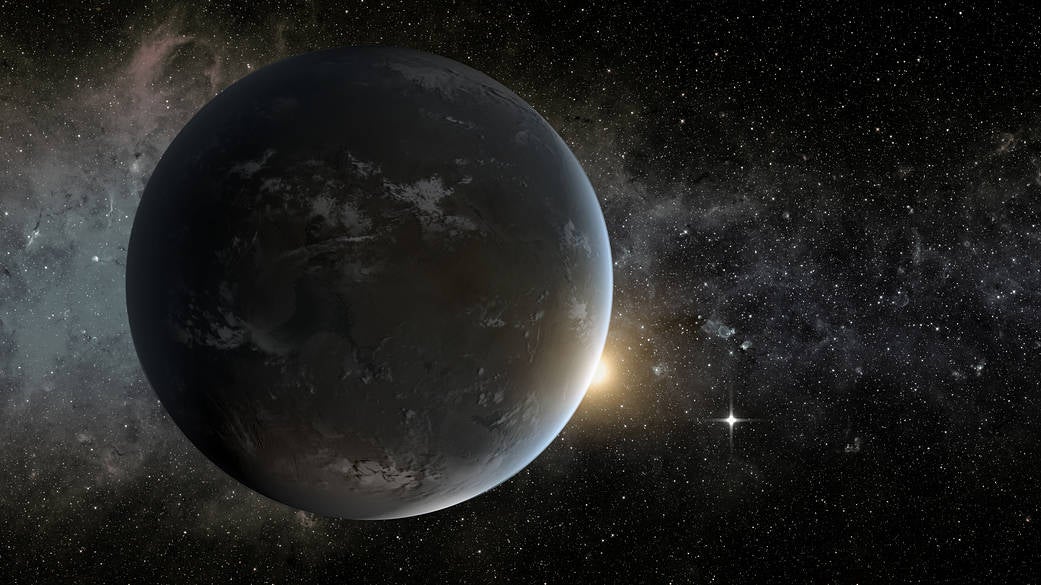
A team of astronomers have found that planet formation in our young Solar System started much earlier than previously thought, with the building blocks of planets growing at the same time as their parent star.
A study of some of the oldest stars in the Universe suggests that the building blocks of planets like Jupiter and Saturn begin to form while a young star is growing. It had been thought that planets only form once a star has reached its final size, but new results, published in the journal Nature Astronomy, suggests that stars and planets ‘grow up’ together.
The research, led by the University of Cambridge, changes our understanding of how planetary systems, including our own Solar System, formed, potentially solving a major puzzle in astronomy.
Recent Comments