Category Astronomy/Space

Uncovering the Massive Quantum Mysteries of Black Holes

Black hole
Mass-quantised black hole – recreated using NightCafe Creator AI.

Bizarre quantum properties of black holes – including their mind-bending ability to have different masses simultaneously – have been confirmed by University of Queensland physicists.

A UQ-led team of theoretical physicists, headed by PhD candidate Joshua Foo, ran calculations that reveal surprising black hole quantum phenomena.

“Black holes are an incredibly unique and fascinating feature of our universe,” Mr Foo said.

“They’re created when gravity squeezes a vast amount of matter incredibly densely into a tiny space, creating so much gravitational pull that even light cannot escape.

“It’s a phenomenon that can be triggered by a dying star.

“But, until now, we haven’t deeply investigated whether black ...

Read More

Magma on Mars likely

Colour-coded topographical view of the Cerberus Fossae features: reds and whites are relatively higher than blues and purples. (Photograph: ESA/DLR/FU Berlin)

Until now, Mars has been generally considered a geologically dead planet. An international team of researchers now reports that seismic signals indicate vulcanism still plays an active role in shaping the Martian surface.

Since 2018, when the NASA InSight Mission deployed the SEIS seismometer on the surface of Mars, seismologists and geophysicists at ETH Zurich have been listening to the seismic pings of more than 1,300 marsquakes. Again and again, the researchers registered smaller and larger Mars quakes. A detailed analysis of the quakes’ location and spectral character brought a surprise...

Read More

Tree Rings Offer Insight into Devastating Radiation Storms

A photoshopped image of a tree ring on a dark background, with one half on fire.
A composite image of a tree ring and flames – the UQ researchers analysed data from tree rings to measure historical cosmic events.

A University of Queensland study has shed new light on a mysterious, unpredictable and potentially devastating kind of astrophysical event. The team led by Dr Benjamin Pope from UQ’s School of Mathematics and Physics applied cutting edge statistics to data from millennia-old trees, to find out more about radiation ‘storms’.

“These huge bursts of cosmic radiation, known as Miyake Events, have occurred approximately once every thousand years but what causes them is unclear,” Dr Pope said. “The leading theory is that they are huge solar flares.

“We need to know more, because if one of these happened today, it would destroy technology including satellite...

Read More

Astronomers find Cosmic Rays driving Galaxy’s Winds

Credit: Institute for Research in Fundamental Sciences- IPM & European Southern Observatory (ESO)

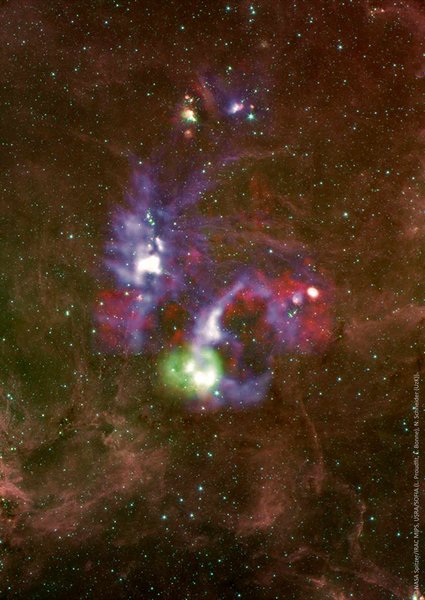
Astronomers using the National Science Foundation’s Karl G. Jansky Very Large Array (VLA) have discovered an important new clue about how galaxies put the brakes on vigorous episodes of star formation. Their new study of the neighboring galaxy M33 indicates that fast-moving cosmicray electrons can drive winds that blow away the gas needed to form new stars.

Such winds are responsible for slowing the rate of star formation as galaxies evolve over time. However, shock waves from supernova explosions and energetic, black hole-powered jets of material coming from galactic cores have been considered the primary drivers of those winds...

Read More