Category Astronomy/Space

Red alert: Massive Stars Sound Warning they are about to go Supernova

This artist’s impression shows the supergiant star Betelgeuse as it was revealed thanks to different state-of-the-art techniques on ESO’s Very Large Telescope (VLT), which allowed two independent teams of astronomers to obtain the sharpest ever views of the supergiant star Betelgeuse. They show that the star has a vast plume of gas almost as large as our Solar System and a gigantic bubble boiling on its surface. These discoveries provide important clues to help explain how these mammoths shed material at such a tremendous rate. Credit: European Southern Observatory/L. Calçada Licence type Attribution (CC BY 4.0)

Astronomers from Liverpool John Moores University and the University of Montpellier have devised an ‘early warning’ system to sound the alert when a massive star is about ...

Read More

Dust Plumes Observed being ‘Pushed’ into Interstellar Space by Intense Starlight

Dust Rings in the Wolf-Rayet 140 System, captured by the James Webb Space Telescope
Dust Rings in the Wolf-Rayet 140 System, captured by the James Webb Space Telescope. Credit: NASA, ESA, CSA, STScI, JPL-Caltech

Astronomers have observed directly for the first time how intense light from stars can ‘push’ matter. Researchers made the observation when tracking a giant plume of dust generated by the violent interactions between two massive stars.

The results, made using infrared images of the binary star system WR140 taken over 16 years, are reported in the journal Nature.

In a complementary study of WR140, published in Nature Astronomy, NASA’s James Webb Space Telescope (JWST) was able to see much deeper to snap an image of not just a single accelerating dust plume, but almost 20 of them, nested inside each other like a giant set of onion skins.

WR140 is compri...

Read More

Black Hole Spews out Material Years after Shredding Star

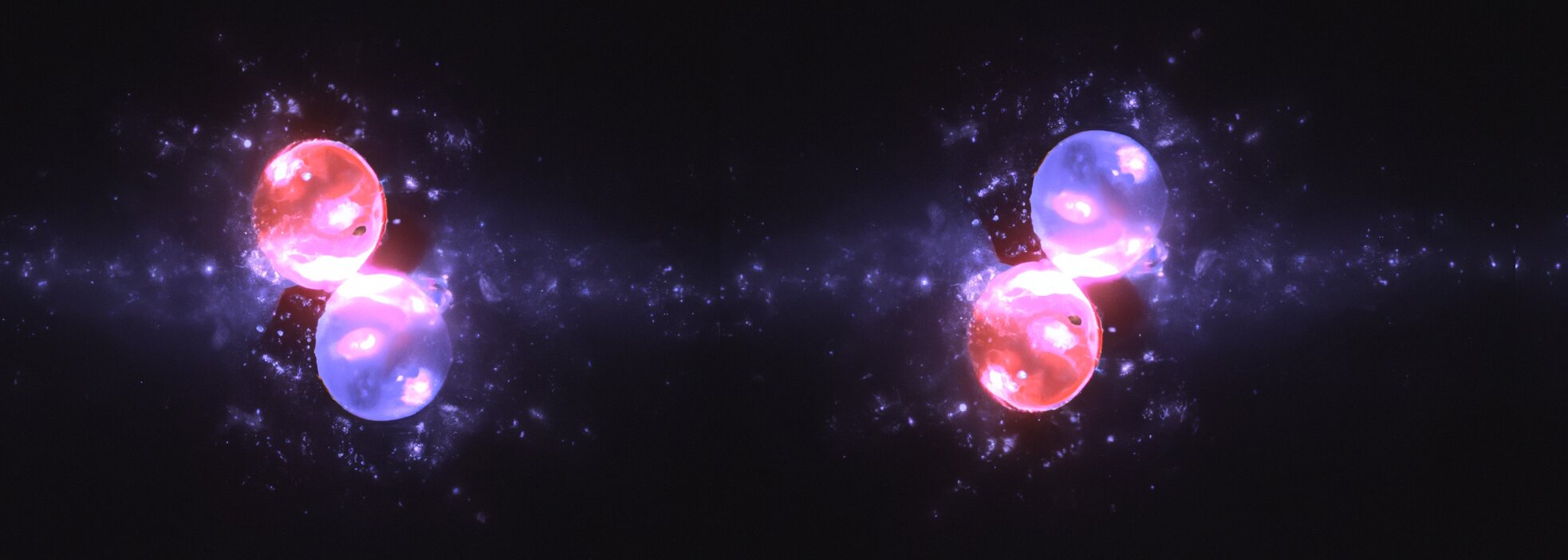
Credit: DESY, Science Communication Lab

Astronomers have observed a black hole burping up stellar remains years after it shredded and consumed the star. In October 2018, a small star was ripped to shreds when it wandered too close to a black hole in a galaxy located 665 million light years away from Earth. Though it may sound thrilling, the event did not come as a surprise to astronomers who occasionally witness these violent incidents while scanning the night sky.

But nearly three years after the massacre, the same black hole is lighting up the skies again — and it hasn’t swallowed anything new, scientists say.

“This caught us completely by surprise — no one has ever seen anything like this before,” says Yvette Cendes, a research associate at the Center for Astrophysics | Harvar...

Read More

NASA Study suggests Shallow Lakes in Icy Crust of Jupiter’s moon Europa could erupt

This illustration depicts a plume of water vapor that could potentially be emitted from the icy surface of Jupiter’s moon Europa. New research sheds light on what plumes, if they do exist, could reveal about lakes that may be inside the moon’s crust.
 Credit: NASA/ESA/K. Retherford/SWR

In the search for life beyond Earth, subsurface bodies of water in our outer solar system are some of the most important targets. That’s why NASA is sending the Europa Clipper spacecraft to Jupiter’s moon Europa: There is strong evidence that under a thick crust of ice, the moon harbors a global ocean that could potentially be habitable.

But scientists believe the ocean isn’t the only water on Europa...

Read More