Category Astronomy/Space

Planetary heist: Astronomers show Massive Stars can Steal Jupiter-sized Planets

Artist impression of a ringed planet

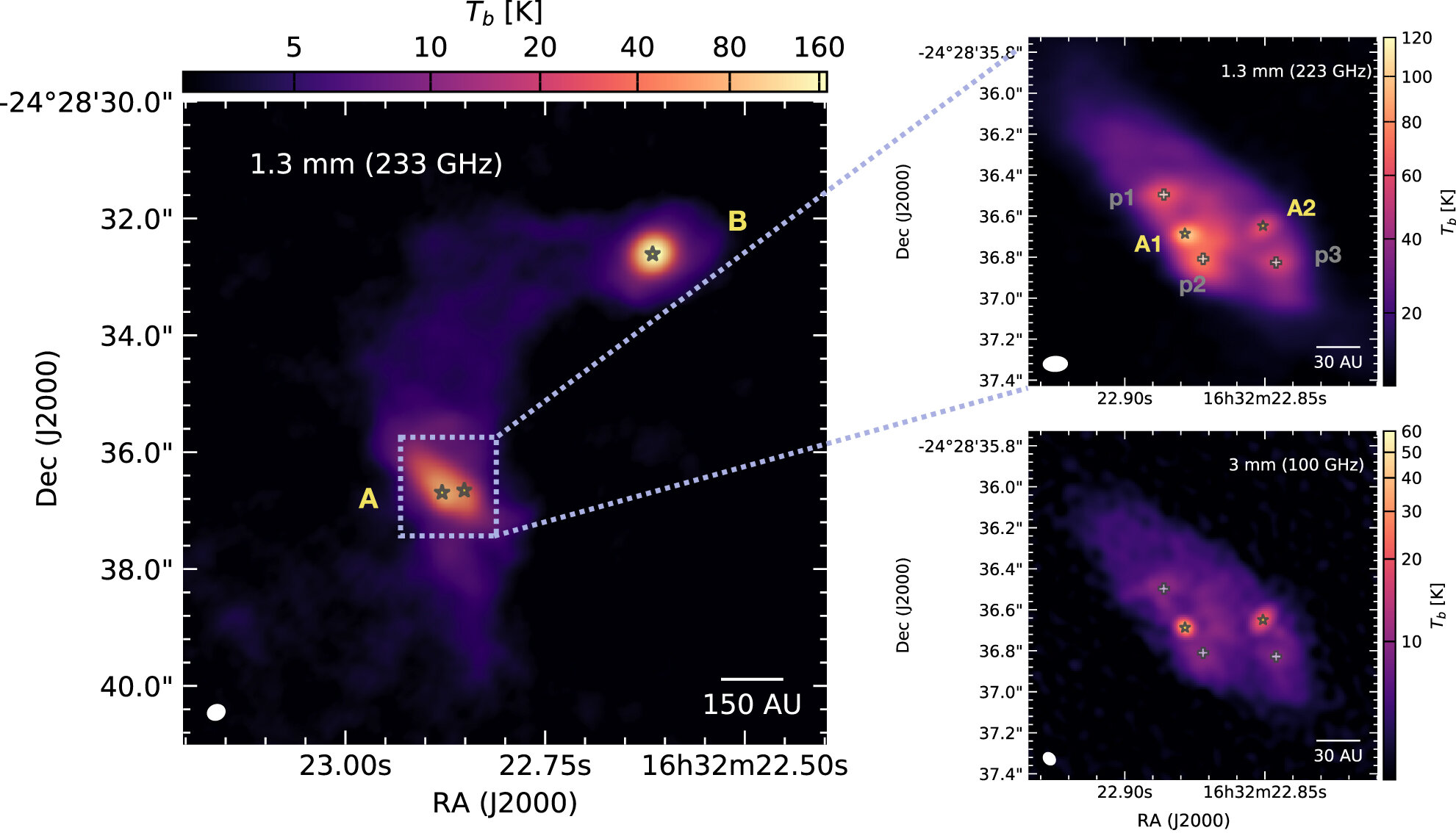
Jupiter-sized planets can be stolen or captured by massive stars in the densely populated stellar nurseries where most stars are born, a new study has found.

Researchers from the University of Sheffield have proposed a novel explanation for the recently discovered B-star Exoplanet Abundance STudy (BEAST) planets. These are Jupiter-like planets at large distances (hundreds of times the distance between the Earth and the Sun) from massive stars.

Until now their formation has been something of a mystery, as massive stars emit large amounts of ultraviolet radiation that stops planets from growing to the size of Jupiter – the largest planet in our solar system.

Dr Emma Daffern-Powell, Co-author of the study, from the University of Sheffield’s Department of Physicsand Astronomy add...

Read More

Gamma rays from Neighboring Galaxy related to Millisecond Pulsars

Sagittarius Dwarf
A small satellite galaxy of the Milky Way – called the Sagittarius dwarf galaxy – has been observed from Earth through giant lobes of gamma radiation (the so-called Fermi bubbles). Although the dwarf galaxy is stuffed with dark matter, this is unlikely to be the cause of the observed emission. Image: O. Macias.

A team of researchers, including UvA physicists and astronomers, has studied gamma rays caused by the Sagittarius Dwarf, a small neighbouring galaxy of our Milky Way. They showed that all the observed gamma radiation can be explained by millisecond pulsars, and can therefore not be interpreted as a smoking gun signature for the presence of dark matter. The results were published in Nature Astronomy this week.

The center of our galaxy is blowing a pair of colossal bubbles ...

Read More

New Polar Ring Galaxy discovered

New polar ring galaxy discovered
The gri composite image of J0953 taken from the hscMap. Credit: Nishimura et al, 2022.

Japanese astronomers report the detection of a new polar ring galaxy using the data obtained with the Subaru Telescope as part of the Hyper Suprime-Cam Subaru Strategic Program (HSC-SSP). The discovery was detailed in a paper published August 26 on the arXiv pre-print server.

The so-called polar ring galaxies (PRGs) are systems composed of an S0-like galaxy and a polar ring, which remain separate for billions of years. In general, these outer polar rings, composed of gas and stars, are aligned roughly in a perpendicular orientation with respect to the major axis of the central host galaxy.

However, although more than 400 PRG candidates have been discovered to date, only dozens of them have been...

Read More

Making Nanodiamonds out of Bottle Plastic

Zoomed image larger
In the experiment, a thin sheet of simple PET plastic was shot at with a laser. The strong laser flashes that hit the foil-like material sample briefly heated it up to 6000 degrees Celsius and thus generated a shock wave that compressed the matter to millions of times the atmospheric pressure for a few nanoseconds. The scientists were able to determine that tiny diamonds, so-called nanodiamonds, formed under the extreme pressure.
Source: Blaurock / HZDR

Research team uses laser flashes to simulate the interior of ice planets – and spurs a new process for producing miniscule diamonds...

Read More