Category Astronomy/Space

X-Shaped Radio Galaxies might Form More Simply than expected

X-shaped radio galaxies might form more simply than expected

Simple simulation accidentally leads to X-shaped galaxy for first time. When astronomers use radio telescopes to gaze into the night sky, they typically see elliptical-shaped galaxies, with twin jets blasting from either side of their central supermassive black hole. But every once in a while — less than 10% of the time — astronomers might spot something special and rare: An X-shaped radio galaxy, with four jets extending far into space.

Although these mysterious X-shaped radio galaxies have confounded astrophysicists for two decades, a new Northwestern University study sheds new insight into how they form — and its surprisingly simple. The study also found that X-shaped radio galaxies might be more common than previously thought.

The study will be published on Aug...

Read More

Discovery of the Oldest Visible Planetary Nebula hosted by a 500-million-year-old Galactic Cluster – a rare beauty with a hot blue heart

Left panel: An enhanced 6.5 x.5 arcminute colour-composite RGB image of PN IPHASX J055226.2+323724 from the IPHAS survey (Drew et al. 2005) that we confirm as a physical member of the Galactic open cluster M37. Red = Hα, Green = broad band red and Blue = broad band ‘i’. The CSPN is circled in blue; Right panel: 190 x145 arcsecond RGB image created from SDSS with red = i, green = r and blue = g-band. These data clearly shows the faint CSPN (arrowed) at the centre. North is top and East is to the left in both images.

An international team of astronomers led by members of the Laboratory for Space Research (LSR) and Department of Physics at The University of Hong Kong (HKU), have discovered a rare celestial jewel-a so-called Planetary Nebula (PN) inside a 500 million-year-old Galactic...

Read More

Here’s what a Black Hole Sounds like, according to NASA. Yes, it’s ‘frightening’

black hole
Credit: Pixabay/CC0 Public Domain

NASA this week shared an audio clip on social media that allows you to “hear” a black hole.
No surprise, the sound is terrifying.

NASA Exoplanets, a team at the agency focused on planets and other information outside of our solar system, tweeted the 34-second clip on Sunday and said there’s a “misconception” that there is no sound in space.

But they explained that “A galaxy cluster has so much gas that we’ve picked up actual sound. Here it’s amplified, and mixed with other data, to hear a black hole.”

NASA initially released the so-called “sonification” earlier this year, explaining that researchers have “associated” the black hole in the Perseus galaxy cluster with sound since 2003.

“This is because astronomers discovered that pressure wave...

Read More

An Extrasolar World Covered in Water?

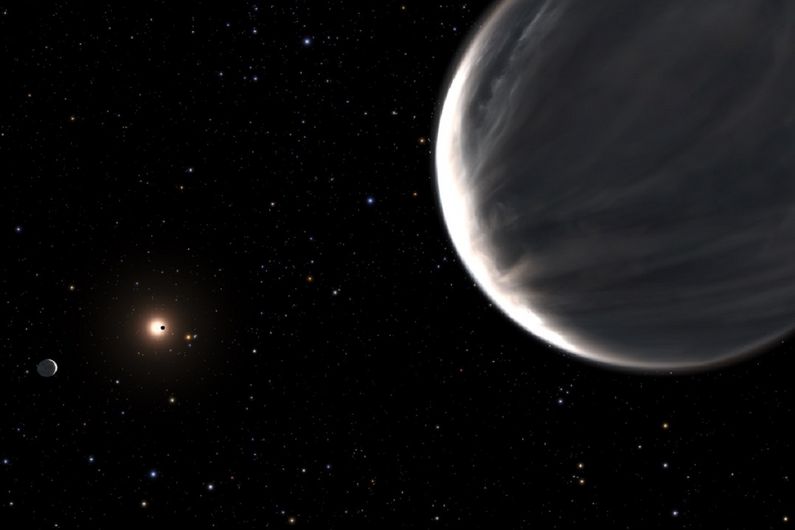
Artistic rendition of the exoplanet TOI-1452 b, a small planet that may be entirely covered in a deep ocean.

An international team of researchers led by Charles Cadieux, a Ph.D. student at the Université de Montréal and member of the Institute for Research on Exoplanets (iREx), has announced the discovery of TOI-1452 b, an exoplanet orbiting one of two small stars in a binary system located in the Draco constellation about 100 light-years from Earth.

The exoplanet is slightly greater in size and mass than Earth and is located at a distance from its star where its temperature would be neither too hot nor too cold for liquid water to exist on its surface. The astronomers believe it could be an “ocean planet,” a planet completely covered by a thick layer of water, similar to some of Jupiter’s and Saturn’s moons.

In an article published today in The Astronomical Journal, Cadieux and his ...

Read More