Category Astronomy/Space

Stardust study resets how life’s atoms spread through space

A yellow star with a surrounding dust cloud
Dust clouds reflect starlight around the star R Doradus. This image combines polarised visible light taken with the Very Large Telescope in Chile, and an image of the star’s surface taken with Alma. Credit: ESO/T. Schirmer/T. Khouri; ALMA (ESO/NAOJ/NRAO)

Starlight and stardust are not enough to drive the powerful winds of giant stars, transporting the building blocks of life through our galaxy. That’s the conclusion of a new study from Chalmers University of Technology, Sweden, of red giant star R Doradus. The result overturns a long-held idea about how the atoms needed for life are spread.

The study, “An empirical view of the extended atmosphere and inner envelope of the asymptotic giant branch star R Doradus II...

Read More

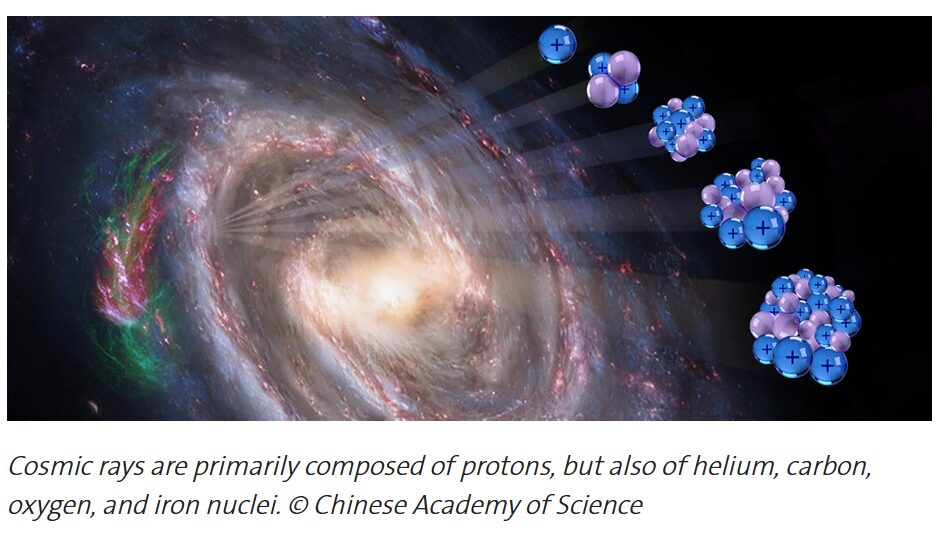
Cosmic rays from a nearby supernova may help explain Earth-like planets

Cosmic rays from a nearby supernova may help explain Earth-like planets
An illustration of a young solar system immersed in high-energy cosmic rays from a nearby supernova. Unlike considering only direct injection of supernova ejecta, this process naturally explains key radioactive nuclei without destroying the protoplanetary disk. Credit: R. Sawada (AI-assisted illustration)

How common are Earth-like planets in the universe? When I started working on supernova explosions, I never imagined that my research would eventually lead me to ask a question about the origin of Earth-like planets. Yet that is exactly where it brought me.

For decades, planetary scientists have believed that the early solar system was enriched with short-lived radioactive elements—such as aluminum-26—by a nearby supernova...

Read More

Einstein’s theory comes wrapped up with a bow: Astronomers spot star ‘wobbling’ around black hole

An artist's impression depicts the accretion disc surrounding a black hole
An artist’s impression depicts the accretion disc surrounding a black hole, in which the inner region of the disc wobbles. In this context, the wobble refers to the orbit of material surrounding the black hole changing orientation around the central object. Credit NASA.

The cosmos has served up a gift for a group of scientists who have been searching for one of the most elusive phenomena in the night sky. Their study, presented in Science Advances, reports on the very first observations of a swirling vortex in spacetime caused by a rapidly rotating black hole.

The process, known as Lense-Thirring precession or frame-dragging, describes how black holes twist the spacetime that surrounds them, dragging nearby objects like stars and wobbling their orbits along the way.

Discovery of ...

Read More

A hidden star found where dust shouldn’t exist

Exozodiacal dust is depicted as a white, glowing haze above the mountainous horizon of a hypothetical exoplanet in this artist's depiction.

A hidden companion star may finally explain why deadly-hot dust survives where planets shouldn’t. A mysterious cloud of ultra-hot dust around Kappa Tucanae A may finally have an explanation: a hidden companion star. The star’s extreme orbit carries it straight through the dust zone, strongly suggesting it plays a key role in keeping the dust alive. This finding could help astronomers untangle one of the biggest challenges in imaging Earth-like exoplanets. It also opens the door to discovering similar hidden companions around other stars.

About 70 light-years from Earth, a star known as Kappa Tucanae A has long puzzled astronomers. It is surrounded by dust heated to more than 1,000 degrees Fahrenheit, glowing intensely while orbiting extremely close to the star...

Read More