Category Astronomy/Space

Dead Star’s Cannibalism of its Planetary System is most far-reaching ever witnessed

Artist’s illustration shows a white dwarf star siphoning off debris from shattered objects in a planetary system. NASA, ESA, Joseph Olmsted (STScI)

White dwarf sheds light on the systemic chaos that occurs when a star dies. The violent death throes of a nearby star so thoroughly disrupted its planetary system that the dead star left behind — known as a white dwarf — is sucking in debris from both the system’s inner and outer reaches, UCLA astronomers and colleagues report today.

This is the first case of cosmic cannibalism in which astronomers have observed a white dwarf consuming both rocky-metallic material, likely from a nearby asteroid, and icy material, presumed to be from a body similar to those found in the Kuiper belt at the fringe of our own solar system.

“We have neve...

Read More

Astronomers find Evidence for most Powerful Pulsar in Distant Galaxy

Version Without Labels — Top Left: A giant blue star, much more massive than our Sun, has consumed, through nuclear fusion at its center, all its hydrogen, helium, and heavier elements up to iron. It now has a small iron core (red dot) at its center. Unlike the earlier stages of fusion, the fusion of iron atoms absorbs, rather than releases, energy. The fusion-released energy that has held up the star against its own weight now is gone, and the star will quickly collapse, triggering a supernova explosion. Top Right: The collapse has begun, producing a superdense neutron star with a strong magnetic field at its center (inset). The neutron star, though containing about 1.5 times the mass of the Sun, is only about the size of Manhattan...
Read More

Near-Sun Comet Roasted to Death

Near-Sun object 323P/SOHO observed by the Subaru Telescope on December 21, 2020 (left) and CFHT on February 11, 2021 (right). 323P/SOHO on its way to perihelion is seen as a point source in the center of the left image; after the perihelion, the comet has developed a long narrow tail as seen in the right image. (Credit: Subaru Telescope/CFHT/Man-To Hui/David Tholen)

Astronomers using a fleet of world leading telescopes on the ground and in space have captured images of a periodic rocky near-Sun comet breaking apart. This is the first time such a comet has been caught in the act of disintegrating and could help explain the scarcity of such periodic near-Sun comets.

The Solar System is a dangerous place...

Read More

A Weird Star Produced the Fastest Nova on Record

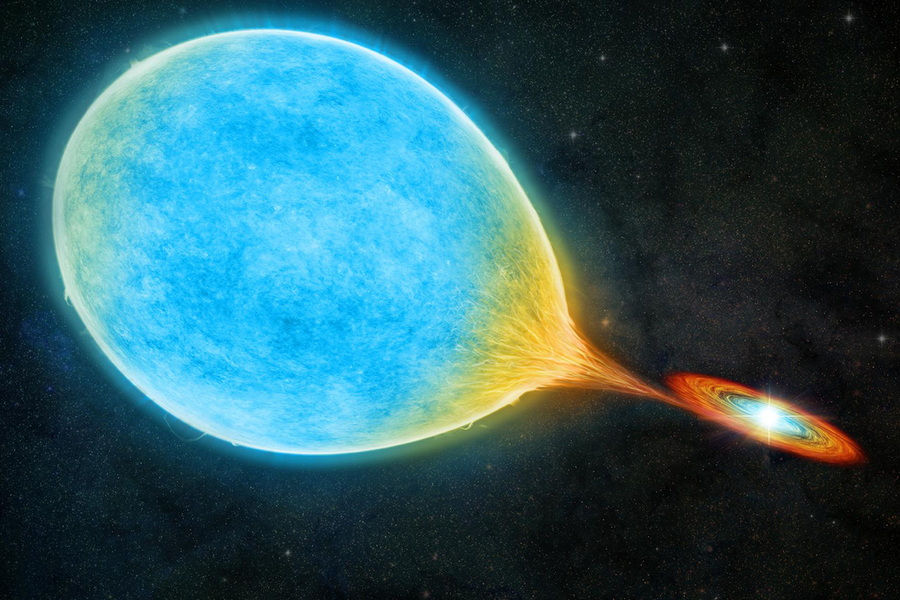
Illustration of an intermediate polar system, a type of two-star system that the research team thinks V1674 Hercules belongs to. A flow of gas from the large companion star impacts an accretion disk before flowing along magnetic field lines onto the white dwarf. Illustration by Mark Garlick

Astronomers are buzzing after observing the fastest nova ever recorded. The unusual event drew scientists’ attention to an even more unusual star. As they study it, they may find answers to not only the nova’s many baffling traits, but to larger questions about the chemistry of our solar system, the death of stars and the evolution of the universe.

The research team, led by Arizona State University Regents Professor Sumner Starrfield, Professor Charles Woodward from University of Minnesota and Re...

Read More