Category Astronomy/Space

Astronomers may have detected a ‘Dark’ Free-Floating Black Hole

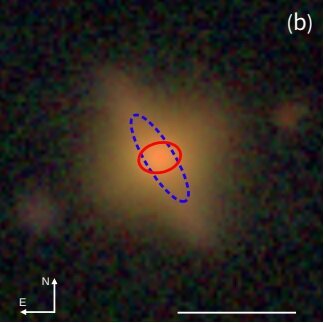
Hubble Space Telescope image of a distant star that was brightened and distorted by an invisible but very compact and heavy object between it and Earth. The compact object — estimated by UC Berkeley astronomers to be between 1.6 and 4.4 times the mass of our sun — could be a free-floating black hole, one of perhaps 200 million in the Milky Way galaxy. (Image courtesy of STScI/NASA/ESA)

If, as astronomers believe, the deaths of large stars leave behind black holes, there should be hundreds of millions of them scattered throughout the Milky Way galaxy. The problem is, isolated black holes are invisible.

Now, a team led by University of California, Berkeley, astronomers has for the first time discovered what may be a free-floating black hole by observing the brightening of a more d...

Read More

Yoyo Stars responsible for Off-Center Bubbles

Simulated star cluster partially embedded in a cloud of hydrogen gas. (Credit: Michiko Fujii, Takaaki Takeda, 4D2U Project, National Astronomical Observatory of Japan)

Astronomers have developed a new code to simulate the formation of a cluster of baby stars. Comparison with the well-known real case of the Orion Nebula shows that its off-center bubble of ionized gas was caused by a massive star that was pushed out of the newborn cluster but is now falling back in.

Groups of stars often form together in clouds of cold hydrogen gas. The brightest and most massive stars ionize the surrounding gas, making it too hot to form new stars. In this way massive stars act as a feedback, shutting off new star formation...

Read More

Particle Accelerator Region revealed inside a Solar Flare

A new study offers the first direct evidence showing where near-light speed particle acceleration occurs inside the largest explosion known in the solar system, the solar flare. Image Credit: Sijie Yu of NJIT/CSTR; NOAA GOES-16/SUVI

A new study offers direct evidence showing where near-light speed particle acceleration occurs inside the largest explosion known in the solar system, the solar flare.

Solar flares are among the most violent explosions in our solar system, but despite their immense energy — equivalent to a hundred billion atomic bombs detonating at once — physicists still haven’t been able to answer exactly how these sudden eruptions on the Sun are able to launch particles to Earth, nearly 93 million miles away, in under an hour.

Now, in a study published June 8 in Na...

Read More

Colossal Collisions linked to Solar System Science

Image of Abell 2146

A new study shows a deep connection between some of the largest, most energetic events in the universe and much smaller, weaker ones powered by our own Sun.

The results come from a long observation with NASA’s Chandra X-ray Observatory of Abell 2146, a pair of colliding galaxy clusters located about 2.8 billion light-years from Earth. The new study was led by Helen Russell from the School of Physics and Astronomy at the University of Nottingham.

Galaxy clusters contain hundreds of galaxies and huge amounts of hot gas and dark matter and are among the largest structures in the universe...

Read More