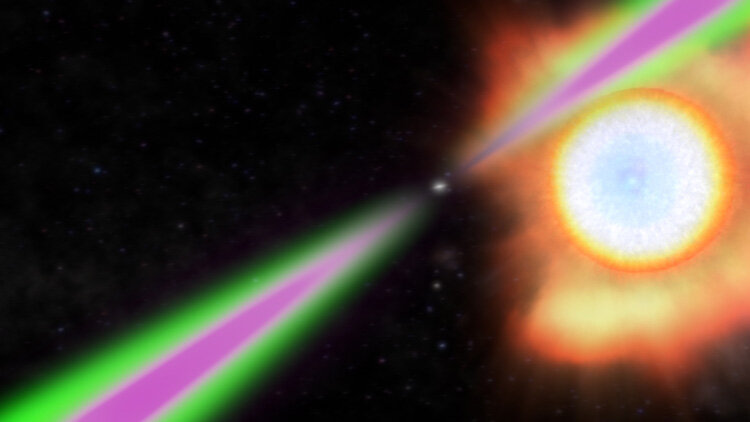
A spinning neutron star periodically swings its radio (green) and gamma-ray (magenta) beams past Earth in this artist’s concept of a black widow pulsar. The neutron star/pulsar heats the facing side of its stellar partner (right) to temperatures twice as hot as the sun’s surface and slowly evaporates it. Credit: NASA’s Goddard Space Flight Center
A dense, collapsed star spinning 707 times per second—making it one of the fastest spinning neutron stars in the Milky Way galaxy—has shredded and consumed nearly the entire mass of its stellar companion and, in the process, grown into the heaviest neutron star observed to date.
Weighing this record-setting neutron star, which tops the charts at 2...
Considered heat sources/sinks and salinity/temperature forcings in our Enceladus experiments
A team of researchers at MIT has found via theoretical modeling that the saltiness of the oceans on Saturn’s moon, Enceladus, may be the right level to sustain life. In their paper published in the journal Science Advances, the group describes the factors that went into building their model and the features of Enceladus that were used to measure the saltiness of its oceans.
The combined data from the Cassini and Galileo missions showed that Saturn’s moon Enceladus and Jupiter’s moon Europa both hold potential for satisfying three of the main features believed to be necessary for supporting life on other celestial bodies: they have a source of energy, they have liquid water and they have a mi...
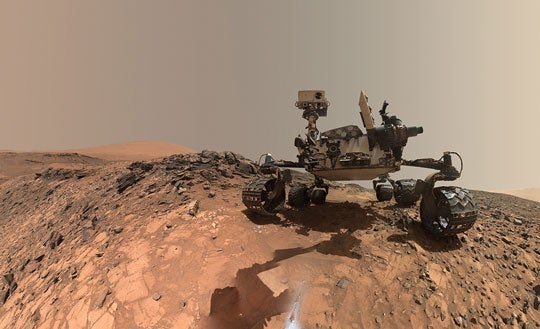
NASA’s Curiosity Mars rover snapped this low-angle self-portrait at the site where it drilled into a rock July 30, 2015, producing a powder (visible in foreground) that was later confirmed to contain the rare mineral tridymite. (Image courtesy of NASA/JPL-Caltech/MSSS)
Researchers publish scenario that explains 2016 discovery by NASA’s Curiosity rover. Planetary scientists from Rice University, NASA’s Johnson Space Center and the California Institute of Technology have an answer to a mystery that’s puzzled the Mars research community since NASA’s Curiosity rover discovered a mineral called tridymite in Gale Crater in 2016.
Tridymite is a high-temperature, low-pressure form of quartz that is extremely rare on Earth, and it wasn’t immediately clear how a concentrated chunk of it ended...
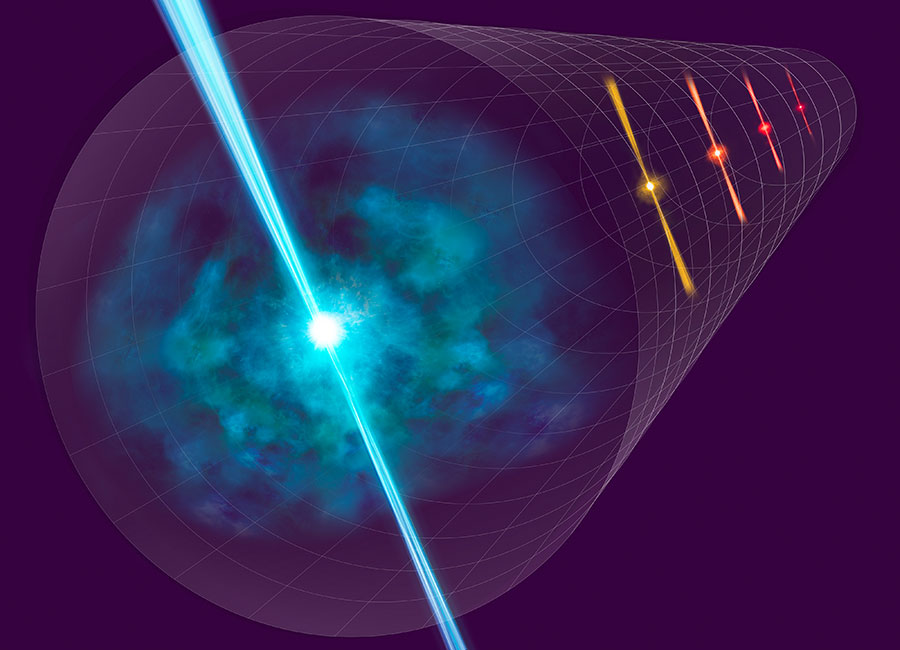
Conceptual image of this research: using Gamma Ray Bursts to determine distance in space. (Credit: NAOJ)
An international team of 23 researchers led by Maria Dainotti, Assistant Professor at the National Astronomical Observatory of Japan (NAOJ), has analyzed archive data for powerful cosmic explosions from the deaths of stars and found a new way to measure distances in the distant Universe.
With no landmarks in space, it is very difficult to get a sense of depth. One technique astronomers use is to look for “standard candles,” objects or events where the underlying physics dictate that the absolute brightness (what you would see if you were right next to it) is always the same...






Recent Comments